What are the cultivation methods and precautions for Rhipsalidopsis rosea?
Watering
In spring and autumn, water once a week to keep the soil moist. In summer, provide appropriate shade; in winter, keep the soil moderately moist, and the specific watering frequency depends on the room temperature.
Fertilizing
Fertilize once a month, using a low-nitrogen fertilizer or a special succulent fertilizer.
Light
During the flowering period, ensure sufficient light and move the plant as little as possible to avoid broken stems and fallen flowers.
Pests and diseases
Common pests and diseases include anthracnose and red spider mites. Once diseased plants are found, promptly remove the diseased leaves and spray with a fungicide.
The above is an introduction to how to grow Rhipsalidopsis rosea. Now let's take a look at how to propagate Rhipsalidopsis rosea by cuttings!
Rhipsalidopsis rosea Rhipsalidopsis rosea profile: how to grow Rhipsalidopsis rosea / how to propagate Rhipsalidopsis rosea
Rhipsalidopsis rosea profileRhipsalidopsis rosea Rhipsalidopsis rosea
Cultivation methods and precautions for Rhipsalidopsis rosea Introduction to Rhipsalidopsis rosea
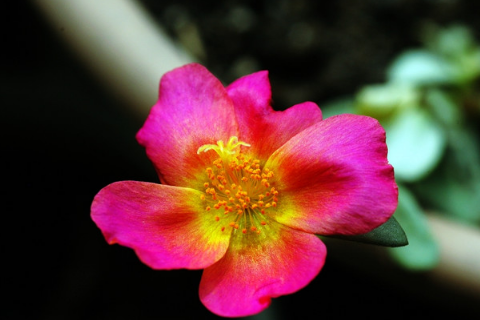
Rhipsalidopsis rosea generally blooms from April to June. The plant is much branched and grows in clusters, thick and succulent, usually with 3-5 ribs, sometimes flat or with irregular angular ribs, and the rib edges are purplish red. Its flowers are somewhat smaller, and the flower receptacle is four-ribbed. The floral tube is relatively short, and the petals are also in a single layer, arranged in a regular and neat pattern. The flowers are pink, extremely similar to those of Rhipsalidopsis gaertneri and difficult to distinguish; identifying them by the stem segments is more accurate.
Morphological characteristics of Rhipsalidopsis rosea
It is an epiphytic plant, with a plant height of 25 cm to 30 cm. The plant is much branched and grows in clusters. The stem segments are thick and succulent, semi-erect, 2 cm to 4 cm long, and highly variable in form, either with 3 to 5 ribs; or with only 2 ribs, appearing flat; or with irregular angular shapes. The general pattern is that the lower stem segments have more ribs and are nearly rounded, while the upper stem segments are flat, similar to Schlumbergera truncata. The rib edges of the stem segments bear areoles, and the areoles have short woolly hairs and a few early-deciduous bristles. The flowers are terminal, pink to rose red, with a flower diameter of 3 cm to 4 cm, radially symmetrical, and with a delicate fragrance.
Ecological habits of Rhipsalidopsis rosea
Rhipsalidopsis rosea is native to southern Brazil, where it grows epiphytically on tree trunks and branch forks in subtropical forests. It prefers a warm, humid, semi-shaded environment. In summer, it needs shading and enhanced ventilation; in winter, maintain a room temperature above 10°C and provide sufficient light.
It prefers a warm and humid semi-shaded environment and requires a certain level of air humidity. In summer, it should have good ventilation and avoid scorching sun exposure. It is suitable for growing in soil rich in humus, loose and fertile, with good drainage and air permeability.
Landscape uses of Rhipsalidopsis rosea
Rhipsalidopsis rosea has not been introduced into China for long. Its flower colors are gorgeous and the flowers are numerous. It is suitable for hanging decoration, and its ornamental effect is no less than the common Schlumbergera truncata. It is well worth promoting.
Propagation methods of Rhipsalidopsis rosea
Propagate by cuttings or grafting.
For propagation, stem segments can be cut during the growing season for cuttings; if Hylocereus undatus or a cactus with thick stem segments is used as rootstock for grafting, not only will the growth be good and the flowering abundant, but the plant shape will also be graceful.
Cultivation techniques for Rhipsalidopsis rosea
During the growing season, apply a dilute liquid fertilizer once every 10-20 days. During the flower bud formation stage, apply more phosphorus and potassium fertilizer and stop applying nitrogen fertilizer to promote the formation of more buds. After flowering, there is a short dormant period, during which fertilization should be stopped and watering should be controlled; after new stem segments grow, normal water and fertilizer management can be resumed. During cultivation, water should be sprayed on the plant frequently to increase air humidity. This species is susceptible to red spider mites, so ventilation should be enhanced for prevention and control. The potting soil should be fertile, rich in humus, and have good drainage and air permeability.
Differences between Rhipsalidopsis rosea and Schlumbergera truncata, Schlumbergera x buckleyi, Rhipsalidopsis gaertneri, and Epiphyllum hybrid
Because Schlumbergera truncata, Schlumbergera x buckleyi, Rhipsalidopsis gaertneri, Rhipsalidopsis rosea, and Epiphyllum hybrid are all epiphytic cacti, and their branches and stems are all in the form of stem segments, the stem segments of these flowers, that is, what are commonly called "leaves," are similar in shape and are often regarded as the same variety of flower, collectively called Schlumbergera truncata. But in fact, they are five different genera of plants.
I. Family - Genus
1. Schlumbergera truncata · Cactaceae, Schlumbergera genus.
2. Schlumbergera x buckleyi · Cactaceae, Schlumbergera genus.
3. Rhipsalidopsis gaertneri · Cactaceae, Rhipsalidopsis genus.
4. Epiphyllum hybrid · Cactaceae, Epiphyllum genus.
5. Rhipsalidopsis rosea · Cactaceae, Rhipsalidopsis genus.
II. Flowering period / flower type
1. Schlumbergera truncata
The flowering period is from November to December. (The earliest) The petals are relatively round and full, and when blooming, the petals spread evenly, and the flower shape is relatively round. The floral tube is long and curved, and the petals are in multiple layers. The lower petals curl upward, and the petals are irregular and not neat. The pistil is red and the stamens are white, both relatively long, extending out of the floral tube. The flower colors include yellow, white, orange, pink, red, purple, lilac, etc., and there are also bicolor varieties. In terms of petal type, there are sharp-tipped petals, blunt-tipped petals, and round petals. At present, there are more than 200 horticultural varieties. The stem segment edges have sharp teeth, and the whole plant is green. Young leaves are purplish red and turn green when mature. (Double-layered flowers; Schlumbergera truncata flowers sometimes tilt upward.)
2. Schlumbergera x buckleyi
The flowering period is from December to February of the following year. The petals are relatively slender and delicate, in multiple layers, regular and neat, and when blooming, the petals fold backward. The pistil is red and the stamens are white, both relatively long, extending out of the floral tube, similar to Schlumbergera truncata. The flower colors are mostly pure red, peach red, tender yellow, and pure white. The stem segment edges have sharp teeth, and the whole plant is green. Young leaves are purplish red and turn green when mature. (Double-layered flowers; Schlumbergera x buckleyi flowers generally droop.)
3. Rhipsalidopsis gaertneri
Usually blooms in April-May. (Relatively late) The petals are relatively pointed and slender, thin and straight, and when blooming, the petals spread evenly in all directions, shaped like an open umbrella, and the petals are regular and neat. The floral tube is relatively short, and the flower colors are mostly pure red and peach red. The stem segment edges have rounded teeth, green, young leaf stems are purplish red and gradually turn green when mature, with dark red edges. It resembles Schlumbergera x buckleyi, but its stem segments are wider and thicker than those of Schlumbergera x buckleyi, and the newly emerging stem segments are red. Compared with Schlumbergera truncata and Schlumbergera x buckleyi, the petals should be single-layered, and the flower receptacle is five-ribbed. The flowers are of two colors: pure red and pink.
4. Epiphyllum hybrid
The flowering period is in April. A single flower blooms for 1-2 days and opens during the day. The single flower grows on both sides of the stem tip. The flower is large and bell-shaped, with the perianth opening and curling back, and the filaments and style curved. The flower colors include purple, red, pink, yellow, white, etc.
5. Rhipsalidopsis rosea
Blooms in May-June. (The latest) The plant is much branched and grows in clusters, thick and succulent, usually with 3-5 ribs, sometimes flat or with irregular angular shapes, and the rib edges are purplish red. Its flowers are somewhat smaller, and the flower receptacle is four-ribbed. The floral tube is relatively short, and the petals are also single-layered, arranged in a regular and neat pattern. The flowers are pink, extremely similar to those of Rhipsalidopsis gaertneri and difficult to distinguish; identifying them by the stem segments is more accurate. Schlumbergera truncata and Epiphyllum hybrid have the greatest variation in flower color, including red, yellow, white, and various bicolor forms; Schlumbergera x buckleyi generally has only pink or rose red, occasionally pale yellow; Rhipsalidopsis gaertneri flowers are generally bright red; Rhipsalidopsis rosea also has relatively many flower colors and has a delicate fragrance.
III. Differences in stem segments (leaves)
1. The stem segments (leaves) of Schlumbergera truncata are flat, with sharp teeth on the leaf edges, shaped like crab claws.
2. The stem segments (leaves) of Schlumbergera x buckleyi are flat and obovate, with no sharp teeth on the leaf edges, appearing slightly wavy.
3. The stem segments (leaves) of Rhipsalidopsis gaertneri are flat and elliptical, with smooth leaf edges, appearing purplish red.
4. The stem segments (leaves) of Rhipsalidopsis rosea are rib-shaped, generally with three ribs or four ribs, and at most no more than five ribs, and the rib edges are also purplish red. Under grafting conditions, thicker flat stem segments may appear.
5. The stem segments (leaves) of Epiphyllum hybrid are flat and lanceolate, with a rounded base, bright green, slightly red edges, coarse serrations, fine spines in the recessed parts between the serrations, and a clearly protruding midrib.
IV. Different basic characteristics
1. Schlumbergera truncata is also called "brocade added upon brocade," "crab-foot overlord whip," "immortal flower," etc. It prefers a shaded, humid environment and is not suitable for direct sunlight. It prefers warmth and humidity and is not cold-tolerant. It is suitable for fertile leaf mold and peat soil, and is afraid of raw coal soil and coal ash.
2. Schlumbergera x buckleyi prefers environmental conditions with sufficient sunlight and a warm climate.
3. Rhipsalidopsis gaertneri is also called "bright red Schlumbergera x buckleyi" and prefers a warm and humid environment. During the growing period, keep the soil moist at room temperature, and appropriate light exposure is sufficient.
4. Epiphyllum hybrid prefers an environment with good light and ventilation, but under hot, high-temperature, and dry conditions, it should be appropriately shaded, and it is afraid of rainwater. It requires fertile, loose, and well-drained soil, and has a certain drought tolerance.
5. Rhipsalidopsis rosea prefers a warm and humid environment.
Rhipsalidopsis rosea pictures
How to grow Rhipsalidopsis rosea, 6 cultivation and planting methods
How to grow Rhipsalidopsis rosea 1. Adapting to the environmentRhipsalidopsis rosea prefers a warm, humid, semi-shaded environment.
2. Soil requirementsRhipsalidopsis rosea prefers soil rich in humus, loose and fertile, so the soil used for potting Rhipsalidopsis rosea must be fertile, rich in humus, and have good drainage and air permeability.
3. Sufficient lightDuring the flowering period of Rhipsalidopsis rosea, ensure sufficient light, and it is recommended that flower lovers move it as little as possible to avoid broken stems and fallen flowers.
4. Watering requirementsThe care environment for Rhipsalidopsis rosea should maintain air humidity, so during watering, flower lovers can spray some water around Rhipsalidopsis rosea to maintain the air humidity of the surrounding environment.
Spring and autumn are the growing seasons for Rhipsalidopsis rosea. Because the climate in spring and autumn is warm, watering in spring and autumn should be moderate. Generally, water once a week; the amount of water does not need to be large, just keep the soil moist.
In summer, when the temperature is high, provide appropriate shade, and generally keep watering once every 8-9 days.
In winter, keep the soil moderately moist. If the indoor temperature is high, water once every 6-7 days; if the indoor temperature is low, water once every 9-10 days.
5. Fertilizing requirementsDuring the growing season (spring and autumn), Rhipsalidopsis rosea is generally fertilized once every 10-20 days. In summer and winter, it only needs to be fertilized once a month. It should be noted that after flowering there is a short dormant period, during which fertilization should be stopped.
In addition, during the growing season of Rhipsalidopsis rosea, nitrogen fertilizer or special succulent fertilizer can generally be used, and the fertilizer should be diluted before light application. During the flower bud formation stage, Rhipsalidopsis rosea should be given more phosphorus and potassium fertilizer and no nitrogen fertilizer to promote the formation of more buds.
6. RepottingRhipsalidopsis rosea is generally repotted once every two years. When repotting, overly long or overly dense branches need to be cut shorter. Usually use a 12-15 cm pot, and for hanging baskets use a 15-20 cm pot, with 3-5 plants per pot.