Cymbidium faberi cultivation methods and points to note
1. Soil
For flowers to grow well, the root system must first be well cared for, so the most suitable soil for Cymbidium faberi is fertile, loose humus soil, which is rich in nutrients and beneficial to root growth.
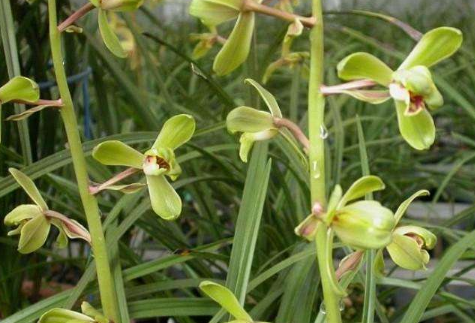
2. Light
Cymbidium faberi is the most light-loving type of orchid and can adapt to relatively strong light, but in summer it still needs shading, while in the other seasons it should be given more light.
3. Water
Cymbidium faberi is the most drought-tolerant orchid, but because its pseudobulbs are small, the soil needs to be kept moist; it can tolerate only short periods of drought.
4. Fertilizer
Cymbidium faberi has inconspicuous pseudobulbs and needs a lot of fertilizer. Fertilization can focus on phosphorus and potassium fertilizers to promote plant growth and make the leaves more emerald green.
Cultivation methods for Cymbidium hybridum
The flowers of Cymbidium hybridum are huge, with many colors such as yellow, white, green, red, pink, and multicolor, with bright and dazzling colors. The flower shape is neat and the texture is firm, lasting a long time without fading. It is a luxurious and elegant type of orchid, a rising star among orchids, with a very bright market prospect. So how do you cultivate high-quality Cymbidium hybridum?
Cymbidium hybridum is usually propagated by division. The division time is mostly after the plant blooms and before the new shoots have grown large, during this short dormant period. Before division, the plant should be properly dried, and the operation should be done when the roots are slightly whitish and soft. Vigorous plants are usually divided once every 2-3 years, and each divided clump of orchid seedlings should carry 2-3 pseudobulbs, one of which must be newly formed in the previous year. To avoid wound infection, sulfur powder or charcoal powder can be applied. Leave in a dry place for 1-2 days, then pot separately, and it becomes a new plant. After division and planting, place in semi-shade and do not water immediately. If it is found to be too dry, spray a small amount of water on the leaves and the surface of the pot to prevent the leaves from drying out, falling off, and the pseudobulbs from severely shrinking. Water only after new roots grow from the base of the new shoots.
Cymbidium hybridum likes strong light. Cymbidium hybridum originates from the tropical and subtropical plateaus of Asia and prefers a cool and highly humid environment. The suitable growth temperature is 10-25°C. In winter it should be kept in a low-temperature greenhouse. When the nighttime temperature is around 10°C, it grows well and the flower stems extend normally, mostly blooming in February to March. When the winter temperature is below 5°C, the leaves turn slightly yellow, the flowering period is delayed, and the flower stems are short. But when the overwintering temperature is around 15°C, the plant's leaves are green and glossy, and flowering is advanced to January to February to supply the Spring Festival market. It likes humidity very much, but attention must be paid to ventilation, otherwise it is prone to anthracnose. Humidity for small seedlings should be 80% to 90%, and for medium and large seedlings 60% to 85%. The flower stems are soft and must be supported with stakes to keep them upright.
Fertilization: During the growth period, the ratio of nitrogen, phosphorus, and potassium is 1:1:1, and during the flowering-forcing period the ratio is 1:2:2 to 3. The pH of the fertilizer solution is 5.8 to 6.2. Generally speaking, the fertilization concentration for small seedlings is 3500 to 4000 times dilution, and for medium and large seedlings 2000 to 3500 times. In summer, 1 to 2 times/day (alternating water and fertilizer), and in other seasons usually fertilize once every 3 days. Organic fertilizer: from the time tissue-cultured seedlings are removed from the bottle until before flowering, apply organic fertilizer once a month. During the growth period, the ratio of soybean cake to bone meal is 2:1, and during the flowering-forcing period apply pure bone meal. Organic fertilizer must not be applied on the roots. If bone meal contains too much salt, it can be rinsed with water before application. In winter it is best to stop applying organic fertilizer.
Watering: In production, sprinkler irrigation is usually used. Water once a day in May and September, twice a day in July to August, and once every 2 to 3 days from October to April of the following year. The number of waterings should be adjusted at any time according to seedling size and weather conditions.
Cultivation of flowering plants: (three years) In spring from March to June, the nighttime temperature is 15°C to 20°C, and the daytime temperature is 23°C to 25°C. From June to October, the nighttime temperature is 15°C to 20°C, and the daytime temperature is 20°C to 25°C; after November, the nighttime temperature is 10°C to 15°C, and the daytime temperature is 20°C. From February to April, apply organic fertilizer 10 g/pot each month (soybean cake:bone meal 2:1), and after April apply organic fertilizer 14 g/pot each time. From June to October, increase the temperature difference. Those cultivating on flat ground generally need to cultivate in the mountains. During this period, mainly apply bone meal, about 15 g per pot. After flower buds appear, stop organic fertilizer immediately. After November, flower spikes form. After the flower scapes are determined, remove all newly occurring buds. Most varieties show flower buds from September to the end of October. If leaf buds grow, they should be removed. Use 5 mm diameter coated iron wire as stakes for the flower scapes, and set them upright when the flower buds grow to 15 cm. The lowest binding point for the flower scapes is 10 cm, with intervals of 6 to 8 cm. Stakes are generally chosen at 80 cm and 100 cm lengths.
Key points of cut flower cultivation techniques: For variety selection, choose cut flower varieties for cultivation. Mountain flowering forcing: At the first flowering, the cut flower cultivation technique is the same as for pot cultivation. In summer, in June, move to the mountains to overwinter and force flowering, and cut the flowers when they open. After flowering, keep 2 buds on the plant for flowering the following year, and thereafter no longer move to the mountains. The flowering period of such plants is later than that of mountain-forced flowers, and as a result this is equivalent to extending the supply period of flowers.
Cut flower harvest: When the inflorescence is 20-30% open is the suitable harvest time, and store in a 2-5°C cold storage. Wrap cut flowers in soft paper and place in cardboard boxes for transport. Vase life can reach more than 30 days.
To cultivate high-quality Cymbidium hybridum, a great deal of effort is indeed required.
Cultivation methods for Cymbidium faberi
According to the characteristics of Cymbidium faberi, its cultivation methods can be roughly summarized into six aspects: airy medium, containing fertilizer, less repotting, suitable deep planting, more sun, and good ventilation.
Airy medium
To grow good roots in Cymbidium faberi, its planting medium is the key point. Nowadays, orchid cultivation mostly follows the path of granular planting medium, and the problems of air permeability and drainage can basically be well solved. But for Cymbidium faberi, it should be emphasized even more that the planting medium should be coarser than that for other orchids. Please mix according to the following steps:
① 60% river sand soil, 20% Kanuma pumice, 10% fired soil (maifan stone can also be used, which has the effect of preserving and enhancing variegated orchids), 10% tree fern (willow bark);
② 80% Lanzhiyou planting medium, 20% river sand soil.
Containing fertilizer
The pseudobulbs of Cymbidium faberi are inconspicuous, and growth basically depends on the roots absorbing nutrients from the planting medium and on characteristics such as thick and long roots and tall grass-like growth. When planting Cymbidium faberi, it needs more fertilizer than other orchids. The leaves of Cymbidium faberi are firm, thick, and hard, so during fertilization, emphasis should be placed on applying phosphorus and potassium fertilizers.
Less repotting
After Cymbidium faberi is planted, it is best not to repot it. The leaves of Cymbidium faberi sometimes still send out central leaves after two or three years, indicating that the growth cycle of Cymbidium faberi is relatively long. For Cymbidium faberi to adapt to the pot, grow roots, increase shoots, become strong, and bloom often takes several years or even as long as 4-5 years. Less repotting means allowing Cymbidium faberi to strengthen and become stronger in a stable growth environment. Time can prove that in the two or three years after Cymbidium faberi adapts to the pot and becomes strengthened, the shoot production rate is considerable.
Suitable deep planting
Because the pseudobulbs of Cymbidium faberi are inconspicuous, its roots are thick and long, so it is suitable for deep planting and large pots. The pseudobulbs of Cymbidium faberi are not obvious. In order to strengthen and make the orchid seedlings stronger, according to the condition of the grass, choose orchid pots that are appropriately larger to satisfy the growth of the orchid roots.
More sun
Because the leaf veins of Cymbidium faberi are transparent and it can accept short periods of strong light, Cymbidium faberi should be given more sunlight. Throughout the year, only in summer should it be properly shaded according to weather conditions; in the other three seasons it can be fully exposed to sunlight. However, if leaf tip burn or old grass collapsing quickly occurs, then the light is too strong, and shading should be increased.
Good ventilation
Because Cymbidium faberi mostly originates in higher-altitude mountain areas, which objectively requires good ventilation and a certain temperature difference, when growing Cymbidium faberi, more attention should be paid to the importance of ventilation than for other orchids. The leaves of Cymbidium faberi are tightly bundled, leathery, firm, and have little flesh. It has relatively low requirements for air humidity, is drought-tolerant, and has strong resistance to waterlogging, making it more suitable for balcony cultivation. In spring, summer, and autumn, balcony windows should be fully opened to increase air exchange capacity.