What are the precautions for growing Desert Rose?
1. Watering
When watering, always make sure the soil surface is dry before watering again to prevent overwatering.
2. Beware of poisoning
Keep in mind that this plant is toxic. When growing it, do not accidentally eat it, to prevent poisoning.
3. Pruning
Many people overlook the pruning of Desert Rose, but regular pruning of this plant can maintain its shape. Desert Rose can survive in harsh environments, and its flower language is "love you unchanging."
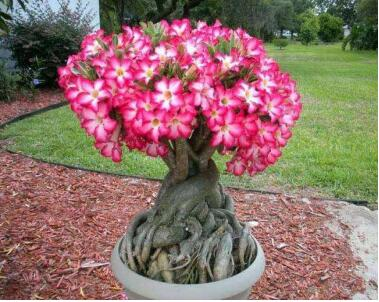
After introducing the growing methods and precautions, we can now learn about the medicinal value of Desert Rose. Desert Rose is not only outstanding in appearance, but in terms of medicinal efficacy, it also stands out among plants. Below we will learn in detail about the medicinal uses of Desert Rose.
Growing Methods and Precautions for Desert Rose
First, let's learn about the habits of Desert Rose. It prefers a climate environment of high temperature, drought, and ample sunlight. It likes calcareous, loose, breathable, well-drained sandy loam soil. It is not tolerant of shade, avoids waterlogging, avoids concentrated fertilizer and raw fertilizer, and fears cold. The optimal growth temperature is 25-30°C. Desert Rose is a plant with great ornamental value and is deeply loved by many people. Below we introduce the growing methods and precautions for Desert Rose.
Growing Methods for Desert Rose1. Soil: Desert Rose does not have high requirements for soil performance, but it needs loose, well-drained soil, which can help Desert Rose grow better. Its growing medium can be prepared with coarse sand, leaf mold, limestone granules, and vermiculite, and adding some NPK compound fertilizer as base fertilizer is also quite good.
2. Sunlight: Desert Rose relatively loves sunlight. During its growth, it can be exposed to direct sunlight, and the pot can be rotated regularly to ensure the beauty of the branches.
3. Watering: Desert Rose likes arid environments. Watering should follow the principle of watering when dry and stopping when wet. The growing season of Desert Rose is in summer. As long as sufficient moisture is ensured, watering once every 1-2 days is generally sufficient. Watering needs to be reduced in winter.
4. Fertilizing: What Desert Rose does not like is heavy and concentrated fertilizer. Generally, during its growing period, nitrogen fertilizer is the main component, supplemented by phosphorus and potassium fertilizer, with a ratio of about 2 : 1 : 1. Generally, apply a dilute compound liquid fertilizer once every 10 days.
5. Pruning: Desert Rose can be pruned regularly, which can effectively ensure the flexibility and ornamental value of its branches. At the same time, the branches can be shaped to maintain the ideal plant form of Desert Rose.
6. Pest and disease control: There is leaf spot disease damage, which can be sprayed with 50% thiophanate wettable powder at 500 times dilution. Pests include scale insects and leaf roller pests, which can be killed by spraying with 50% fenitrothion emulsifiable concentrate at 1000 times dilution. The main pest is scale insects. When the infestation is severe, it can cause all leaves to fall off, the plant's growing points to die, and even the plant to die. When growing at home, pay attention to observation. Once discovered, immediately wipe them off with a water-moistened cotton swab.
Precautions for Growing Desert Rose1. Desert Rose is quite susceptible to leaf spot disease, which in severe cases can cause large numbers of leaves to fall off. It can be controlled with 25% carbendazim wettable powder at 500 times dilution, or 50% thiophanate at 1000 times dilution.
2. The main pest of Desert Rose is scale insects. When the infestation is severe, it causes all leaves to fall off, the plant's growing points to die, and even the plant to die. When growing at home, pay attention to observation. Once discovered, immediately wipe them off with a water-moistened cotton swab. You can also spray 1-2 times with 40% omethoate emulsifiable concentrate at 1000-2000 times dilution, or 50% fenitrothion emulsifiable concentrate at 1000 times dilution during the egg-laying and hatching periods.
Value of Desert Rose 1. Ornamental valueWhether it is the flowers, leaves, stems, or its shape, all are elegant and unique, natural and generous, and distinctive. It is especially suitable for home indoor and balcony decoration. When in full bloom, most of the leaves fall off, and flowers cover the branches, with a graceful posture.
2. Horticultural designThe Desert Rose plant is short, with an ancient and vigorous tree shape, and its root stem is swollen like a wine bottle. It blooms twice a year, in April-May and September-October, with bright red and beautiful flowers shaped like trumpets, extremely unique and deeply loved by people. When planted in the ground in the south to arrange small courtyards, it is quaint and dignified, natural and generous. When grown in pots for ornamental purposes, it is distinctive for decorating interiors and balconies.
Growing Methods and Precautions for Desert Rose: When Does Desert Rose Bloom?
The Desert Rose plant is short, with an ancient and vigorous tree shape, and its root stem is swollen like a wine bottle. It blooms twice a year, in April-May and September-October. When grown in pots for ornamental purposes, it is distinctive for decorating interiors and balconies. So, let's take a look at the growing methods and precautions for Desert Rose.
Morphological characteristics of Desert Rose:
Succulent shrub or small tree, up to 4.5m tall; trunk swollen. Leaves simple, alternate, clustered at branch tips, obovate to elliptic, up to 15cm long, entire, apex obtuse with a short point, fleshy, nearly sessile. Corolla funnel-shaped, externally pubescent, 5-lobed, about 5cm in diameter, outer edge red to pink, lighter in the middle, lobe margins wavy; terminal corymbose inflorescence.
The flowers of Desert Rose are shaped like small trumpets, rose-red, very gorgeous. The umbel inflorescence grows in clusters of three to five, brilliant as brocade, blooming continuously throughout the four seasons. It is named Desert Rose because its place of origin is close to the desert and it is red like a rose. Desert Rose has simple, alternate leaves, obovate, apex acute, 8 cm-10 cm long, 2 cm-4 cm wide, leathery, glossy, dark green on the upper surface, grayish-green on the underside, entire. Racemose inflorescence, terminal, bearing more than 10 flowers, trumpet-shaped, 6 cm-8 cm long; corolla 5-lobed, with rose-red, pink, white, and multicolor varieties. May to December is the flowering period of Desert Rose, and the flowers come in red, rose-red, pink, white, and other colors. Greenhouse cultivation in the south makes it easier to set seed. Seeds have white fine hairs that help them fly and disperse. Note:
Desert Rose is definitely toxic, and its milky sap is the most toxic part. However, Desert Rose can be kept indoors. Just remember, as long as it is not accidentally eaten, it is fine.
Growth habits of Desert Rose:
It prefers a climate environment of high temperature, drought, and ample sunlight. It likes calcareous, loose, breathable, well-drained sandy loam soil. It is not tolerant of shade, avoids waterlogging, avoids concentrated fertilizer and raw fertilizer, and fears cold. The optimal growth temperature is 25-30°C.
In summer, it can be placed outdoors in a sunny spot without shading, and watered thoroughly to keep the soil moist, but not waterlogged. In winter, watering needs to be restricted, and the overwintering temperature should be maintained above 10°C so that it sheds its leaves and goes dormant. During cultivation, apply organic fertilizer 2 to 3 times a year as appropriate.
For propagation, in summer, select 1-year to 2-year-old branches about 10 cm long and cut them. After the cut surface dries slightly, insert them into a sand bed, and they will root in 3 to 4 weeks. It can also be propagated in summer by air layering. If seeds can be collected, sowing propagation can also be carried out.
Growing Methods and Precautions for Desert Rose——Growing Methods:
1. Desert Rose is mainly propagated by sowing and cutting. Sowing is best done in spring, using the spot sowing method to facilitate management after seedlings emerge. Before sowing, the substrate must be disinfected. After seedlings emerge, note that the substrate in the sowing tray must not be too wet, otherwise the roots may rot and cause large numbers of seedlings to die. Cutting is best done in the vigorous growing season. Cut branch sections to about 10 cm, soak the lower end in water to dilute the mucus at the cut, to prevent gumming that affects root formation. They can be inserted into a sand bed or directly into sterilized growing substrate, and will root in about 15-30 days. When propagating, it is recommended to use the sowing method, because this way the plant's root stem can naturally swell to form a good plant shape. Cutting seedlings cannot do this, and their ornamental value is also greatly reduced.
2. In addition, during cultivation, Desert Rose branches tend to grow leggy, affecting the beauty of the plant shape. Grafting can be used to change its plant shape. At a certain height of the plant, cut off all branches according to a certain shape, then take the upper ends of the cut branches and use the cleft grafting method for grafting. The grafted plant has a beautiful plant shape, and after blooming, the flowering branches are compact and highly ornamental.
3. Desert Rose is relatively drought-tolerant. Do not water too much each time. If there is too much water, it is very easy to cause root rot, and the branches will also grow leggy, making pruning more troublesome. In summer when temperatures are high, water according to soil conditions. Generally, water once every two or three days, and there must be no water accumulation in the pot. In winter when temperatures drop, Desert Rose also enters a semi-dormant period. At this time, watering should be properly controlled, and attention should be paid to keeping the soil dry. Watering once a week is sufficient. Appropriate drought is very beneficial to the growth of Desert Rose. [When Desert Rose enters the dormant period in winter, its leaves will gradually fall off. This is normal leaf drop, so there is no need to be nervous about it.]
4. Desert Rose relatively likes phosphorus and potassium fertilizer. Supplement it about once a month normally. During the vigorous summer growing period, sufficient fertilizer and water are needed, so that the flowers produced can be lush and vivid. In addition, in conjunction with repotting once a year, some long-acting base fertilizer can also be appropriately applied in the pot, such as decomposed soybean cake, bone meal, etc. Desert Rose relatively likes phosphorus and potassium fertilizer. Supplement it about once a month normally. During the vigorous summer growing period, sufficient fertilizer and water are needed, so that the flowers produced can be lush and vivid. In addition, in conjunction with repotting once a year, some long-acting base fertilizer can also be appropriately applied in the pot, such as decomposed soybean cake, bone meal, etc.
5. The pruning work for Desert Rose is also very important. If you do not pay attention to regular pruning and let it grow leggy freely, it will easily lose its ornamental value. After the flowering period is the best time for pruning, and you can make choices according to personal preference. Note: More branches mean more flowers. If you want more flowers, you need to find ways to keep more branch divisions.
Growing Methods and Precautions for Desert Rose: Precautions:
1. Desert Rose is quite susceptible to leaf spot disease, which in severe cases can cause large numbers of leaves to fall off. It can be controlled with 25% carbendazim wettable powder at 500 times dilution, or 50% thiophanate at 1000 times dilution.
2. The main pest of Desert Rose is scale insects. When the infestation is severe, it causes all leaves to fall off, the plant's growing points to die, and even the plant to die. When growing at home, pay attention to observation. Once discovered, immediately wipe them off with a water-moistened cotton swab. You can also spray 1-2 times with 40% omethoate emulsifiable concentrate at 1000-2000 times dilution, or 50% fenitrothion emulsifiable concentrate at 1000 times dilution during the egg-laying and hatching periods. [When carrying out pest and disease control, pay attention to medication safety.]
3. Care points: [Good sunlight], [Temperature around 30°C], [Water only after the potting soil is dry], [Appropriate fertilizing in spring and summer rainy seasons], [Change potting soil and repot at appropriate times]