Cymbidium kanran cultivation methods and precautions explained in detail
1. Cymbidium kanran has slender leaves with many stomata, and the thin leaves have a large surface area in contact with the air, so only a fresh environment can promote good plant growth. Cultivated Cymbidium kanran should be placed away from cooking fumes and air conditioner vents, and the leaves can often be rinsed with clean water.
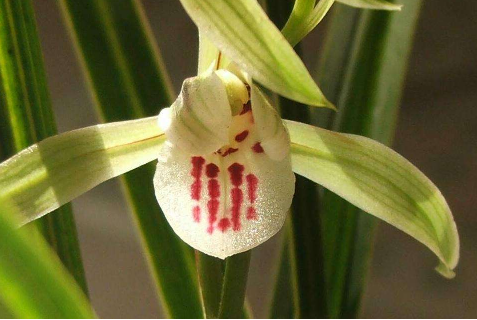
2. Division usually begins in August, which helps inhibit the formation of sprouts, reduce nutrient consumption, and improve its ability to survive independently.
3. Cymbidium kanran fears both heat and cold. In autumn and winter, avoid strong winds, and cover it for warmth during frost.
That is all we will share about Cymbidium kanran cultivation methods and precautions. I believe that after reading this you will definitely be able to grow Cymbidium kanran well, and the orchid plants will give off fragrance.
How to grow Cymbidium kanran? Cultivation methods and precautions for Cymbidium kanran
Image: Cymbidium kanran
[Common questions] How to grow Cymbidium kanran? Cultivation methods and precautions for Cymbidium kanran
[Expert answer]
Introduction:
Cymbidium kanran is also called winter orchid, because its flowering season is mostly during Cold Dew and Minor Snow (October to November), and it has the characteristic of blooming in the cold and giving off a subtle fragrance, hence the name. The flowering period of Cymbidium kanran varies depending on the place of origin, and it can bloom in all four seasons, so Cymbidium kanran is further divided into spring Cymbidium kanran, summer Cymbidium kanran, autumn Cymbidium kanran, and winter Cymbidium kanran. The places of origin of Cymbidium kanran are mainly distributed in Jiangxi, Fujian, Zhejiang, Sichuan, Yunnan, Guizhou, Hunan, Hubei, Guangdong, Guangxi, Anhui, Taiwan, China, and others. As a major strain and rising star of Chinese orchids, Cymbidium kanran has increasingly attracted people's attention with its majestic leaf posture, tall upright flower scapes, elegant flowers, and fascinating subtle fragrance, and the number of cultivation enthusiasts is growing day by day.
Cultivation methods and precautions for Cymbidium kanran:
1. Planting
Cymbidium kanran mostly grows under dense broad-leaved forests on steep slopes, with little light, shallow roots, and the roots covered with a thin layer of humus soil, with good water permeability. For this reason, when planting, choose a tall purple clay pot, line the bottom third of the pot with coarse brick pieces and porous material blocks, mix the middle part with mushroom mud, coarse sawdust, weathered stone, Zhijin stone, pond foundation stone, and soybean-sized brick granules until it reaches one third of the pot, and mix the upper part with rice-sized weathered stone and brick granules plus a small amount of humus soil. The planting medium should be loose, breathable, well-drained, and strongly insulating. Special attention should be paid to the fact that if hard planting materials, sawdust, humus soil, and the like are used for cultivation, the survival rate, sprouting rate, and flowering rate are all not high.
2. Cultivation: Because Cymbidium kanran's growth background differs from that of Cymbidium goeringii and Cymbidium faberi, the cultivation methods should differ slightly.
(1) Shading and temperature are similar to those for Cymbidium sinense.Especially in high-temperature seasons with strong light, even more attention should be paid to shading and supplementary watering. In addition, on sunny mornings or evenings, water should be sprayed on the leaf surface every day, with shading of about 80%. In this way, the leaf texture is glossy and there is less disease; in high-temperature seasons, I place Cymbidium kanran on the lower layer of the orchid rack, with Cymbidium goeringii and Cymbidium faberi on the rack blocking light, and the effect is quite good.
(2) Wind protection and freeze protection.In autumn and winter, prevent strong winds from blowing, and cover for warmth during frost damage days.
(3) Fertilizing.Cymbidium kanran planted with the above-mentioned medium generally can be given little fertilizer, or even no fertilizer, and from April to June a nitrogen-rich chemical fertilizer can also be sprayed on the leaves, such as Hyponex No. 4, B1 sprouting agent, and so on. From August to October, spray phosphorus- and potassium-containing chemical fertilizers, such as flowering fertilizer, Hyponex No. 3, potassium dihydrogen phosphate, and so on.
3. Care
Whether Cymbidium kanran can bloom, bloom well, and give off a subtle fragrance depends crucially on care. For dark-colored flowers, light should be slightly stronger, and for plain-centered ones, light should be slightly shadier. From when the flower scape begins to elongate until before flowering, if plant protection is neglected, the flower buds easily become damaged and rot. For this reason, Cymbidium kanran's flower buds are also easily attached and bitten by mites; the pest's color and luster are similar to those of the flower buds and are often hard to notice, but once discovered, prevention and control must be carried out early, otherwise the flowers will not bloom. Therefore, spraying insecticides such as Huakang No. 1 and fenvalerate can effectively prevent and control them. Cymbidium kanran mostly opens in late autumn and early winter, when the weather gradually turns cold, and people often feel the fragrance is faint and the scent insufficient. In order to make Cymbidium kanran's subtle fragrance elegant and free, it should be exposed to more sun during the flowering period; in this way, even at night the light fragrance fills the air. Cymbidium kanran has fragrant flowers and beautiful form, brilliant flower colors, scapes rising above the rack, leaves upright and arching, well-spaced and orderly, elegant and graceful, soft yet firm, with leaves and flowers equally refined, and among Chinese orchids it is uniquely attractive and will be valued.
[Editor's comments] Cymbidium kanran is not easy to grow. Because it is difficult to cultivate, there is even a saying of "nine deaths and one life." In fact, this is due to cultivators not mastering the techniques well enough. As long as you master the cultivation techniques for Cymbidium kanran, its sprouting rate is even no lower than that of Cymbidium goeringii and Cymbidium faberi. The editor of First Agricultural Economics above has introduced the cultivation methods and precautions for Cymbidium kanran. Friends who want to grow Cymbidium kanran must pay attention; reading the article carefully will help you.
Cultivation methods and precautions for Cymbidium kanran
Chinese scientific name: Cymbidium kanranLatin scientific name: Cymbidium Kanran Mak.Kingdom: PlantaePhylum: AngiospermsClass: MonocotyledoneaeOrder: MicrospermaeFamily: OrchidaceaeSubfamily: OrchidoideaeTribe: EpidendreaeGenus: CymbidiumSubgenus: Jianlan subgenusSpecies: Cymbidium kanranDistribution area: Anhui, Zhejiang, Jiangxi, Fujian, Taiwan, Hunan, Guangdong, Hainan, Guangxi, Sichuan,Cymbidium kanran, Latin scientific name: Cymbidium Kanran Mak. An orchid family, Cymbidium genus plant, with a slender and graceful plant type, elegant and handsome leaf posture, brilliant and changeable flower colors, and a clear, mellow, lasting fragrance. It combines the beauty of many orchids in one and gathers the spiritual energy of all things in one. The plant type of Cymbidium kanran is very similar to that of Cymbidium ensifolium, but the leaves are thinner, especially at the base, and the leaf posture is unrestrained, appearing elegant and noble. Leaves 3-7 per cluster, strongly upright, 40-70 cm long, 1-1.8 cm wide, entirely green or with fine teeth near the tip, slightly glossy. The flower scape is upright, equal in height to the leaves or taller than the leaf surface, with sparsely arranged flowers, more than 10 flowers per scape. Both petals and sepals are relatively narrow and slender, delicate and lovely, and flower colors are rich, including yellow-green, purple-red, deep purple, and so on, generally with variegated veins and spots. The flowering period is October to December, and it gives off fragrance while braving frost and cold, which is truly precious, hence the name "Cymbidium kanran." The flower fragrance is rich and lasting.1. Morphological characteristics
Terrestrial plant; pseudobulbs narrowly ovoid, 2-4 cm long, 1-1.5 cm wide, enclosed within the leaf bases. Leaves 3-5 (-7), strap-shaped, thinly leathery, dark green, slightly glossy, 40-70 cm long, 9-17 mm wide, front margins often with fine teeth, articulation located 4-5 cm from the base. Flower scape arising from the base of the pseudobulb, 25-60 (-80) cm long, upright; raceme sparsely bearing 5-12 flowers; floral bracts narrowly lanceolate, the lowest one up to 4 cm long, the middle and upper ones 1.5-2.6 cm long, generally nearly equal in length to the pedicel and ovary; pedicel and ovary 2-2.5 (-3) cm long; flowers often pale yellow-green with a pale yellow lip, also in other colors, often with a strong fragrance; sepals nearly linear or linear-lanceolate, 3-5 (-6) cm long, 3.5-5 (-7) mm wide, apex acuminate; petals often narrowly ovate or ovate-lanceolate, 2-3 cm long, 5-10 mm wide; lip nearly ovate, inconspicuously 3-lobed, 2-3 cm long; lateral lobes upright, more or less embracing the column, with papillose pubescence; mid-lobe larger, recurved, also with similar papillose pubescence on the upper surface, margins slightly erose; disk with 2 longitudinal lamellae extending from the base to the base of the mid-lobe, upper part inclined inward and close together, forming a short tube; column 1-1.7 cm long, slightly curved forward, with narrow wings on both sides; pollinia 4, in 2 pairs, broadly ovate.Capsule narrowly elliptic, about 4.5 cm long, about 1.8 cm wide. Flowering period August to December.
The flowering period of Cymbidium kanran varies depending on the region, usually concentrated in October to November, but there are also those that bloom in July and January, and even some that bloom in April to May, so some people believe that Cymbidium kanran should be divided into spring Cymbidium kanran, summer Cymbidium kanran, autumn Cymbidium kanran, and so on.
2. Growth habits
Growing under forests, beside streams and valleys, or on slightly shaded, moist, stony soil, at an altitude of 400-**** m.3. Geographical distribution
Distributed in Anhui, Zhejiang, Jiangxi, Fujian, Taiwan, Hunan, Guangdong, Hainan, Guangxi, Sichuan, Guizhou, and Yunnan.4. Subspecies types
The plant type of Cymbidium kanran is very similar to that of Cymbidium ensifolium, but the leaves are thinner, especially at the base, and the leaf posture is unrestrained, appearing elegant and noble. Leaves 3-7 per cluster, strongly upright, 40-70 cm long, 1-1.7 cm wide, entirely green or with fine teeth near the tip, slightly glossy. The flower scape is upright, equal in height to the leaves or taller than the leaf surface, with sparsely arranged flowers, more than 10 flowers per scape. Both petals and sepals are relatively narrow and slender, delicate and lovely, and flower colors are rich, including yellow-green, purple-red, deep purple, and so on, generally with variegated veins and spots. The flowering period is October to December, and it gives off fragrance while braving frost and cold, which is truly precious, hence the name "Cymbidium kanran." The flower fragrance is rich and lasting. Cymbidium kanran avoids heat and also fears cold, and when cultivated in the south it must be kept in a cool environment for management. In China, Cymbidium kanran is usually divided into forms by perianth color. There are the following four: 1. green Cymbidium kanran; 2. green-purple Cymbidium kanran; 3. purple Cymbidium kanran; 4. red Cymbidium kanran. Among them, green Cymbidium kanran and red Cymbidium kanran are precious. The so-called plain-centered Cymbidium kanran produced in Taiwan, China has pale green flowers and belongs to the green Cymbidium kanran type. Up to now, the number of plain-centered Cymbidium kanran is especially small, and the price is very expensive. Its famous varieties are "Hanxiangsu," "Guanghansu," and "Hanshansu." In Japan, the famous varieties are "Yuemiao" and "Fengxue." The famous red Cymbidium kanran variety is "Riguang," and all are rare treasures. In addition, line-art varieties of Cymbidium kanran have been found in Taiwan, China and Japan, but the quantities are very few. The only rare line-art Cymbidium kanran successfully cultivated in Taiwan, China is "Wushanhuang."According to a report by Mr. Peng Shuangsoong of Taiwan, China, two natural hybrids related to Cymbidium kanran, "Sulu Cymbidium kanran" and "Chunlu Cymbidium kanran," were discovered only in the last thirty years, and quite a few orchid growers in Taiwan, China have already cultivated them. The origin of "Sulu Cymbidium kanran" is that in 1959, Japanese people discovered an orchid resembling Taiwan Cymbidium kanran near Sulu community in the mountain indigenous tribe of Tai'an Township, Miaoli County, at an altitude of about 1,000 m. They collected it and brought it back to Japan for cultivation, and it ended up blooming during the flowering period of Cymbidium sinense. Its petals were thicker and broader than those of Cymbidium kanran, so it was learned to be a natural hybrid of Taiwan Cymbidium kanran and Taiwan Cymbidium sinense, and it was then named "Sulu Cymbidium kanran." After being published, it was widely loved by Japanese orchid growers. The leaf posture of this species is similar to that of Cymbidium kanran, and when identifying it one can only rely on the flowering period and flower type. Because it is a first-generation hybrid, its reproductive capacity is especially strong, and it is easier to cultivate than Cymbidium kanran. Also, because its flowers are larger than those of both parents, the buds are rich in variation, and the flower fragrance is fragrant, it spread quite quickly in Taiwan, China and Japan, and there are more and more cultivators. The other, "Chun Cymbidium kanran," is a natural hybrid of Taiwan broad-leaved Cymbidium goeringii and Taiwan Cymbidium kanran, produced in the Pinglin mountain area of Taipei, with seedlings collected from mountainous areas and Hualien and other places. This species has dark green leaves and a smooth leaf surface like Cymbidium kanran, but its leaf posture is shorter and smaller than that of Cymbidium kanran, with leaves 30-50 cm long and 0.6-0.9 cm wide, flower scapes 20-25 cm, usually one to two flowers, flower diameter 5-6 cm, flower color brown or purple-brown, and a strong fragrance like Cymbidium goeringii, while the flowering period is the same as that of Cymbidium sinense. The rare variety was named "Songchun."