How to grow a Desert Rose? Detailed explanation of cultivation methods
1. How to propagate Desert Rose seedlings
This plant can be propagated into seedlings either by seed or by cuttings, each method has its pros and cons. You can choose according to your own needs.
2. The growth habits of the Desert Rose
Just like its name suggests, the Desert Rose plant enjoys a growing environment of high temperatures, dryness, and intense sunlight, and it also needs a certain temperature range. Therefore, when growing a Desert Rose, note that the winter temperature must be kept above 10°C. The Desert Rose loves sunlight and can be placed on a balcony to ensure plenty of sunshine.
3. The conditions needed to grow a Desert Rose
The soil used for growing a Desert Rose is best a loose, well-draining substrate. The Desert Rose does not have high soil requirements; as long as this requirement is met, it is fine. In addition, as mentioned above, the Desert Rose likes dryness and is very drought-tolerant, so there is no need to water it too much. In summer, water the Desert Rose once every one to two days, while in winter, water it with more days in between. During the dormant period of the Desert Rose, do not water it.
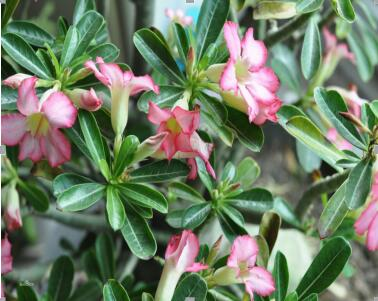
Desert Rose cultivation methods. The flower language of the Desert Rose.
There is a kind of stone that can also bloom, and its name is the Desert Rose. Today we will talk about the Desert Rose and explain the cultivation methods of the Desert Rose and the flower language of the Desert Rose.
Desert Rose cultivation methods:
1. Habits: The Desert Rose prefers a high-temperature, sunny, dry, and well-ventilated environment. The growing temperature for the Desert Rose is 25-35°C. It can survive well in the harsh summer, but it is not cold-tolerant, so the winter temperature generally must be kept above 10°C.
2. Soil: The Desert Rose does not have high soil requirements, but it requires loose, breathable soil with good drainage, which helps the Desert Rose grow better. Its growing medium can be prepared with coarse sand, leaf mold, limestone granules, and vermiculite in a ratio of 3:4:1:2, and an appropriate amount of ternary compound fertilizer can be added to the soil as a base fertilizer.
3. Sunlight: The Desert Rose relatively loves sunlight. During its growing period, it can receive long periods of direct sunlight, and the pot can be rotated regularly to maintain the beauty of the branches.
4. Watering: The Desert Rose is relatively drought-tolerant. Watering can follow the principle of watering when dry and withholding when wet. Summer is the growing period of the Desert Rose; as long as sufficient moisture is ensured, watering once every 1-2 days is generally enough. In winter, water can be appropriately reduced.
5. Fertilizing: What the Desert Rose does not like is heavy fertilizer. Generally, during its growing period, nitrogen fertilizer is the main component, supplemented by phosphorus and potassium fertilizers, in a ratio of about 2:1:1. Generally, a diluted compound liquid fertilizer is applied once every 10 days.
6. Pruning: The Desert Rose can be pruned regularly, which can effectively maintain the softness and ornamental value of its branches. At the same time, the branches can be shaped to maintain the ideal plant form of the Desert Rose.
The flower language of the Desert Rose:
The Desert Rose is a flower species that grows close to deserts. Like the cactus, it needs great courage to survive, so the Desert Rose symbolizes strength and courage. At the same time, its flowers are strikingly beautiful and can be called a wonder flower in tropical regions. When in bloom, it looks like a scene of false azaleas, so in its place of origin it is also called false azalea. The flower language of the Desert Rose represents "love you unswervingly."
The Desert Rose belongs to the Apocynaceae family, genus Adenium, and is somewhat toxic. Its milky sap is quite toxic. If accidentally ingested, it can cause symptoms such as irregular heartbeat and accelerated heart rate. Although the Desert Rose is somewhat toxic, it can be placed indoors as long as it is not accidentally ingested.
Desert Rose cultivation methods_Desert Rose pictures
The Desert Rose is also called Adenium obesum. It is a succulent plant in the Apocynaceae family, genus Adenium, and is also called a succulent plant. It is a succulent shrub and small tree plant. The plant height is generally 4.5 m, and the trunk is swollen in shape. The leaves of the Desert Rose are simple and alternate, growing at the ends of the branches. The leaf shape is obovate and elliptical, with a length of 15 cm, entire margins, and a blunt apex with a short point. It is relatively fleshy and grows without a petiole. Below, let us take a look at the cultivation methods of the Desert Rose and an introduction to Desert Rose pictures.
[Desert Rose pictures—morphological characteristics]
The Desert Rose is a succulent shrub and small tree plant. Its shape is like a small trumpet, and the color of the flowers is rose red, very bright. The inflorescence is umbel-shaped, brilliant like brocade, and it blooms in all four seasons of the year. The leaves of the Desert Rose are simple and alternate, obovate in shape, with an acute apex, a length of 8-10 cm, and a width of 2-4 cm. The leaves are leathery and very glossy. The colors of the corolla include white, bicolor, rose red, pink, and so on. The flowering period is from May to December, and the flower colors include red, rose red, pink, white, and so on. In southern regions, it is mainly planted in greenhouses and will bear abundant fruit. The seeds are white with soft hairs.
[Desert Rose pictures—growth habits]
The Desert Rose likes to grow in environments with sufficient light, drought, and high temperatures. It grows in sandy soil rich in calcium, loose, well-aerated, and well-draining. The Desert Rose's cold tolerance and shade tolerance are quite good. It avoids waterlogging, heavy fertilizer, and raw fertilizer in its growing environment. It is afraid of cold and is suitable for growing in an environment of 25-30°C. If grown at home, it needs to be placed in a sunny place or a place with diffused light. Its flowering period is from May to December, and the flower colors include pink, white, rose red, red, and so on. In southern regions, it is relatively sturdy when planted in greenhouses.
[Desert Rose pictures—propagation methods]
The Desert Rose mainly uses cutting propagation, grafting propagation, layering propagation, and seed propagation. Cutting propagation is generally carried out in summer, and 1-2 year old branches can be selected for cuttings. For grafting, oleander is used as the rootstock, and the cleft grafting method is used when attacking; after surviving, the plant grows very luxuriantly and the flowers bloom very brilliantly. Layering propagation is also carried out in summer, generally using the air layering method in summer. It generally takes about one month to take root, and after one and a half months it can be potted. The seed propagation method is also carried out in summer, and the suitable temperature for germination is 21°C.
[Desert Rose cultivation methods]
1. Light: Providing sufficient light is more conducive to the Desert Rose blooming. During vigorous growth, appropriate shading should be carried out, and during dormancy, appropriate light should also be given.
2. Temperature: The Desert Rose likes to grow in a sunny and well-ventilated environment. In the southern regions in summer, the Desert Rose is in its growing period, with an average temperature of 30°C. This temperature is very favorable for the growth of the Desert Rose. In winter, the Desert Rose's cold tolerance is very poor, so it should be placed indoors for cultivation.
3. Watering: The Desert Rose should not be placed in a humid environment to grow. Even during the growing period, there should not be too much water. Watering should only be done when the potting soil is completely dry. During the growing period, avoid adding [water]; otherwise, the plant will be threatened by pests and wither.
4. Fertilizing: Summer is the growing period of the Desert Rose. During the growing period, sufficient fertilizer should be given, which is more conducive to the growth of the Desert Rose. The Desert Rose grows relatively slowly, so some slow-release fertilizer can be applied, and decomposed compost can be applied. During the autumn dormant period, the growth rate of the Desert Rose will also slow down or stop, and fertilizing should be stopped.
5. Pruning: If you want the Desert Rose plant shape to be very beautiful, pruning work is very important. If pruning management is not carried out normally and it is allowed to grow leggy, it can very easily lose its ornamental value. Pruning after the flowering period is the best time, and you can also prune according to your own preferences.
6. Pest and disease prevention: The disease that appears on the Desert Rose is leaf spot disease, which can be prevented by spraying with thiophanate. The pests encountered include scale insects and leaf roller pests, which can be sprayed with fenitrothion.
More related information: Rohdea japonica flowering pictures What effects and functions does Rorippa indica have How to grow a miniature coconut tree How to grow Adiantum Smilax glabra pictures