Falcata Aerides: Cultivation Methods and Points to Note
1. Soil
For soil, generally choose a loose and breathable substrate; you can mix leaf mold, bark, or charcoal and river sand.
2. Light
Potted Falcata Aerides needs plenty of scattered light; it can receive two to three hours of light in the early morning, or the plant can be placed under a tree for cultivation, which is more conducive to blooming.
3. Temperature
Falcata Aerides prefers warmth; the suitable growing temperature is 16-28°C, and in winter it must not go below 8°C, otherwise it is very easily frostbitten.
4. Water
During the growing period, Falcata Aerides needs a large amount of water; it can be watered once every 3 days to keep moisture sufficient, and the soil should be kept appropriately on the dry side; in summer, humidity can be maintained by misting.
5. Repotting
Falcata Aerides grows vigorously and quickly, so according to its growth condition it can be repotted into a larger pot as appropriate to leave room for growth; generally it can be repotted about once every 3 months.
Falcata Aerides is inexpensive, easy to cultivate, and can beautify the environment very well. Are you tempted? Then hurry and buy one to grow.
How to Grow Aerides rosea: Potting Methods and Care Management
Aerides rosea is suitable for planting in an environment with good air circulation. It likes shade and avoids direct sunlight; it likes moisture and avoids dryness; it is suitable to use sandy loam rich in humus. Below, the editor brings you a detailed introduction to the cultivation methods of Aerides rosea and related knowledge.
Introduction to Aerides rosea
Aerides rosea (scientific name: Aerides rosea Lodd. ex Lindl. et Paxt.): The stem is stout, 5-20-plus cm long, and together with the leaf sheaths up to 2.5 cm thick. The leaves are fleshy, narrowly oblong or strap-shaped, with obtuse apices and unequally 2-lobed. The inflorescences are axillary, usually 1-3, unbranched, longer than the leaves; the inflorescence axis is relatively long, about 1/2-3/5 of the total length of the inflorescence, densely bearing many flowers; the petals are similar to and equal in size to the dorsal sepal; the lip is 3-lobed; the side lobes are small, upright, ear-shaped, with the lower edge densely covered with fine papillae, and the front edge dark purple; the upper surface is densely covered with purplish-red spots, and the edges have slightly irregular serrations. The capsule is nearly ovate. The flowering period is July, and the fruiting period is from August to May of the following year.
Aerides rosea grows on tree trunks in mountain forest margins or in open evergreen broad-leaved forests on mountain slopes at an altitude of 320-1530 m. It is distributed in China, Bhutan, India, Myanmar, Laos, and Vietnam.
Cultivation Methods of Aerides rosea
I. Potting Methods
For clay pots, fill with broken tiles; for purple clay pots, the bottom of the pot must be covered with a perforated nylon gauze. Before planting, first spread coarse stones in the pot, occupying about 2/5 of the pot depth, then coarse stone culture soil, 3-5 cm thick, and then place the orchid plant in. After preparing the orchid pot and planting material, hold the orchid plant upside down (roots up, leaves down) and rinse it under a faucet with slow water, but the water pressure must not be too strong, so as not to damage the orchid roots and leaves. Grasp the orchid head with your thumb and index finger, brace the edge of the pot with your little finger, and fix the roots with bamboo chopsticks. When placing it into the pot, try not to let the roots touch the pot wall. When potting, note that the roots should spread out on their own and must not curl.
Pour bean-sized mixed gravel into the bottom of the pot to one third of the way. Then pour in medium-sized planting material to four fifths of the way, filling it firmly and trying not to leave spaces. When planting, hold the orchid plant with the left hand and add soil with the right hand (be careful to prevent soil from entering the leaf center), then lift the orchid plant slightly so that the roots spread naturally. Then add soil while shaking the pot so that the soil and roots are in close contact. Then press the soil around the stem firmly with your hands, and finally make the pot surface slightly mound-shaped (that is, slightly lower in the middle and around the edges). Pull out the bamboo chopsticks and shake the planting material in the pot firm. After filling the planting material firmly, add large-sized planting material up to 1.5 cm from the pot rim. Finally, pour in bean-sized planting material again, to the extent that the pseudobulbs are completely buried in the soil, and then shake it fully firm. Use a soil-pressing tool to gently press the planting material and smooth the surface.
II. Care Management
After Aerides rosea is planted, it is best for the planting material in the pot to be slightly higher in the center. After potting, water immediately. The first watering should be sufficient in quantity. Finally, place the orchid pot in a shaded place. Within one month, it should not be exposed to direct sunlight, and watering should be controlled; it should not be too wet. Afterward, the placement location should be chosen where there is half shade and half sun, ventilation, and morning sunlight.
Watering: During the peak growth period of the orchid, once water is lacking in summer, the potted orchid will grow poorly; orchids need eight parts dry and two parts wet. Watering should follow the principle of "water when dry, stop when wet, appropriately on the dry side." Watering must be thorough, and half watering must not be done. Fertilization should be frequent and light, with small meals and more frequent feeding. Orchids do not need much fertilizer during the development and growth period; for vigorous and healthy orchid plants, a dilute liquid fertilizer can be applied once every 10-15 days. Natural organic matter should be the main component.
Morphological Characteristics of Aerides rosea
Stem: The stem of Aerides rosea is stout, 5-20-plus cm long, and together with the leaf sheaths up to 2.5 cm thick.
Leaves: The leaves of Aerides rosea are fleshy, narrowly oblong or strap-shaped, up to 30 cm long and 2-3.5 cm wide, with obtuse apices and unequally 2-lobed.
Flowers: Inflorescence
The inflorescences of Aerides rosea are axillary, usually 1-3, unbranched, longer than the leaves; the inflorescence stalk is stout, covered by 3 scale-like sheaths about 1 cm long; the inflorescence axis is relatively long, about 1/2-3/5 of the total length of the inflorescence, densely bearing many flowers; the floral bracts are green, thick in texture, ovate-lanceolate, 5-7 mm long, with acuminate apices; the pedicel and ovary are white with a pale purple tinge, 12-14 mm long; the ovary is rod-shaped and trigonous; the flowers are white with purple spots, spreading; the dorsal sepal is nearly obovate, about 12 mm long and 7 mm wide, with an obtuse apex and narrowed base, with 4-5 veins; the lateral sepals are slightly obliquely ovate, 8 mm long and 7 mm wide, with obtuse apices, with 4-5 veins.
Petals
The petals of Aerides rosea are similar to and equal in size to the dorsal sepal; the lip is 3-lobed; the side lobes are small, upright, ear-shaped, with the lower edge densely covered with fine papillae, and the front edge dark purple; the mid-lobe is nearly rhombic, 16-18 mm long, 12-14 mm wide above the base, sharply narrowed and curved downward toward the apex, with a nearly acute apex, densely covered with purplish-red spots on the upper surface, with slightly irregular serrations on the edges, and at the base extending into the spur as a linear appendage with a hooked apex, the surface of the appendage covered with fine papillae; the spur is white, extending forward, narrowly conical, about 5 mm long; the column is white slightly tinged with purplish-red, about 5 mm long, with a column foot about 1 mm long; the rostellum is narrowly long and fleshy; the anther cap is white, yellow on the dorsal side at the apex, with the front end narrowed into a beak shape.
Fruit: The capsule of Aerides rosea is nearly ovate, about 2 cm long and 1.2 cm thick, with a stalk about 7 mm long at the base. The flowering period of Aerides rosea is July, and the fruiting period is from August to May of the following year.
Ecological Habits of Aerides rosea
Aerides rosea is suitable for planting in an environment with good air circulation. It likes shade and avoids direct sunlight; it likes moisture and avoids dryness; 15°C to 30°C is most suitable for growth. Above 35°C, growth is poor. Severe cold below 5°C will affect its growth capacity; at this time, the orchid is often in a dormant state. If the temperature is too high plus sun exposure, then within one or two days leaf scorch or withering will appear. If the temperature is too low and it is not moved indoors in time, then frost damage will occur.
Aerides rosea has fleshy roots and is suitable for sandy loam rich in humus; drainage performance must be good, and leaf mold or mountain soil with more humus should be chosen. Slightly acidic loose soil or iron-containing soil is suitable, with a pH of 5.5-6.5.
Uses and Functions of Aerides rosea
1. Ornamental value
As a plant of the orchid family, Aerides rosea, not to mention its other effects, is unique at first glance and has distinctive ornamental value. Like many orchid plants, Aerides rosea is overall purple. However, the colors on the flower branches are white, with purple spots, embellishing each other, which is quite charming. So in the eyes of outsiders, although it does not match the bearing of peonies and roses, Aerides rosea still stands gracefully, and its brilliant appearance makes people take notice.
2. Decorative effect
Aerides rosea has no toxic side effects, and combined with its clear and elegant appearance, it is very suitable for indoor pot cultivation. Any plant can more or less purify the air through photosynthesis; because Aerides rosea is rare, it can better show the owner's ingenuity. It is most appropriate as an item for the family, and can bring the whole family the lively interest of nature, making life full of leisure.
Falcata Aerides: Cultivation Methods and Points to Note
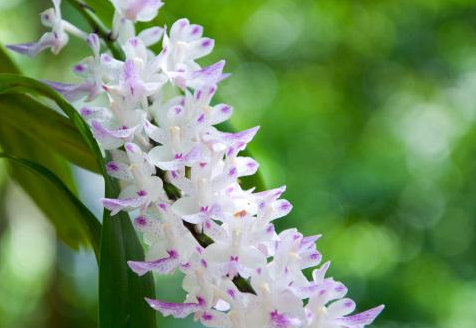
Chinese name: Falcata AeridesLatin scientific name: Aerides falcata Lindl.Kingdom: PlantaeDivision: AngiospermsClass: MonocotyledonsOrder: MicrospermaeFamily: OrchidaceaeSubfamily: OrchidoideaeTribe: VandeaeGenus: AeridesSpecies: Falcata AeridesNaming author and year: Lindl., 1882Falcata Aerides (scientific name: Aerides falcata Lindl.): The stem is stout, more or less elongated, with several distichous leaves. The leaves are strap-shaped, 20-29 cm long and 2.5-3.7 cm wide. The raceme is loosely few-flowered, with flowers 2-2.5 cm in diameter; the sepals and petals are pale white, with purplish-red on the upper part; the lateral sepals are broadly ovate, with the base completely adnate to the column foot; the lip is 3-lobed; the column foot is up to 1 cm long or longer; the front end of the anther cap is narrowed into a beak shape. It grows on tree trunks in mountain evergreen broad-leaved forests. It is produced in southeastern Yunnan, China (Jinping). It is distributed in northeastern India, Myanmar, Thailand, Cambodia, Laos, and Vietnam. This flower is cultivated and has relatively high horticultural value.1. Morphological characteristics
The stem of Falcata Aerides is stout, more or less elongated, with several distichous leaves. The leaves are strap-shaped, 20-29 cm long and 2.5-3.7 cm wide. The raceme is loosely few-flowered, with flowers 2-2.5 cm in diameter; the sepals and petals are pale white, with purplish-red on the upper part; the lateral sepals are broadly ovate, with the base completely adnate to the column foot; the lip is 3-lobed, and the side lobes are sickle-shaped oblong; the mid-lobe is nearly broadly ovate, purple in the front half and white with purple spots and stripes in the back half, with a retuse apex, and with a semicircular callus at the base (at the mouth of the spur), with fine teeth on the edges; the spur is almost parallel to the mid-lobe and curved upward, 3-4 mm long; the column foot is up to 1 cm long or longer; the front end of the anther cap is narrowed into a beak shape.2. Origin and habitat
It grows on tree trunks in mountain evergreen broad-leaved forests. It is produced in southeastern Yunnan, China (Jinping). It is distributed in northeastern India, Myanmar, Thailand, Cambodia, Laos, and Vietnam. The type specimen was collected from Myanmar.3. Growth habits
Orchids generally grow on mountain slopes and valley walls in deep mountains and secluded valleys, on inclined slopes or in rock crevices with good water permeability and water retention, beside sparse mountain grass, and under the shade of secondary mixed forests. Or in places with shade, short sunshine duration, or only scattered filtered light. In places with high air humidity and air circulation, sometimes they also grow on cliffs beside mountain streams.Orchids are suitable for planting in an environment with good air circulation. They like shade and avoid direct sunlight; they like moisture and avoid dryness; 15°C to 30°C is most suitable for growth. Above 35°C, growth is poor. Severe cold below 5°C will affect their growth capacity; at this time, the orchid is often in a dormant state. If the temperature is too high plus sun exposure, then within one or two days leaf scorch or withering will appear. If the temperature is too low and it is not moved indoors in time, then frost damage will occur.
Orchids have fleshy roots and are suitable for sandy loam rich in humus; drainage performance must be good, and leaf mold or mountain soil with more humus should be chosen. Slightly acidic loose soil or iron-containing soil is suitable, with a pH of 5.5-6.5.