A Detailed Guide to Growing Ariocarpus from Seed
Substrate
Ariocarpus does not like humus-type materials. You can choose gravel and medium-grade vermiculite, then add a little rice husk ash and base fertilizer, mixing them in proportion. The substrate must be strictly sterilized at high temperature. When laying the substrate, it is best to first place some large particles at the bottom to aid aeration and drainage, with the substrate about 6 or 7 cm thick.
Sowing
There should be a certain spacing between plants and between rows, generally about 1 cm between each seed. Place the seeds directly on top of the substrate, soak thoroughly with water, cover, and keep warm, and that is all. Seeds will germinate during the germination period whether there is light or not, so light is not important; what matters is temperature and moisture!
The above is an introduction to the question of how to sow Ariocarpus. Now let us look at how Ariocarpus should be cared for through the four seasons!
How to Propagate Ariocarpus: An Example of the Seed-Growing Method
Ariocarpus is very easy to propagate. Generally it can be done by sowing, cuttings or grafting, but sowing is the most commonly used propagation method. Below is a detailed introduction to growing Ariocarpus from seed. It is hoped that through the following text, flower enthusiasts can better propagate by seed and make their Ariocarpus collection grow larger and larger.
Ariocarpus Seed-Growing Method 1. Potting Soil Configuration for SowingAriocarpus does not like humus-type materials. You can choose gravel and medium-grade vermiculite, then add a little rice husk ash and base fertilizer, mixing them in proportion. The substrate must be strictly sterilized at high temperature. When laying the substrate, it is best to first place some large particles at the bottom to aid aeration and drainage, with the substrate about 6 or 7 cm thick. The substrate must be strictly sterilized at high temperature. When laying the substrate, it is best to first place some large particles at the bottom to aid aeration and drainage, with the substrate about 6 or 7 cm thick.
2. Ariocarpus Sowing MethodSowing should have a certain spacing between plants and between rows, generally about 1 cm between each seed. Place the seeds directly on top of the substrate, soak thoroughly with water, then cover to keep warm.
3. Ariocarpus Seedling-Stage ManagementFrom the emergence of Ariocarpus seedlings up to the two-year stage, the suitable daytime temperature is about 35°C, while at night it is around 20°C. Generally you can cover the small seedlings with a large plastic bag for enclosed cultivation to effectively control temperature and humidity. Place it in a balcony or similar spot with preferably scattered light, and it is best if a layer of water droplets forms inside the bag. No fertilizing is needed; keep the potting soil moist. You can use the soaking method, and note that you must use clean well water or tap water that has been left to stand. The water depth should be about half the depth of the potting soil, and once the surface layer of the potting soil begins to become wet, you can take it out. It must be noted that at this stage, it is best not to move the seedlings easily.
4. Repotting AriocarpusDuring the two-to-four-year period of Ariocarpus. Repot around the two-year mark in May or June. After taking it out of the pot, trim the roots appropriately, remove the fibrous roots and unhealthy roots, and sprinkle on some rooting powder. Let the seedling dry for about 3 days. Add more base fertilizer to the substrate, then still pot it up in moist soil, controlling the spacing between seedlings well. After one week of scattered light, soak the pot; no enclosed cultivation is needed. After normal watering 3 or 4 times, you can apply fertilized water. Fertilize appropriately according to specific conditions, adhering to the principle of light fertilizer applied frequently.
Ariocarpus Ariocarpus retusus Illustrated Guide: How to Grow Ariocarpus / How to Propagate Ariocarpus
Ariocarpus ProfileAriocarpus Ariocarpus retusus
Ariocarpus Cultivation Methods and Precautions: An Introduction to Ariocarpus
Ariocarpus is a succulent cactus that grows in the subtropics. The Ariocarpus is half-buried in the soil and has a very large taproot. The upper part is flat, 6-12 cm in diameter, with triangular tubercles that overlap to form transverse wrinkles.
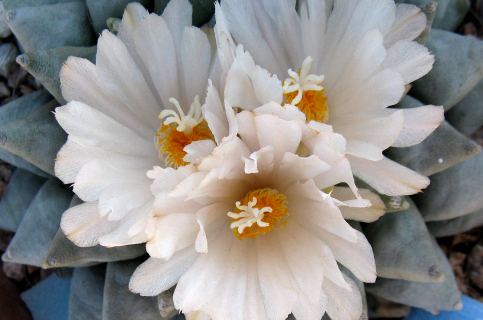
Ariocarpus has no crown at all and is gray in color, making it very easy to hide itself in its growing area. The top of the Ariocarpus has hairs, and after several years of growth it will produce large pink or yellow flowers.
Ariocarpus contains bitter and toxic alkaloids, such as hordenine. These alkaloids can protect the plant itself from being eaten by herbivorous animals.
Morphological Characteristics of Ariocarpus
Ariocarpus plants are mostly solitary, and adult plants occasionally produce offsets from the base. They have a beet-like, enlarged taproot. The above-ground part of the plant is rosette-shaped, with milky-white fuzz attached at the top. The body color is blue-green, with a coating of white powder. The plant width varies from 7-20 cm depending on the variety, and the tubercles are thick and triangular. Flowers: borne terminally in late summer and early autumn, about 5-6 cm in diameter.
Due to the year-round arid and hot climate, the entire Ariocarpus plant is almost completely buried underground in its place of origin.
The tubercles of Ariocarpus are arranged in a rosette, green or gray-green, with a surface covered in white powder, flat or slightly concave on top, and smooth; outwardly it appears to have no spines. In fact, the newly grown tubercles in the middle of the plant do have spines, but they are very small and wither early, so they appear absent. Between the tubercles there is white or pale yellow woolly hair. The flowering period is summer.
Ecological Habits of Ariocarpus
Ariocarpus likes ample sunlight, air circulation, well-draining soil (preferably sandy soil), and deep soil (because it has a thick, fleshy taproot).
Ariocarpus needs plenty of water during the growing season, but must not be waterlogged. In winter it requires cool conditions and the potting soil should be kept dry; it is relatively cold-tolerant. Own-rooted plants grow very slowly. The seed-setting rate of the mother plant is very low, and the fruit takes a very long time to mature.
Cultivation Techniques for Ariocarpus
Although Ariocarpus grows very slowly, it is very easy to cultivate. They have a tuberous root system and are especially sensitive to soil conditions. The ideal is well-draining soil with only a small amount of humus. Special care must be taken to avoid overwatering; the soil must be allowed to dry out completely before watering. They need water only during the summer growing period, and care must be taken against excessive cold, with a minimum maintained at 12°C.
Ariocarpus plants all grow in calcareous soil. Due to the relatively arid climate environment year-round, plants of this genus also possess extremely strong water-storage and anti-transpiration capabilities. Through field survey data from their place of origin, we can see that Ariocarpus has a huge underground tuberous root, thereby ensuring the continuation of life.
Ariocarpus plants are very difficult to grow in cultivation environments that use peat soil and similar soil types as long-term growing media (the root system cannot breathe well), especially at maturity. Although in the short term they will show good growth signs, ultimately it will only lead to poor root development. This phenomenon is especially obvious in Ariocarpus trigonus - it causes its triangular tubercles to turn yellow until death.
Through comparative analysis of soil from the place of origin and the author's experience, the ideal medium more suitable for wild plants of this genus should be fertile soil containing coarse sand. The ideal growing medium ratio for wild plants is: 30% heavy clay, 50% coarse sand and 20% limestone fragments of about 4 mm.
This medium has good water permeability and can return to a dry state just right, without becoming dense and airtight while moist. Of course, there are no strict requirements for the proportions of the various components in this formula, and enthusiasts can make appropriate adjustments according to local climatic conditions - for example, in dry and hot areas, the proportion of clay can be appropriately increased and the amount and size of coarse sand reduced to prevent water in the medium from being lost too quickly. At the same time, porous materials such as pumice can be added to the medium as part of the coarse sand, and a certain amount of potassium carbonate slow-release fertilizer can also be added; these are all very beneficial for growing plants of this genus.
For horticultural varieties of this genus, because they have lived from a young age in high-quality environments with large temperature differences and high air humidity, the root systems of most of these plants are not as well developed as those of wild plants. At the same time, in order to promote growth, most nurseries adopt the methods of root cutting and sterile cultivation to shorten the growth period.
This makes the cell concentration in such plants relatively low, and their drought resistance and disease resistance weak. If cultivated and grown according to the soil and methods used for wild plants, the root system will find it very hard to develop. At the same time, because there is no nutritional reserve from a large wild root system, the leaves (tubercles) are extremely prone to shriveling and turning yellow, thereby losing the ornamental value of the horticultural plant, or even dying. In this regard, the author suggests appropriately increasing the proportion of heavy clay (to satisfy the growth of the weak root system of horticultural plants), and at the same time using coarse earthenware pots with strong air permeability for planting.
Propagation Methods of Ariocarpus
Ariocarpus is easy to propagate; sowing, cuttings or grafting are all acceptable.
Handling of Grafted Plants When De-grafting
For grafted Ariocarpus plants, because the woody core is embedded relatively deep and it takes a long time to root on its own, most enthusiasts, due to improper early handling, end up with the plant rotting and becoming moldy before it has rooted, thus causing the entire de-grafting process to fail. In order to effectively explain the key points of de-grafting Ariocarpus plants, the author has compiled and explained this based on his own experience and relevant online materials, hoping to express the key points of the de-grafting operation through intuitive illustrated explanations.
Grafting should mainly be based on the conditions the rootstock needs. If it is a three-ribbed cactus, then ample light, sufficient water during the growing season, fertilizer, and relatively high humidity and temperature will make the rootstock happy. When the rootstock is happy, the scion is happy. During winter dormancy, note that the minimum temperature should not be lower than 10°C. Also note that you should water occasionally, so as not to let the root hairs of the three-ribbed cactus die from excessive drought, causing it to shrivel or even die.
If it is an own-rooted adult plant, then the growing season requires high temperatures, a large temperature difference, attention to ventilation, and absolutely ample light. Water and fertilizer must be kept up with, and mastering this balance often determines whether your Ariocarpus is shriveled, plump and healthy, or rotted into a puddle of soup: P I like to use clay pots, or purple clay pots, and a mixed soil of half coarse sand and half pumice for planting. In this way, in very hot seasons the plant may even need watering every day! If plastic pots are used, perhaps watering once a week is enough. In short, it also depends on how your plant is growing. If it is not growing at all, and you still forcefully give it water and fertilizer, that is very dangerous... During winter dormancy, I generally do not water at all. Under such conditions, Ariocarpus plants can generally tolerate a sustained low temperature of 5°C. If the temperature is high and the sunlight is good, some people also do not completely cut off water in winter. I belong to the more conservative type.
If it is an own-rooted small seedling rather than an adult plant, then note that you absolutely must not completely cut off water. Some people even put the whole pot into a plastic bag after sowing, for as long as a year! It can be seen that when the temperature is sufficient, these small seedlings very much like moisture. If they are allowed to dry out completely and the root hairs die, then it is very difficult for them to recover.
Ariocarpus Cultivation Methods: Light, Temperature and Ventilation
For a plant to grow healthily, in addition to having a strong root system for absorption and normal watering and fertilizing care, it is also necessary to make full use of light, temperature and ventilation conditions for regulation, so as to ensure healthy growth and reproduction.
Light
For Ariocarpus plants growing in northern Mexico, moderate sunlight intensity is especially important for the plant's growth. In the wild environment, most wild Ariocarpus plants are half-buried in the ground by stones and soil, which can effectively resist direct exposure to high-intensity sunlight. Sunlight can maintain the compactness of their leaves while promoting root development, enabling the plant to grow healthily.
Of course, high-intensity light can promote the formation of a huge root system, but it will also make the plant's leaves turn yellow and shrivel, which for enthusiasts' cultivation means losing a certain degree of ornamental value (especially most horticultural varieties, which under strong light will rapidly turn yellow and shrivel, thereby losing their horticultural ornamental value). At the same time, for newly potted plants, high-intensity light will cause them to dehydrate rapidly, or even lead to death.
According to the author's cultivation experience, generally wild plants can be placed in a scattered-light environment for cultivation after potting. When the light is relatively strong, shading must be applied appropriately (so as to ensure the plant does not dehydrate due to overly strong light). Once the plant gradually recovers, the light intensity and light duration can be appropriately increased according to the cultivation environment. The author suggests that during the plant's recovery period, one should follow the principle of preferring weaker light over stronger light, so as to ensure normal recovery of the root system. When the plant has fully recovered and begun to grow, it can be moved to a full-sun environment. Most domestic enthusiasts like to place wild plants outdoors to receive full sun, which is very beneficial for maintaining Ariocarpus strains (but it must be emphasized again that full-sun care can only be given after the plant has fully recovered). For horticultural varieties, the light intensity differs greatly from the care of wild plants.
Through comparison of horticultural and wild plants, it can be seen that because humidity, water and light are all moderate, horticultural plants grow very plump and with brilliant colors. According to the author's experience, horticultural plants need soft light and relatively high air humidity to ensure the plumpness of their leaves. If exposed to strong light, the plant's leaves will immediately shrink and turn yellow, thereby completely losing their horticultural ornamental value, and in the worst case the root system will provide insufficient support and lead to death.
The author suggests that in the cultivation of horticultural Ariocarpus, relatively soft light should be maintained so that the leaves are delicate and plump; at the same time, to ensure the compactness of the leaves, a relatively long light duration should be maintained. According to light testing: a color temperature of 6000°K is the light most beneficial for the growth of horticultural Ariocarpus, able to maintain good leaf color and promote flowering.
Temperature and Ventilation
In the third section, "Potting and Repotting Handling," the author explained the optimal growing temperature for Ariocarpus (outdoors: 30°C during the day, 20°C at night; greenhouse: 40°C during the day, 20°C at night). Above 40°C Ariocarpus plants grow slowly, and when it exceeds 45°C for a long time the plant stops growing. According to the author's experience, when the temperature reaches 50°C and there are no good ventilation conditions, the plant will rapidly shrivel and become limp, and the plant may even be scorched or possibly die (this phenomenon is more obvious in horticultural varieties). In this regard, in the hot summer, when the cultivation temperature rises to 45°C, forced ventilation and shading should be applied, so as to alleviate plant losses caused by rising temperatures.
According to experience, a healthy plant at a temperature above 5°C already fully meets the requirements for overwintering. The hardest thing to control is the period from the flowering season to mid-to-late December, and the period after the first watering in spring. At these times the plant's roots are not completely dry. If the temperature drops to 5°C, it may cause root rot. In this regard, the author suggests maintaining a temperature above 10°C as much as possible in winter, and appropriately maintaining air humidity, so as to benefit the plant's recovery in spring.
Variety Classification of Ariocarpus: Main Varieties
Ariocarpus retusus var. major, Ariocarpus retusus var. nigrum, Ariocarpus scapharostrus, Ariocarpus furfuraceus, Ariocarpus retusus var. major, Ariocarpus retusus, Ariocarpus trigonus, Ariocarpus furfuraceus var. niveus, Ariocarpus lloydii, Ariocarpus fissuratus, Ariocarpus agavoides, Ariocarpus bravoanus, etc.
Plants of the Same Genus
Ariocarpus retusus var. major, Ariocarpus scapharostrus, Ariocarpus furfuraceus, Ariocarpus trigonus, etc.
Species
Ariocarpus agavoides
Ariocarpus Genus Species
Ariocarpus Genus Species (5 photos)
Ariocarpus bravoanus
Ariocarpus fissuratus
Ariocarpus furfuraceus
Ariocarpus lloydii
Ariocarpus retusus
Ariocarpus scapharostrus
Ariocarpus trigonus
Distribution Range of Ariocarpus
Ariocarpus plants are mainly distributed in the northern Mexico, Texas and New Mexico regions. They are now introduced and cultivated in both southern and northern China.
Most of Mexico is plateau and mountainous terrain. Apart from the coastal areas of the Gulf of Mexico, which receive relatively more precipitation, the vast inland plateau areas receive scarce rainfall. In particular, precipitation in the north is less than 250 mm, making it a desert and semi-desert region, very suitable for the growth of cacti. Cacti have tenacious vitality and adaptability. In Mexico, cacti can be seen everywhere, whether on plateaus or plains, hills or basins. Mexico has a great variety of cacti, accounting for more than half of the world's known cactus varieties. They come in myriad forms and with different charms, among which are many rare varieties such as Ariocarpus.
Garden Uses of Ariocarpus: Horticultural Planting
The medium ratio is 50% heavy clay, 30% coarse sand and 20% limestone fragments of about 3 mm. This potting method, combined with coarse earthenware pots, can effectively meet the plant root system's needs for aeration and growth, ensuring good growth of the hair-like root system.
Cultural Background of Ariocarpus: Origin of the Name
Ariocarpus is a genus of succulent cacti that grows in the subtropics. Its scientific name comes from the ancient Greek words for "oak" and "fruit," because their fruits are very similar.
Legend
At the beginning of creation, Ariocarpus had a heart that was tough outside and tender inside. Ariocarpus was the most delicate thing in the world; she was as tender as water, and a gentle touch could take her life.
God could not bear it, and added a suit of armor to her heart, hard as iron, with steel thorns on it that could wound. From then on, no one could ever see the heart of the Ariocarpus again, and any creature that came near her would be covered in blood. Long afterward, a brave hero wanted to eliminate this evil thing. With the sword drawn and the blade falling, the Ariocarpus was split in two, and from within came green liquid. It turned out that this was the sealed heart of the Ariocarpus. Because no one understood its loneliness, it turned into drop after drop of tears. The green teardrops made the delicate Ariocarpus all the more striking in her strength.
The Flower Language of Ariocarpus
The flower language of Ariocarpus is: strength.
Due to the relatively arid climate environment year-round, Ariocarpus plants all grow in calcareous soil, half-buried in the ground.
Ariocarpus Photos