How to Grow and Care for the Peace Tree: Methods and Precautions
1. Light
The Peace Tree's light requirements change over time. Plants 3 to 5 years old grow faster under shaded conditions; plants 6 to 10 years old require fairly abundant sunlight. After potted plants enter summer, do not give them full sunlight; they can be placed under the dense shade of large trees or under a shade shed, given about 50% scattered light, and allowed to receive full light in the morning and evening, which produces ideal growth. Be sure to note that the light must not be too strong, as too much light will cause the leaves to turn yellow and affect the ornamental effect.
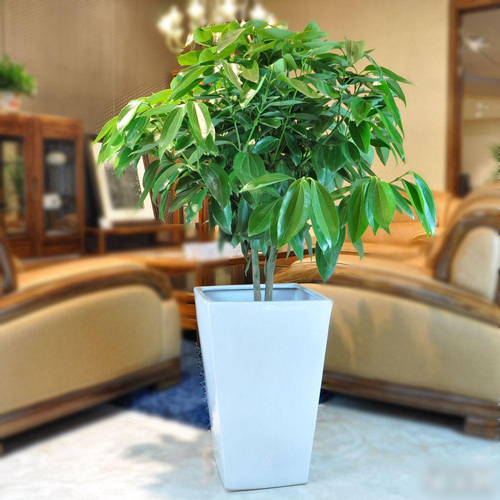
2. Temperature
The suitable growing temperature for the Peace Tree is around 25°C. It is not cold-tolerant and tolerates low temperatures below zero, otherwise it easily causes the bark to freeze and crack and the branches and leaves to wither, and the sapling will freeze to death roots and all.
3. Watering
It likes moisture. Normally, water when half of the pot soil surface has dried. In dry weather, frequently spray or mist the leaf surface. In winter, water after about half of the pot soil has dried. The Peace Tree likes an environment with fairly high air humidity; generally, only when the relative humidity is greater than 80% can it grow vigorously. In summer or the dry autumn, and even when placed indoors in winter, the leaves should be sprayed with water frequently to create a relatively moist spatial environment for it. If water accumulates in the pot, it easily leads to root rot, so we must water in moderation.
4. Soil
Potted Peace Trees should use loose, fertile, well-drained acidic soil that is also rich in organic matter. Soil that is compacted and clayey, or that lacks enough acidity, has poor drainage, or has compacted pot soil, may all lead to fibrous root rot, causing the plant's leaves to yellow and growth to be poor. Leaf mold soil can be used for cultivation.
5. Repotting
Small Peace Trees should be repotted once a year, while large ones should be repotted about once every 2 years on average.
6. Fertilizing
The Peace Tree relatively likes fertilizer. During the growing season, apply a compound quick-acting fertilizer once a month, and after autumn begins, apply phosphorus and potassium fertilizer 1 to 2 times.
How to Grow and Care for the Peace Tree: Methods and Precautions How to Grow and Care for the Peace Tree: Methods and Precautions
[Related Reading]
? Floor mat brands
? Soundproof curtains
? How are air beds
? How to Grow and Care for Alocasia macrorrhizos
The bark of the Peace Tree is a medicinal material and has the effect of dispelling wind and dispersing cold, and it is also very effective for relieving pain and resolving blood stasis. The flower language of the Peace Tree: praying for peace, everything going as wished, and family happiness. People are also eager to learn the Peace Tree's growing methods and precautions. The editor brings you the Peace Tree's growing methods and precautions?
1. Pot soil selection: In the Peace Tree's growing methods and precautions, the choice of pot soil is very important. The soil must be fertile, and the pot must have drainage holes. It should be able to drain, and choose loam containing acidic sand. If the leaves of the grown plant turn yellow, it means the soil's acidity is too low and the soil's stickiness is too heavy. When the leaves of the grown plant turn yellow, budding will slow down, thereby affecting the plant's growth lifespan.
2. Suitable growing temperature: In the Peace Tree's growing methods and precautions, the choice of temperature alone is something many people easily overlook. The optimal temperature is 22°C to 30°C. In the winter in the north, if there is heavy snow or frost, good insulation measures must be taken for the Peace Tree to prevent the bark from freezing and cracking and the branches and leaves from withering, and in severe cases it may freeze to death.
3. Sunlight exposure requirements: The Peace Tree's growing methods and precautions, and sufficient sunlight, are basic conditions for every plant. Any green plant needs good light for photosynthesis. Only then can it grow healthily. As a light-loving plant, the Peace Tree is also very afraid of strong sunlight exposure, so in summer do not expose the Peace Tree to the sun.
4. Growing and fertilizing knowledge: When the Peace Tree begins to sprout, fertilize once each month. But during fertilization, do not apply too much; just a thin layer is enough. Too much fertilizer will burn the Peace Tree. It shows as leaves turning yellow, and in severe cases until death.
1. If a small number of diseased leaves appear, promptly remove and burn them; avoid the whole leaf turning yellow and wilting, which causes the plant to drop a large number of leaves.
2. If water accumulates in the pot soil, it easily causes the plant to yellow, and the lower leaves to yellow and then fall off; in severe cases it causes the plant's roots to rot and death.
3. The appearance of brown spots may be infection with brown spot disease. The causes are poor indoor ventilation, high temperature and high humidity, and insufficient light.
4. Improper fertilization, or applying too much or too concentrated fertilizer, causes nutrient imbalance, and the fibrous roots lose water, shrink, and then necrose.
Conclusion: After reading the Peace Tree's growing methods and precautions introduced by the editor, do all you friends who love growing flowers and plants have some insights? The Peace Tree is a plant with great ornamental value; it not only beautifies the environment but can also purify the air.
▽Latest Information Articles▽
◇ ▏How to Grow and Care for Gardenia ▏European Royal Cross-Stitch ▏What to Do When Asparagus Fern Leaves Turn Yellow ▏Modern Abstract Painting ▏◇
◇ ▏What Plants Absorb Formaldehyde ▏Wall Art Paint Liquid Wallpaper ▏Indoor Plant Pictures and Names ▏Iris Flower Language ▏◇
◇ ▏How to Grow and Care for Narcissus ▏Cross-Stitch Nian Nian You Yu ▏What Is the Flower Language of Cornflower ▏Chongqing Carpet Cleaning ▏◇
◇ ▏Best Cross-Stitch Brands ▏What Fabric Is Chiffon ▏What Brand of Down Quilt Is Good ▏ Lithops ▏◇
◇ ▏Is Liquid Wallpaper Good ▏Cross-Stitch Brand Rankings ▏ Bedroom Hand-Painted Wall Pictures ▏ Statice ▏◇
How to Grow the Peace Tree
The Peace Tree is a Cinnamomum kotoense with an auspicious meaning. It has a graceful form and small leaves. The Peace Tree is a very precious and beautiful potted plant. We can also write our wishes for peace on cards and hang them on the tree to pray for peace, which is also a kind of spiritual sustenance. We can grow it indoors or in front of the door, which gives a feeling of representing peace. Every ornamental plant has its own flower language, and the Peace Tree's flower language is: begging for peace, family happiness, and everything going as wished. So, do you all also very much want to grow a Peace Tree with such beautiful blessings? Now the editor can tell you the Peace Tree's growing methods! Those who want to grow one must not miss it.
How to Grow the Peace Tree1. The Peace Tree is a high-temperature plant, and its living environment should be around 25°C. Young trees are not cold-tolerant, so when first growing it, it is best to choose spring.
2. In winter, the Peace Tree should be moved back indoors for growing, and when summer temperatures are too high, it needs watering.
3. The Peace Tree needs fairly good sunlight, and it is also relatively shade-tolerant. Its sunlight requirements differ as the sapling grows. When it is a seedling, it can grow in a cool place, and after about 4 years of growth, once it has grown large, it needs sufficient sunlight, which allows it to grow better.4. After autumn begins, the amount of watering should be controlled. If water accumulates in the pot soil, it easily causes the lower leaves of the sapling to yellow and then fall off, and in severe cases it causes the plant's roots to rot and death. So pay attention to this point.