How to Grow and Care for Spathoglottis pubescens: Cultivation Methods and Precautions
1. Light
Spathoglottis pubescens loves shade and generally grows in deep mountains and secluded valleys, so when cultivating it, place it in semi-shade or a spot with short daylight hours, and let it absorb as much scattered light as possible.
2. Soil
Spathoglottis pubescens has fleshy roots and does best in sandy loam rich in humus. You can use leaf mold, slightly acidic loose soil, or iron-containing soil to grow Spathoglottis pubescens.
3. Temperature
The suitable growing temperature for Spathoglottis pubescens is 15-30°C. Too high a temperature will hinder the plant's growth, and temperatures below 5°C will cause the plant to go dormant and stop growing.
4. Watering
Spathoglottis pubescens likes moisture, especially during the peak growth period in summer. Water when the soil is dry; keep it moist but not soggy, and keep the soil slightly on the dry side.
5. Fertilizer
Spathoglottis pubescens can be given some farmyard manure, but it must first be piled up and composted for a year before use. The fertilizer can be diluted with water and poured on, taking care not to let it touch the roots or leaves.
How to Grow Spathoglottis pubescens: Cultivation Methods for Spathoglottis pubescens
How to grow Spathoglottis pubescens? Many people are not very familiar with Spathoglottis pubescens. It is distributed in China, northeastern India, Myanmar, Cambodia, Vietnam, Laos and Thailand. This flower is cultivated, so let us take a detailed look at the relevant knowledge about Spathoglottis pubescens below.
Introduction to Spathoglottis pubescens
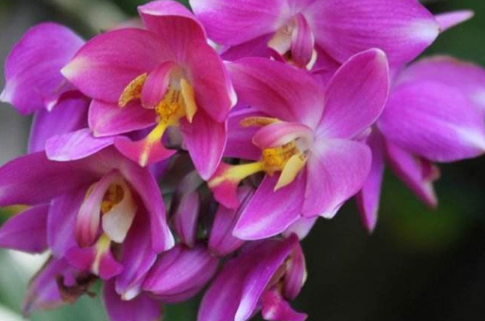
Spathoglottis pubescens (scientific name: Spathoglottis pubescens Lindl.): The pseudobulbs are flattened and spherical, usually 1-2.5 cm thick, covered with leathery scale-like sheaths, and bear 1-3 leaves at the apex. The leaves are strap-shaped or narrowly lanceolate, hairless on both sides. The flowering stem is slender or stout, up to 50 cm long, densely covered with soft hairs, with the lower part enclosed by several tubular sheaths that clasp the inflorescence stalk tightly; the raceme is 2-9 cm long, loosely bearing 2-8 flowers; the flowers are yellow; the sepals are elliptical, with 7 veins, and the back is covered with soft hairs; the petals are broadly oblong, equal in length to the sepals, 9-10 mm wide, with obtuse tips, bearing 5-6 main veins, with the outer main veins branching, and hairless on both sides; the lip is about equal in length to the petals and 3-lobed. The flowering period is July to October.
Spathoglottis pubescens grows in mountain slope grasslands or under sparse forests at an altitude of 380-1700 m. It is distributed in China, northeastern India, Myanmar, Cambodia, Vietnam, Laos and Thailand. This flower is cultivated and has high horticultural value.
I. Morphological Characteristics
Stem: The pseudobulbs of Spathoglottis pubescens are flattened and spherical, usually 1-2.5 cm thick, covered with leathery scale-like sheaths, and bear 1-3 leaves at the apex.
Leaves: The leaves of Spathoglottis pubescens are strap-shaped or narrowly lanceolate, up to 43 cm long and 1-1.7 (-4-5) cm wide, with acuminate tips and bases narrowed into slender stalks, hairless on both sides.
Flowering stem: The flowering stem of Spathoglottis pubescens is slender or stout, up to 50 cm long, densely covered with soft hairs, with the lower part enclosed by several tubular sheaths that clasp the inflorescence stalk tightly; the raceme is 2-9 cm long, loosely bearing 2-8 flowers; the floral bracts are lanceolate or ovate-lanceolate, 5-9 mm long, covered with soft hairs; the pedicel and ovary are 2-2.5 cm long, densely covered with soft hairs; the flowers are yellow; the sepals are elliptical, usually 12-17 mm long and 5-7 mm wide, with slightly obtuse or acute tips, bearing 7 veins, and the back is covered with soft hairs.
Petals: The petals of Spathoglottis pubescens are broadly oblong, equal in length to the sepals, 9-10 mm wide, with obtuse tips, bearing 5-6 main veins, with the outer main veins branching, and hairless on both sides; the lip is about equal in length to the petals and 3-lobed; the lateral lobes are upright, sickle-shaped and oblong, about twice as long as wide, with rounded or truncate tips, and the space between the two lateral lobes is sunken and sac-like; the mid-lobe is obovate-cuneate, about 1.3 cm long, with a nearly truncate tip and a notch, and a claw at the base; the claw is short and wide, bearing a pair of semicircular, fleshy appendages on top, and sometimes with one slightly raised blunt tooth on each side at the base; the lip disc bears 3 longitudinal keeled ridges, of which the central one is raised into a fleshy lamella; the column is 8-10 mm long; the rostellum is nearly circular.
The flowering period of Spathoglottis pubescens is July to October.
II. Ecological Habits
Spathoglottis pubescens generally grows on mountain slopes and valley walls in deep mountains and secluded valleys, on inclined slopes or in rock crevices with good water permeability and water retention, beside sparse mountain grasses, and in the shade of secondary mixed forests. Or in places with shade, short sunshine hours, or only scattered light filtering through. It grows in places with high air humidity and good air circulation, and sometimes also on cliffs beside mountain streams. Orchids are best planted in an environment with good air circulation. They love shade and avoid direct sunlight; they like moisture and avoid dryness; 15°C to 30°C is the most suitable for growth. Growth is poor above 35°C. Severe cold below 5°C will affect their growth capacity, and at this time the orchids are often in a dormant state. If the temperature is too high and combined with exposure to the sun, leaf scorch or withering will appear within one or two days. If the temperature is too low and they are not moved indoors in time, frost damage will occur. Orchids have fleshy roots and are suited to sandy loam rich in humus, and the drainage performance must be good; leaf mold or mountain soil with more humus should be chosen. Slightly acidic loose soil or iron-containing soil is suitable, with a pH value of 5.5-6.5 being ideal.
Cultivation Methods for Spathoglottis pubescens
I. Cultivation Techniques for Spathoglottis pubescens
1. Orchid shed
The orchid shed and orchid room should be chosen in a place facing east with its back to the west, with an open area to the southeast and a high wall or large tree to the west and north. It should be able to receive the early sun while blocking the scorching sun. The surrounding microenvironment should have clean air, and the courtyard should have a certain degree of humidity. Pay attention to ventilation, receiving dew, avoiding the scorching sun, and avoiding smoke. If built on a roof or a balcony on an upper floor, in addition to shade above, curtains should mainly be hung on the northwest side to prevent the slanting light of the afternoon setting sun from burning the grass leaves. It is best to use a mud floor beneath the orchid shed or set up a clear water pool below to keep the air around the orchid shed humid. Also pay attention to ground cleanliness to prevent the breeding of pests and diseases. When the outdoor temperature drops to around 0°C, the orchid pots must be moved indoors to prevent frost damage to the orchid roots. In winter, if the weather is clear, the temperature in the orchid room can exceed 15°C; only when the weather is cloudy, rainy, windy or snowy does the room temperature drop, and at this time heating and additional light should be provided to keep the room temperature at 15°C. No heating is needed at night; maintaining 5°C is sufficient. Heating can be carried out in late autumn and early winter, with the aim of prompting the new plants of that year to fully mature. After mid-December to the end of January, however, heating is not needed; just keep the room temperature no lower than 5°C and let vegetative growth remain in a very slow state. From February onward, increase humidity and temperature and provide sufficient light to make the orchids enter the growth period early. After heating, new shoots sprout early; generally, after 45 days of heating, new shoots emerge from the soil. After another 90 days, they can become mature plants. By mid-June, the second batch of new shoots emerges again, thus achieving the effect of growing two batches of new seedlings in one year. When heating in winter, note that light must be added, but never heat continuously for 24 hours so that there is no temperature difference. In addition, heating should not be too high; exceeding 25°C is harmful rather than beneficial.
2. Potting
The time for potting (or repotting) is generally March-April in spring or October-November in autumn. Flower pots with a small mouth, deep body, and large bottom hole are best. Wild seedlings newly dug from the mountains need to be planted in clay pots (earthen pots), so that the orchid soil dries easily, has good aeration, and roots form easily; only after 2-3 years can they be transferred to purple clay pots or porcelain pots. The method of planting orchids (in pots) differs from that of ordinary flowers, especially for famous orchid varieties, where roots must be washed when repotting and transferring. The method is to soak the roots in clean water and gently scrub them with an old toothbrush or writing brush, never using too much force, which would damage the roots; use scissors to cut off residual leaves, yellow leaves, broken roots, and blackened, rotting roots, taking care not to damage young shoots. Then place the treated plant in a cool, ventilated place to dry, and when the roots turn white and show fine wrinkles and become soft, plant them in the pot.
Method One
After preparing the orchid pot and planting medium, hold the orchid plant upside down (roots up, leaves down) and rinse it under a faucet with slow water, but never with too strong water pressure, so as not to damage the orchid roots and leaves. Grasp the orchid head with your thumb and index finger, brace your little finger against the rim of the pot, and use a bamboo chopstick to secure the roots; when placing it into the pot, try not to let the roots touch the pot wall. Pour bean-sized mixed gravel into the bottom of the pot to one third of its depth. Then pour in medium-grained planting medium to four fifths of the depth, filling it firmly and trying not to leave any gaps. Pull out the bamboo chopstick and shake the planting medium in the pot firmly. After filling the medium firmly, add large-grained planting medium up to 1.5 cm from the pot rim. Finally, pour in bean-sized planting medium until the pseudobulbs are completely buried in the soil, then shake firmly. Use a soil-pressing tool to gently press the planting medium and smooth the surface. After planting is complete, it is best for the planting medium in the pot to be slightly higher in the center.
Method Two
Pay attention to drainage at the bottom of the pot. For clay pots, fill with broken tiles; for purple clay pots, the bottom of the pot must be covered with perforated nylon gauze. Before planting, first spread coarse stones in the pot, occupying about 2/5 of the pot depth, then coarse stone culture soil, 3-5 cm thick, and then place the orchid plant in. When potting, make sure the roots spread out naturally and do not curl. When planting famous orchid varieties, be sure to place the old growths toward the edge and the new growths in the center, so that there is room for new growths to develop later. When planting, hold the orchid plant with your left hand and add soil with your right hand (be careful to prevent soil from entering the heart of the leaves), then lift the orchid plant slightly so that the roots spread naturally. Then add soil while shaking the pot so that the soil and roots are in close contact. Then use your hands to press the soil firmly around the stem, and finally make the pot surface slightly mound-shaped (that is, slightly lower in the middle and around the edges). Cover the surface with a layer of moss or fine gravel, so that the potting soil is less likely to harden and water evaporation can be reduced. After potting, water immediately. The first watering should be generous. Finally, place the orchid pot in a shady place. Within one month, it should not be exposed to direct sunlight, and watering should be controlled so that it is not too wet. Afterward, the placement location should be chosen in a spot with half shade and half sun, good ventilation, and morning sunlight.
3. Watering
During the peak growth period of orchids, once there is a water shortage in summer, the potted orchids will grow poorly. Orchids need eight parts dry and two parts wet. Watering should follow the principle of "water when dry, stop when wet, and keep appropriately on the dry side." Watering must soak through; do not give only a half watering. The number of waterings can depend on the planting medium of the potted orchid. For hard, well-draining media such as volcanic rock, red brick granules, and pumice, water once a day; for media with strong water absorption such as pond mud and humus soil, water once every two or three days. Watering is generally done in the early morning or evening, and never at noon or poured directly onto the crown. Clean, pollution-free, slightly acidic water (pH 5.5-6.5) is best. Orchid root rot, black spots on the leaf surface, rotting leaf buds and other abnormal conditions are mostly related to improper watering.
After a flowering plant is planted, the first watering is called "root-setting water." The root-setting water must be sufficient and thorough. Generally, after potting, water twice in succession; for the first watering, after seeing water flow out of the bottom hole of the pot, water again. Choose a suitable watering method. Usually the spray watering method is used, which can both increase air humidity and wash dust off the leaf surface. However, for flowers with fuzzy leaves or those currently blooming, spray watering is not suitable; instead, place the entire flower pot in a water basin, making sure the water does not cover the pot rim, and use seepage through the bottom hole to moisten the potting soil. Pay attention to water temperature. If the water temperature differs greatly from the soil temperature (more than 6°C), in winter first leave the water indoors for a while, or add a little warm water to raise the water temperature to about 15°C before watering the flowers; in summer, avoid watering under the scorching sun and during the high temperatures at noon. Watering time: in spring, autumn and winter, around 10 a.m. and after 4 p.m. are the most suitable times to water flowers.
4. Fertilizing
Farmyard manure is a very good organic fertilizer, but it must be piled up and composted for more than a year before it can be applied. This kind of fertilizer liquid can be diluted 10-20 times with water and poured on, as much as possible along the edge of the pot, not touching the roots and not touching the orchid leaves. When applying chemical fertilizers, pay attention to the balance of nitrogen, phosphorus and potassium, and strictly control the concentration. For variegated-leaf seedlings, the synthesis of chlorophyll should be controlled, so nitrogen fertilizer should not be applied, nor should fertilizers containing manganese and magnesium (such as calcium magnesium phosphate fertilizer, etc.), because manganese and magnesium elements can accelerate the synthesis of chlorophyll. For flowering orchids, if cultivating large-petaled flowers, an appropriate amount of nitrogen fertilizer can be added. Foliar feeding is the main method. Foliar feeding can both supplement the orchid plant's nutrition through absorption by the orchid leaves and avoid fertilizer damage caused by fertilizer touching the roots, making it the best fertilizing method for orchids. As long as during the growth and development period you persist in foliar feeding about once every 10 days, you can completely grow orchids well without needing to fertilize in the pot. You can use 1:1000 monopotassium phosphate and 1:1000 boron fertilizer, or aloe liquid. This is because aloe contains large amounts of nutrients such as polysaccharides and amino acids, and contains more than twenty kinds of minerals, which can satisfy the nutrients needed by orchids, and the aloe contains aloe emodin, which can kill almost all bacteria and viruses, so after application there is no need to apply pesticides to prevent disease. Fertilizing should be frequent and light, eating little but often: orchids do not need much fertilizer during the growth and development period. For vigorous, healthy orchid plants, apply a dilute liquid fertilizer once every 10-15 days. Natural organic matter should be the main choice. Natural organic fertilizers have relatively comprehensive nutrient elements, so no other fertilizers need to be applied, and they are mild in nature with no side effects on plants, whereas chemical fertilizers easily harden the substrate, and most chemical fertilizers are acidic, so long-term application will make the substrate too acidic and cause disease.
II. Propagation Methods for Spathoglottis pubescens
Division propagation
This can be done in both spring and autumn, generally dividing once every three years. Any plant that grows vigorously and has densely clustered pseudobulbs can be divided, and after division each clump must retain at least 5 pseudobulbs connected together. Before division, reduce watering to make the potting soil relatively dry. When potting after division, first cover the bottom hole of the pot with broken tile pieces, then spread coarse stones, occupying 1/5 to 1/4 of the pot depth, then place coarse-grained soil and a small amount of fine soil, and then plant with sandy loam rich in humus. The planting depth should be just enough to bury the pseudobulbs in the soil, leave a 2 cm rim at the edge of the pot, cover the surface with Selaginella uncinata or fine gravel, and finally water thoroughly, place in a shady place for 10-15 days, keep the soil moist, gradually reduce watering, and carry out normal care.
III. Disease and Pest Control for Spathoglottis pubescens
(I) Disease control
1. Sheath rust fungus
Usually on the upper and lower surfaces of the leaves, and less often on the stems, raised small pustules appear, containing yellow, orange, rust-colored or even purple-black powdery spores. Rust disease is not fatal, and the leaves will not die, but it weakens the plant's growth. In addition to cutting off diseased leaves, the control method is to spray with a 500-600 times solution of 65% zineb powder or a copper-containing fungicide.
2. Southern blight
It mostly occurs in the moldy rainy season. At the initial stage of the disease, the leaf base is covered with white mycelium, causing the rhizome to rot. Control method: remove the infected potting soil and sprinkle on quintozene powder or lime. Thorough treatment method: pay attention to ventilation and light transmission, and good drainage of the potting soil. Severely diseased plants should be burned.
3. Anthracnose
It occurs throughout the year, and is more rampant in hot, rainy seasons, with Cymbidium ensifolium being especially susceptible. The lesions first extend from the leaf tip toward the rhizome, initially brown, then gradually expand and increase, with many dry black spots appearing, and in severe cases causing the whole plant to die. Control method: in addition to actively improving environmental conditions, during the disease period, first spray with an 800-**** times solution of 50% thiophanate-methyl wettable powder, once every 7-10 days; then supplement with 1% Bordeaux mixture of equal amounts, once every half month, spraying continuously 3-5 times.
(II) Pest control
Scale insects
Commonly known as "orchid lice." They reproduce fastest under conditions of high temperature, high humidity, and poor air circulation. During the hatching period, spray with 1% omethoate or 1500 times 50% malathion. If there are not many pots, they can also be removed manually by brushing.
How to Grow and Care for Spathoglottis pubescens: Cultivation Methods and Precautions
Chinese name: BaoshelanLatin scientific name: Spathoglottis pubescens Lindl.Kingdom: PlantaeDivision: AngiospermsClass: MonocotyledonsOrder: MicrospermaeFamily: OrchidaceaeSubfamily: OrchidoideaeTribe: EpidendreaeGenus: SpathoglottisSpecies: Spathoglottis pubescensNaming authority and year: Lindl.,Spathoglottis pubescens (scientific name: Spathoglottis pubescens Lindl.): The pseudobulbs are flattened and spherical, usually 1-2.5 cm thick, covered with leathery scale-like sheaths, and bear 1-3 leaves at the apex. The leaves are strap-shaped or narrowly lanceolate, hairless on both sides. The flowering stem is slender or stout, up to 50 cm long, densely covered with soft hairs, with the lower part enclosed by several tubular sheaths that clasp the inflorescence stalk tightly; the raceme is 2-9 cm long, loosely bearing 2-8 flowers; the flowers are yellow; the sepals are elliptical, with 7 veins, and the back is covered with soft hairs; the petals are broadly oblong, equal in length to the sepals, 9-10 mm wide, with obtuse tips, bearing 5-6 main veins, with the outer main veins branching, and hairless on both sides; the lip is about equal in length to the petals and 3-lobed. The flowering period is July to October. It grows in mountain slope grasslands or under sparse forests at an altitude of 380-1700 m. It is distributed in China, northeastern India, Myanmar, Cambodia, Vietnam, Laos and Thailand. This flower is cultivated and has high horticultural value.1. Morphological Characteristics
The pseudobulbs of Spathoglottis pubescens are flattened and spherical, usually 1-2.5 cm thick, covered with leathery scale-like sheaths, and bear 1-3 leaves at the apex. The leaves are strap-shaped or narrowly lanceolate, up to 43 cm long and 1-1.7 (-4-5) cm wide, with acuminate tips and bases narrowed into slender stalks, hairless on both sides. The flowering stem is slender or stout, up to 50 cm long, densely covered with soft hairs, with the lower part enclosed by several tubular sheaths that clasp the inflorescence stalk tightly; the raceme is 2-9 cm long, loosely bearing 2-8 flowers; the floral bracts are lanceolate or ovate-lanceolate, 5-9 mm long, covered with soft hairs; the pedicel and ovary are 2-2.5 cm long, densely covered with soft hairs; the flowers are yellow; the sepals are elliptical, usually 12-17 mm long and 5-7 mm wide, with slightly obtuse or acute tips, bearing 7 veins, and the back is covered with soft hairs.The petals are broadly oblong, equal in length to the sepals, 9-10 mm wide, with obtuse tips, bearing 5-6 main veins, with the outer main veins branching, and hairless on both sides; the lip is about equal in length to the petals and 3-lobed; the lateral lobes are upright, sickle-shaped and oblong, about twice as long as wide, with rounded or truncate tips, and the space between the two lateral lobes is sunken and sac-like; the mid-lobe is obovate-cuneate, about 1.3 cm long, with a nearly truncate tip and a notch, and a claw at the base; the claw is short and wide, bearing a pair of semicircular, fleshy appendages on top, and sometimes with one slightly raised blunt tooth on each side at the base; the lip disc bears 3 longitudinal keeled ridges, of which the central one is raised into a fleshy lamella; the column is 8-10 mm long; the rostellum is nearly circular. The flowering period is July to October.
2. Origin and Habitat
It grows in mountain slope grasslands or under sparse forests at an altitude of 380-1700 m. It is produced in China in Zhejiang (Longquan), Jiangxi (Wugong Mountain, Anfu, Jinggangshan, Xunwu, Shicheng), Fujian (Pinghe, Longyan, Shanghang, Yongding, Liancheng, Taining, Changting), Hunan (Yizhang, Qianyang), Guangdong (Shantou, Meixian, Ruyuan, Xinyi, Luofu Mountain, Yingde, Zhaoqing and other places), Hong Kong, China, Guangxi (Rongshui, Longsheng, Hexian, Jinxiu and other places), Sichuan (Leshan, Tianquan, Mabian, Butuo, Miyi, Mount Emei, Ebian and other places), Guizhou (Panxian, Xingren, Xingyi, Mount Fanjing and other places) and Yunnan (Mengzi, Menghai, Simao). It is also distributed in northeastern India, Myanmar, Cambodia, Vietnam, Laos and Thailand. The type specimen was collected from northeastern India.