How to propagate Oncidium? A detailed guide to common propagation methods
Division propagation
Oncidium is a sympodial type of orchid, and mature plants will have offsets. Division propagation can only be carried out once the pseudobulbs of the offsets have grown. Generally, pseudobulbs with two buds are cut off and planted directly in a pot with sphagnum moss, kept moist, which better promotes root growth.
Tissue culture
Tissue culture requires waiting for young shoots to grow from the base of the Oncidium. First, the surface of the young shoots must be disinfected with 70% alcohol. After disinfection, they can be rinsed with sterile water, the stem tips cut, and inoculated onto the culture medium. Keep them in a warm environment, and they will generally sprout in 20 days. This propagation method has high requirements and is not suitable for ordinary flower growing.
Hydroponic culture
Hydroponic culture of Oncidium has relatively high technical requirements and is generally carried out at professional hydroponic flower bases, allowing the Oncidium to grow water roots and adapt to the water environment. Hydroponic Oncidium is also very elegant and graceful, and looks very clean and beautiful placed in a home or office.
How to grow Oncidium
1. Soil
Oncidium needs naturally airy, fertile soil. Before planting, a layer of broken tiles can be placed at the bottom of the pot, and the soil is commonly a mix of bark, fern roots, sphagnum moss, charcoal, etc.
2. Light
Oncidium likes a semi-shaded environment, and the light should not be too strong or too weak, otherwise flowering will be affected. In summer it needs shading to avoid scorching, and in winter it can receive full light all day.
3. Temperature
Because Oncidium varieties differ, their suitable growing temperatures also differ. The suitable growing temperature for thick-leaved varieties is 18~25°C, and it must not go below 12°C; the suitable temperature for thin-leaved varieties is 10-22°C, and the minimum must not go below 8°C.
4. Watering
Oncidium relatively prefers dryness. Water as soon as the soil surface is slightly dry, but there must be no standing water. In winter, reduce the amount and frequency of watering, and the water used should not be too cold.
5. Fertilizing
Because Oncidium [grows actively] in spring and autumn, apply organic fertilizer once every half month, which can be poured on the roots or leaves. Because winter temperatures are low, there is no need to fertilize.
How to grow Oncidium
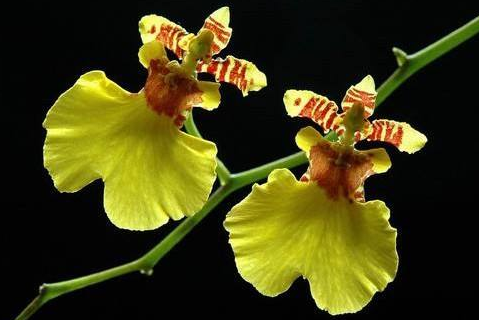
Oncidium, also known as jixiang orchid, dancing orchid, dancing-lady orchid, golden butterfly orchid, tuberculate-lipped orchid, etc., has 1~3 leaves and can be divided into thin-leaved types, thick-leaved types and sword-leaved types. Grasp its growth habits and let it adapt to the climate environment you are in, and growing Oncidium well is still not difficult.
Key points of this article
Oncidium
Soil: For the Oncidium growing medium I generally use pure sphagnum moss, or a mix of wood chips, granular orchid stone and a small amount of peat soil. When planting, the pseudobulbs must be left exposed, because they are aerial roots; if the pseudobulbs are buried underneath, it is very difficult for them to grow vigorously, and producing small shoots is also difficult this way.
Temperature: The winter temperature should not be lower than 15°C, and the air humidity should be around 80% in all four seasons. In dry seasons, spray water on the plants every day, and keep the growing medium in the pot moist. In the humid plum rain season of summer, do not give too much water, otherwise root rot easily occurs (if root rot is found, the prompt remedy is to take the plant out to dry, spray with carbendazim, and then replant).
Fertilizing: During growth, apply fertilizer once every half month. At the seedling stage, nitrogen fertilizer is the main type, and for mature plants, phosphorus and potassium fertilizer is the main type. The roots have a poor ability to absorb fertilizer, so fertilizing should be dilute, and concentrated fertilizer must be avoided; fertilizer that is too concentrated will make the leaves turn yellow and thin, and can even cause root rot and withering. Fertilizing should be stopped during the flowering period, winter and summer. I occasionally sprinkle some compound fertilizer into the flower pot, and before flowering, spray diluted phosphorus fertilizer water on the plants or roots.
Light: In spring, summer and autumn, a semi-shaded environment is needed; in winter, full sunlight can be given, but never expose it to the scorching sun of midsummer. During the flowering period, in order to extend the flowering period and let its fragrance linger in the room for a few more days, it is best to place it somewhere where the temperature is not too high and the sunlight does not reach, and at this time give less water. My Oncidium's longest flowering period was nearly one month.
Propagation: Oncidium is mostly propagated by division. Generally, do not water immediately after division; when it is slightly dry, spray some water on the leaves, and wait until new roots grow before watering, then spray some balanced fertilizer, but the concentration must not be too high, generally 0.6% to 0.8%. During care, water must not be given too much, as this easily causes root rot, and attention should be paid to ventilation and light.
Note: 1. Oncidium is prone to black spot disease. I generally cut off the spotted leaves and spray carbendazim twice a week, and the ventilation environment should be good.
Note: 2. Normally, water again when the substrate is about half dry. It likes high air humidity. During dry periods, frequently spray water on the leaves, and it is best to place the flower pot on a shallow saucer containing pebbles and water.
Note: 3. Repotting is usually carried out after flowering. For plants that have not flowered, it can be done before the growth period, such as in early spring or after autumn when the weather turns cool. The growing material should be replaced at the same time, and repotting can be combined with division.
Precautions
Suitable light, temperature, water and fertilizer