What are the key points to note when growing a Peace Lily tree?
1. Prune promptly. If the branches and leaves are too dense, you need to regularly clean up and remove leaves and prune away branches to keep good ventilation.
2. Pay attention to pruning timing. It can be pruned in all four seasons, but spring or autumn is the period of vigorous growth for the Peace Lily tree. If you prune at this time, it will easily send out new branches. In spring, when the temperature is 20°C, prune, cutting some branches shorter to increase the number of branches, but note that when pruning, the distance from the cut to the bud eye at the node should be larger, otherwise it will lose water and cause the branch to wither. Also, the cut must be smooth and must not be torn.
3. The main factor causing the leaves of the Peace Lily tree to turn black is damage from pests and diseases. Among these, brown spot disease is the most important disease. This disease generally occurs when indoor ventilation is poor, when it is stuffy and highly humid, or when there is insufficient light. At first, some brown spots appear on the leaves, and afterward they continuously expand, and many small black dots also appear on the leaves. April to May each year is when the disease is most severe. We should usually observe the leaves of the Peace Lily tree and deal with problems promptly when found.
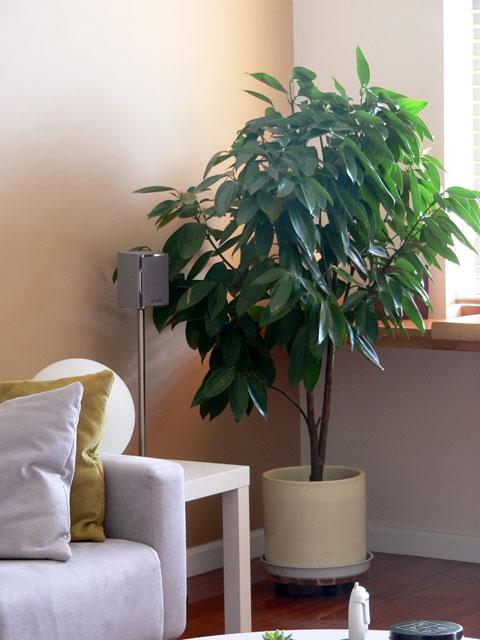
How to grow a Peace Lily tree and key points to note; key points to note when growing a Peace Lily tree
Fertilizing the Peace Lily tree
The Peace Lily tree has fairly high fertilizer requirements. From spring to autumn, the Peace Lily tree should be given 1 application of thin cake fertilizer each month. After autumn begins, phosphorus and potassium fertilizer needs to be applied 2 times in a row. This can increase the plant's cold resistance, promote early lignification of new branches and tender shoots, and enable it to overwinter safely.
After winter begins, all fertilizing should be stopped to prevent fertilizer from damaging the plant's root system, which would cause the leaves to turn yellow or wither and drop.
How to water a Peace Lily tree
We all know that the Peace Lily tree likes a growing environment with good conditions and is not tolerant of drought, so the potting soil must maintain a certain humidity. The number of waterings is determined according to the different seasons. On the surface, when the topsoil is a bit dry, it needs watering.
In dry weather conditions, the leaves need to be sprayed with water. In summer, keep watering once a day. After the Peace Lily tree enters autumn, the amount of watering should be controlled well. In winter, spray water more and water less. If there is standing water in the potting soil, it will cause the plant to turn yellow.
Key points for propagating the Peace Lily tree
The Peace Lily tree is mostly propagated by sowing. In southern regions, during September to October, planting is usually done mainly by drilling furrows and sowing in spots. When the seedlings grow 3-4 true leaves, liquid fertilizer should be applied once a month. Stop fertilizing after autumn, do a good job of cold protection, and overwinter at an indoor temperature of no lower than about 5°C.
Key pruning techniques for the Peace Lily tree
The Peace Lily tree is pruned in spring. When the temperature is 20°C, cut some branches shorter to increase the number of branches. The cut should be smooth, and pinching should be done promptly to encourage multiple branch buds and avoid imbalanced growth of the plant. Practice has shown that for Peace Lily trees grown in the north, the effect of timely pinching is much better than pruning.
Replacing the potting soil of a Peace Lily tree
During the growing season, potted Peace Lily trees should have their soil loosened once a month to maintain normal development of the roots and keep the root system in a well-aerated state. Small Peace Lily trees can be repotted once a year, while large ones should be repotted once every 2-3 years. During repotting, all dead root systems should be cut off to ensure normal growth and development of the plant.
How to grow a Peace Lily tree; key points to note when growing a Peace Lily tree
In China, many plants and flowers have names with very beautiful meanings, and the Peace Lily tree is one of them. The real name of the Peace Lily tree is Lanyu cinnamon (Cinnamomum kotoense), which belongs to the evergreen Lauraceae family. Its trunk is upright, yellowish-green in color, smooth, and without down. The upper surface of the leaves is bright green with a metallic-like luster, while the underside is grayish-green. Below, we will explain the growing methods and key points to note for the Peace Lily tree, hoping it can help everyone.
How to grow a Peace Lily tree
Potting soil selection: For potted Peace Lily trees, the potting soil should preferably be loose, fertile, well-drained, acidic sandy loam rich in organic matter. This is also the potting soil requirement for growing most indoor flowers. If the soil has heavy stickiness or low acidity, it will cause the leaves of the plant to turn yellow, reduce sprouting and renewal, and thereby affect the plant's growth lifespan.
Suitable growing temperature: The best temperature for the growth of the Peace Lily tree is 22°C to 30°C, and the lowest temperature must not be below 5°C. If there is freezing or consecutive frost days, good insulation work should be done to prevent the bark from frost-cracking and the branches and leaves from withering, and in severe cases it may freeze to death.
Moderate light. The Peace Lily tree not only likes sunlight but is also quite shade-tolerant. However, it must not be placed in direct sunlight for prolonged exposure. Especially in summer, when placed in the sun, a certain amount of shading is needed, and shading about 50 percent of its area is appropriate. Otherwise, sunlight may scorch the leaf surface. In winter, it can be exposed directly to sunlight without any shading.
Proper watering. The Peace Lily tree likes a moist environment and is not tolerant of drought. Its potting soil should remain relatively moist. In dry weather, spray water on the leaves. In summer, the leaves should be sprayed once a day, and the relative indoor air humidity should be maintained, preferably above 60 percent. When watering, water once first, then water again after half an hour. This can avoid the appearance of half-watering. The number of waterings is determined by the different seasons; water when the topsoil looks a bit dry.
Fertilizing. Except in winter, fertilize once every other month. Fertilizing in winter may harm the roots and stems.
Pest prevention. Aphids are likely to appear on the tender leaves and new buds of the Peace Lily tree. After spreading plant ash on the plant, rinse it clean with clear water; spraying chinaberry leaf juice can effectively kill insects; use a 2000-fold dilution of 10% imidacloprid wettable powder to spray and kill them.
Key points to note when growing a Peace Lily tree
There are 4 main points in growing a Peace Lily tree. The first point, light. In summer, the Peace Lily tree needs shading on its leaves, otherwise it will easily be scorched by sunlight. The second point, temperature. The Peace Lily tree likes warmth, and the most suitable temperature is 20 to 30 degrees. In winter, it is best not to place the Peace Lily tree outdoors; it should be moved indoors for growing. The third point, proper watering. The Peace Lily tree likes moist soil, so in summer it should be watered once a day. The fourth point, loosening the soil. When growing a Peace Lily tree, it is best to loosen the soil once a month, so the Peace Lily tree grows better.
Causes of yellowing leaves on the Peace Lily tree and solutions
In the process of growing indoor flowers, yellowing leaves are a relatively common phenomenon. The same is true in indoor cultivation of the Peace Lily tree; yellowing leaves are unavoidable. The main reasons for yellowing or dropping leaves on the Peace Lily tree include the following aspects:
First, due to accidents or special circumstances, the plant's root system is severely damaged, causing the leaves to turn yellow.
Second, the indoor temperature is below 5°C, causing yellowing and leaf drop in the Peace Lily tree due to freezing damage.
Third, excessive watering causes root rot at the bottom, thereby causing the plant to turn yellow and drop leaves.
Fourth, the water quality is too alkaline, causing the leaves to slowly turn yellow. This situation is relatively common in the north, especially in places such as **.
Fifth, improper fertilizing, with too much or too concentrated fertilizer, causes the nutrient fibrous roots to lose water, shrink, and die.
Sixth, prolonged exposure to strong sunlight causes the leaves to dry out and turn yellow.
The above is the explanation of the growing methods and key points to note for the Peace Lily tree. Is everyone clear now? For more home decoration knowledge, please follow.