What are the care methods for Agapanthus during its flowering period?
The flowering period of Agapanthus lasts about two months. The flowers of Agapanthus are especially beautiful, with deep blue and white blooms that are very lovely and captivating. Since the flowers are so beautiful, we naturally need to protect them so that we can enjoy them.
1. Light management
In summer, avoid prolonged exposure to sunlight so the plant is not scorched to death. Moreover, if the flower buds are sunburned, it will affect the blooming of Agapanthus.
In winter, it needs to receive plenty of sunlight to keep it warm.
2. Soil requirements
The soil should be loose, fertile sandy loam with a pH of 5.5-6.5, and waterlogging must be strictly avoided.
3. Fertilizing
During the flowering period of Agapanthus, apply some fertilizer appropriately to ensure that the flowers bloom even more brilliantly.
4. Temperature management
Agapanthus likes to grow in a relatively warm environment. In summer it requires cool conditions, without a feeling of intense heat. In winter it requires warmth so it is not frozen to death.
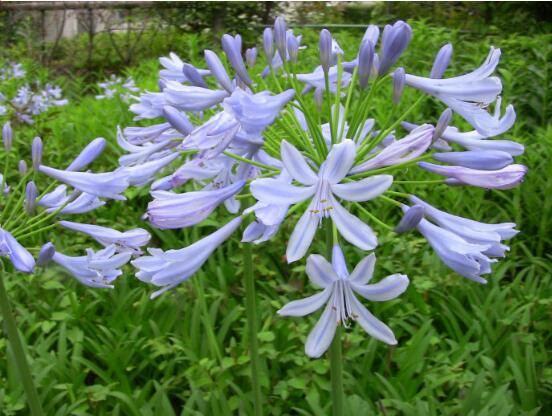
The flowering period of Agapanthus
Agapanthus flowering period
The flowering period of Agapanthus is in midsummer and lasts until early autumn. Its flowering period is considered long, generally two months from July to August. During this time, Agapanthus produces deep blue or white flowers that are bright and captivating. After mid-August, the flowers of Agapanthus will gradually wither until they fade.
Care during the flowering period of Agapanthus
The flowering period of Agapanthus is during July and August. The flowers are beautiful and captivating, so we naturally need to protect them so that we can enjoy them. Agapanthus likes warmth and moisture, so during the flowering period it is essential to maintain a warm environment and water moderately to keep the growing soil moist, but do not let water accumulate.
Light also affects the blooming of Agapanthus. During the summer flowering period, avoid direct strong sunlight so the flower buds are not damaged and blooming is not affected.
For fertilizing during the flowering period of Agapanthus, on the day before fertilizing, pause watering once so the potting soil can take up water. The fertilizer used can be manure, cake fertilizer and chemical compound fertilizer used alternately, or phosphorus fertilizer can be used before flowering. As long as sufficient fertilizer and water are provided, Agapanthus will bloom early and bloom well.
Alright, the editor has already told you about the flowering period of Agapanthus and its care during the flowering period. Hurry up and take action, and let your Agapanthus outshine all the other flowers.
How to plant Agapanthus? Cultivation and care tips for the elegant Agapanthus
Agapanthus is the clivia, but it is not an ordinary clivia. Its flower colors are enchanting, appearing in purple, white and blue, and its ornamental value is very high. It generally blooms in summer and is suitable for planting in courtyards or as a potted plant. Below are the cultivation and care tips for the elegant Agapanthus. Everyone, do not miss them.
Environment
Agapanthus likes a warm, moist environment with plenty of sunlight. In high temperatures, avoid prolonged direct strong light. It tolerates partial shade and fears waterlogging. It is slightly cold-tolerant but not tolerant of severe cold. The suitable growth temperature is 15-25°C. In the south it can be planted in the ground in partial shade, while in the north it is grown in pots.
Soil
Agapanthus likes loose, fertile sandy loam, and garden soil mixed with rice husk ash and river sand can be used.
Sunlight
Agapanthus likes warm sunlight and is not tolerant of direct strong light, so from June to September in summer, attention should be paid to shading to prevent leaf scorch, while in winter it needs to be given sufficient sunlight. In the north, potted plants should be moved indoors in winter, keeping the indoor temperature no lower than 5°C, and it is best to keep the potting soil slightly dry.
Watering
During the growing period, Agapanthus is best watered to keep it moist, alternating between dry and moist. Note that water must not accumulate when watering, otherwise the roots will rot. During high temperatures, spray water on the plant and around it to increase humidity and lower temperature; potted plants can be shaded or moved to a cool place. In winter, control watering and keep the potting soil only slightly moist.
Fertilizing
For fertilizing Agapanthus during the growing period, on the day before, apply organic manure or cake fertilizer as a dilute liquid fertilizer, then water the next day so the potting soil takes up water. After fertilizing, spray the leaves with clean water. Fertilize once every half month.
Temperature
The suitable growth temperature for Agapanthus is 15-25°C. In the north, when the temperature drops to 8°C, move it indoors to a sunny spot, and keeping it above 5°C allows it to overwinter.
Management
① Agapanthus likes fertilizer and water. Just keep the potting soil moist; it must not be too wet or waterlogged, or the roots will rot. Fertilize once every 2 weeks, and add phosphorus fertilizer before flowering. After flowering, when growth enters a semi-dormant state, watering needs to be controlled, and it is better dry than wet. Stop fertilizing after October.
② Because the leaves of Agapanthus grow in dense clusters, high temperature and humidity must be strictly avoided in summer, otherwise it will cause rot. If cut flowers are needed, they should be cut in the early morning, and after cutting the flower stalks they should be placed in water immediately. The vase life is about 7-10 days.
Propagation: division and sowing.
Division: In spring from March to April, repot the plant, separate the overly dense old clumps, and plant 2-3 clumps per pot. They can bloom after two years. If divided after flowering in autumn, they can also bloom the following year.
Sowing: Sowing takes 4-5 years to bloom, because the seedlings grow slowly and the seeds take about 15 days to germinate.
Agapanthus is the African lily and has very good ornamental value. It can be used as a cut flower for display or grown as a potted plant. What are the flower lovers still waiting for? Such beautiful flowers, everyone, hurry up and try planting them according to the methods shared by the editor.