How to grow gazania? A detailed guide to gazania growing methods
1. Soil
Gazania does not have high soil requirements, but it is still best to choose soil with good breathability and drainage. If that is not available, it does not matter much, because as we said earlier, its soil requirements are not that high.
2. Light
Gazania, like most plants, likes sunlight and needs sufficient sunlight exposure. Only this way can it help gazania grow and make it bloom more brilliantly. Especially during the growing period of gazania, it must get plenty of sunlight.
3. Water
Gazania likes to grow in a relatively moist environment and does not like living in a dry, water-deficient environment. However, it should not be given too much water either, and there should not be too much standing water in the flowerpot, because this will drown it.
4. Temperature
It does not like living in a hot environment, because gazania cannot survive in high-temperature conditions. The suitable growing temperature is around 13-20 degrees. During cultivation, try to avoid both high-temperature and low-temperature climates. Keep it warm in winter and cool in summer.
5. Fertilizing
Because gazania's adaptability is still relatively strong among plants, its fertilizing requirements are actually not very strict, and its demand for nutrients is not very high either. Generally, fertilizing plants once every half month during the growing period is enough. There is no need for heavy fertilizer; ordinary light fertilizer is sufficient.
6. Prevention and control
Gazania's resistance is actually quite good, so basically the plant rarely suffers from pests and diseases. But this does not mean the plant has no pests and diseases at all, so during cultivation you should still pay attention to watering and sunlight exposure to prevent the plant from becoming sick and dying.
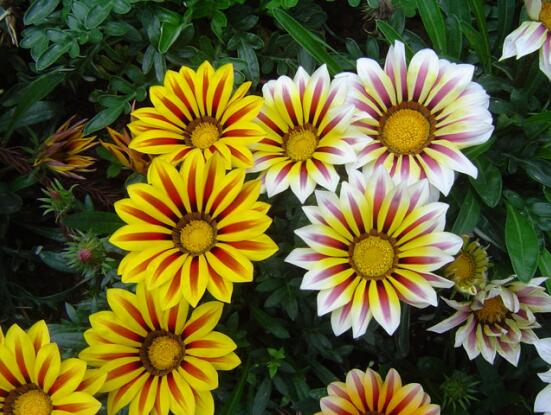
How to grow gazania, a complete guide to gazania growing methods
In today's life, many friends are very fond of growing all kinds of plants, so we often see various plants and flowers indoors, and gazania is one of them. This is a very beautiful flower. When in full bloom, it looks like a sunflower blooming in the desert, very passionate and warm, making people unable to help but love it. But how do you grow gazania, and what are its growing methods? Below let us take a look at the introduction to gazania growing methods.
Introduction to gazania
Gazania, also called treasure flower or African sun flower, is a perennial herbaceous flowering plant in the Asteraceae family. This is a very beautiful plant and flower, native to areas around South Africa and Mozambique. Because this flower has high ornamental value, gazania is often planted in various places as an ornamental flower or garden flower. The reason this flower is called gazania is that when the flower blooms, the arrangement of its petals looks like a medal, very solemn and beautiful.
Gazania growth habits
Gazania comes from the warm South Africa region, so it fundamentally likes warm and sunny growing environments. However, the flower is still relatively robust and can grow very well even in a cool and moist environment, but it still cannot adapt to hot and waterlogged environments. Gazania is semi-hardy, meaning the flower is not particularly drought-tolerant, so in winter, as long as the temperature is not unusually low, it can generally overwinter safely. This is a clump-forming flower, usually appearing in groups, very beautiful.
Gazania growing methods
1. Temperature
The suitable growing temperature is around 13 to 20 degrees. It is not tolerant of high temperatures and is semi-hardy, and is not particularly adaptable to hot and low-temperature environments. During cultivation, try to avoid both high-temperature and low-temperature climates. Keep it warm in winter and cool in summer.
2. Water
The plant is relatively sensitive to water and loves a moist growing environment, but at the same time it is also very vulnerable to drought and waterlogging problems. Therefore, when watering daily, strictly control the amount. Do not let water accumulate in the flowerpot, otherwise it may very likely cause the plant to die.
3. Light
A light-loving flower, it very much likes sufficient light, and when the plant is in the growing and flowering stages, it needs even more sufficient light. Therefore, when growing the plant normally, let it get more sun and fully enjoy the light.
4. Soil
Its soil requirements are not very high, but when growing it, it is still better to prepare some loose, breathable soil with good drainage. It can be mixed with potting soil, leaf mold and an appropriate amount of coarse sand. The soil's drainage must be good to prevent standing water.
5. Fertilizing
Gazania's fertilizing requirements are actually really not very strict, because gazania's adaptability is still quite strong and its demand for nutrients is not very high. Generally, fertilizing plants once every half month during the growing period is enough. There is no need for heavy fertilizer; ordinary light fertilizer is sufficient.
6. Prevention and control
Gazania's resistance is actually quite good, so basically the plant rarely suffers from pests and diseases. But this does not mean the plant has no pests and diseases at all, so during cultivation you should still pay attention to watering and sunlight exposure to prevent the plant from becoming sick and dying.
Summary: Gazania is a very beautiful flower. Its beauty is like warm sunlight, giving people a very gentle warmth. That is why people love to grow it, and it just so happens that the flower is also very easy to grow.
Gazania growing methods and precautions
Content summary: Gazania, also known as African sun flower, has brightly colored flowers and is famous for its overall shape and color resembling a medal. It is a perennial herbaceous plant. Although it likes sunlight, it is suitable for planting in cool environments. Next, we will introduce gazania growing methods and precautions.
[Gazania growing methods and precautions]
►Step 1: Propagation methods
Division propagation. When gazania is propagated by division, at the end of winter the mother plant should be taken out. You can directly take the soil and plant out of the flowerpot completely. After removing the soil, use a knife to cut it from the root position. It should be held vertically to ensure that each divided clump of gazania has independent young shoots and roots. After successful separation, directly transplant them separately.
Cuttage propagation. This propagation method does not have overly strict seasonal restrictions and is suitable for propagation in all four seasons. The location is mainly chosen as open air. You can mainly cut young shoots from the mother plant, or choose branches from the mother plant, about 15 cm in length, and directly insert them into sandy soil. During this period, the temperature should be controlled at around 25 degrees Celsius. After about half a month, the plant will take root.
►Step 2: Raising seedlings
Directly transplant the successfully propagated gazania outdoors. It is recommended to mainly use row spacing for planting, with the distance controlled at about 8 cm. For the choice of sloped land, choose a sunny spot with artificial irrigation capability.
First stage: about one week, when the main root of gazania will appear. At this time, just ensure the routine of watering once a day.
Second stage: after half a month, once gazania has finished sprouting and the main root has stabilized, it will begin to extend. At this time, artificial nutrients such as peat need to be applied. Chemical fertilizer is not needed. Keep sunlight exposure at more than 14 hours per day.
Third stage: at this time the main root has grown to about 5 cm, and gazania will begin to grow its first true leaf. After the leaf has fully grown, it can be fertilized, mostly with heavy fertilizer, twice a week.
Fourth stage: at this stage, the main root of gazania has fully grown, the root system in the soil has clustered together, and its vitality has stabilized. At this time it has entered the seedling stage, and the plant will grow about 4 true leaves. It is only necessary to maintain the care routine of the third stage.
►Step 3: Key cultivation points
Temperature: when entering the normal care stage, the growing environment temperature for gazania should be controlled at around 20 degrees Celsius, and should not be lower than 13 degrees Celsius. In winter, the lowest temperature it can withstand is 7 degrees Celsius. In summer, the highest temperature it can withstand is 30 degrees Celsius.
Water: the leaves and stems of gazania have a relatively high water storage capacity, so in addition to normal natural water, artificial watering is also needed. Once the soil dryness reaches more than 60%, it needs to be watered in time. But when watering, the amount should be accurately controlled to avoid standing water, otherwise it will also affect the growth of gazania.
Light: gazania can also be called sun flower. The plant faces the sun. After lacking light, it will directly wither, the flower color will become lighter, and phenomena such as soft flower buds and smaller buds will appear, affecting its ornamental value.