Care methods and precautions for Spiranthes sinensis
1. Soil
Spiranthes sinensis is an orchid with fleshy roots, so it needs to be planted in well-aerated, slightly acidic sandy loam; mixing in mountain soil rich in humus or peat soil will be more beneficial for growth.
2. Water
Spiranthes sinensis needs a large amount of water during its vigorous growth period. Lack of water in summer will cause poor plant growth, but watering should not be excessive either; keeping it slightly dry is sufficient, as overwatering easily causes root hypoxia and rot. In winter, the plant needs little water, so watering should be controlled to prevent the roots from freezing.
3. Fertilizing
For Spiranthes sinensis, farmyard manure diluted 10 times can be used for watering; when watering, try not to touch the roots or get it on the leaves, so as to avoid burning the plant. The fertilizer concentration must be controlled; spraying foliar fertilizer is the best fertilizing method, applying foliar fertilizer once every 10 days during the vigorous growth period.
Now everyone knows that Spiranthes sinensis is not an ordinary plant, right? Spiranthes sinensis is also the smallest orchid in the world, like a cute little elf. I hope everyone will like Spiranthes sinensis.
Care methods and precautions for Spiranthes sinensis
Soil selection for Spiranthes sinensis
Spiranthes sinensis is an orchid, and like other orchids it has fleshy roots, so it needs to be planted in well-aerated, slightly acidic, iron-containing sandy loam; mixing in mountain soil rich in humus or peat soil is even better.
Water supply for Spiranthes sinensis
Spiranthes sinensis needs relatively more water during its vigorous growth period, and special attention should be paid to water control in summer and winter. Once it lacks water in summer, it will grow poorly. Watering Spiranthes sinensis should follow the principle of "water when dry, stop when wet, keep appropriately on the dry side"; overwatering easily causes root hypoxia and root rot. Watering is generally done in the early morning or evening, and must not be done at noon, because after watering at noon the water temperature rises quickly and easily scorches the plant. In winter, water control should be noted, because at lower temperatures the plant's metabolism is weaker and it needs less water; prevent the potting soil from freezing and injuring the root system.
Fertilizing measures for Spiranthes sinensis
For fertilizing Spiranthes sinensis, farmyard manure diluted 10 times can be used for watering; when watering, try to water along the edge of the pot, do not touch the roots, and do not get it on the leaves, to avoid burning the plant. When applying chemical fertilizer, attention should be paid to balancing the ratio of nitrogen, phosphorus and potassium, and the concentration must be strictly controlled. Spraying foliar fertilizer can both supplement the plant's nutrients through leaf absorption and avoid fertilizer damage caused by fertilizer directly contacting the roots; this is the best fertilizing method for Spiranthes sinensis. During the vigorous growth period, spray foliar fertilizer once about every 10 days, and Spiranthes sinensis can be grown well without applying fertilizer into the pot. When fertilizing, apply frequently and lightly, and eat small meals more often.
Growing methods and precautions for Spiranthes sinensis
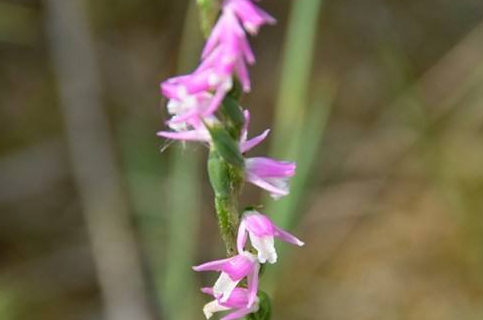
Chinese scientific name: Spiranthes sinensisLatin scientific name: Spiranthes sinensis (Pers.) AmesKingdom: PlantaeDivision: AngiospermsClass: MonocotyledonsOrder: MicrospermaeFamily: OrchidaceaeSubfamily: OrchidoideaeTribe: NeottieaeGenus: SpiranthesSpecies: Spiranthes sinensisNamed by and year: Ames, 1908Spiranthes sinensis (scientific name: Spiranthes sinensis (Pers.) Ames): the plant is 13-30 cm tall. Several roots, finger-shaped, fleshy, clustered at the base of the stem. The stem is relatively short, with 2-5 leaves near the base. The leaf blades are broadly linear or broadly linear-lanceolate, very rarely narrowly oblong, upright and spreading. The flowering stem is upright, 10-25 cm long, the upper part covered with glandular pubescence to hairless; the raceme has many densely arranged flowers, 4-10 cm long, spirally twisted; the flowers are small, purple-red, pink or white, arranged in a spiral on the inflorescence axis; the lower parts of the sepals are close together, the middle sepal narrowly oblong, boat-shaped, 4 mm long, 1.5 mm wide, the tip slightly pointed, close together with the petals forming a hood shape. The flowering period is July-August. It grows in mountain forest understories, under shrubs, in grasslands or riverbank marshy meadows at an altitude of 200-3400 m. It is distributed in China, Russia, Mongolia, the Korean Peninsula, Japan, Afghanistan, Kashmir region to Bhutan, India, Myanmar, Vietnam, Thailand, the Philippines and Malaysia, and is also distributed in Australia. This species is cultivated, and the whole plant is used as folk medicine.1. Morphological characteristics
The plant of Spiranthes sinensis is 13-30 cm tall. Several roots, finger-shaped, fleshy, clustered at the base of the stem. The stem is relatively short, with 2-5 leaves near the base. The leaf blades are broadly linear or broadly linear-lanceolate, very rarely narrowly oblong, upright and spreading, 3-10 cm long, usually 5-10 mm wide, the tip acute or acuminate, the base narrowed with a stalk-like stem-clasping sheath. The flowering stem is upright, 10-25 cm long, the upper part covered with glandular pubescence to hairless; the raceme has many densely arranged flowers, 4-10 cm long, spirally twisted; the floral bracts are ovate-lanceolate, the tip long acuminate, the lower ones longer than the ovary; the ovary is spindle-shaped, twisted, covered with glandular pubescence, 4-5 mm long including the pedicel; the flowers are small, purple-red, pink or white, arranged in a spiral on the inflorescence axis; the lower parts of the sepals are close together, the middle sepal narrowly oblong, boat-shaped, 4 mm long, 1.5 mm wide, the tip slightly pointed, close together with the petals forming a hood shape; the lateral sepals are oblique, lanceolate, 5 mm long, about 2 mm wide, the tip slightly pointed.The petals are obliquely rhombic-oblong, the tip obtuse, equal in length to the middle sepal but thinner; the lip is broadly oblong, concave, 4 mm long, 2.5 mm wide, the tip very obtuse, the upper part of the front half with long stiff hairs and the margin with strongly wrinkled wavy teeth, the base of the lip concave and forming a shallow sac, with 2 calli inside the sac. The flowering period is July-August.
This species is very widely distributed, and its plant size, leaf shape, flower color, and whether the upper part of the flowering stem is hairy often vary greatly depending on the region of distribution.
2. Origin and habitat
It grows in mountain forest understories, under shrubs, in grasslands or riverbank marshy meadows at an altitude of 200-3400 m. It is produced in all provinces and regions of China, and is also distributed in Russia (Siberia), Mongolia, the Korean Peninsula, Japan, Afghanistan, the Kashmir region to Bhutan, India, Myanmar, Vietnam, Thailand, the Philippines and Malaysia, and also in Australia. The type specimen was collected from Guangdong, China.3. Growth habits
Orchids generally grow on mountain slopes and valley walls in deep mountains and secluded valleys, on inclined slopes or in rock crevices with good water permeability and water retention, beside sparse mountain grasses, and under the shade of secondary mixed woods. Or in places with shade, short sunshine duration, or only scattered light. In places with high air humidity and air circulation, they sometimes also grow on cliffs beside mountain streams. Orchids are suitable for planting in an environment with air circulation. They are shade-loving, averse to direct sunlight, fond of moisture, and averse to dryness, and 15°C to 30°C is most suitable for growth. Above 35°C they grow poorly. Severe cold below 5°C will affect their growth vigor, and at this time orchids are often in a dormant state. If the temperature is too high plus exposure to the sun, leaf scorching or withering will appear within one or two days. If the temperature is too low and they are not moved indoors in time, frost damage will occur.Orchids have fleshy roots and are suitable for sandy loam rich in humus, and the drainage performance must be good; leaf mold soil or mountain soil with more humus should be selected. Slightly acidic loose soil or iron-containing soil is suitable, with a pH value of 5.5-6.5.