How to grow Agapanthus? Teaching you the correct cultivation methods
1. Soil selection
Agapanthus has relatively high soil requirements among plants. First, it needs good air permeability, and second, it needs good drainage. The best mix is 3 parts garden soil, 1 part rice husk ash and 1 part compost mixed together.
2. Watering management
Watering is also a very crucial step. You can neither water too much nor too little. In summer, special attention should be paid to giving sufficient water, and it is best to frequently spray or sprinkle water on the environment around the plant to cool it down. In winter, also pay attention to controlling the amount of watering; do not water too much, and keeping the potting soil slightly moist is enough.
3. Fertilization management
One day before fertilizing, pause watering once to let the potting soil dry out; after fertilizing, spray the leaves with clean water. There are many choices of fertilizer. For divided seedlings, sufficient fertilizer and water should be given so that they can bloom as early as possible. After flowering, remove the spent flowers and apply fertilizer promptly. Fertilization can help Agapanthus grow better, so an appropriate amount of fertilizer is still very important.
4. Temperature management
Agapanthus likes to live in a relatively warm environment, because it has a certain degree of cold resistance, but it cannot be placed in a very low-temperature place. In southern regions, it can overwinter in the open ground with slight covering, but in northern regions, in winter it needs to be placed in a greenhouse no lower than 5°C to overwinter, otherwise it may freeze to death.
5. Light
Avoid direct sunlight, and remember not to expose it to the sun, especially in summer. If it is exposed to the sun for a long time, the leaves will be scorched.
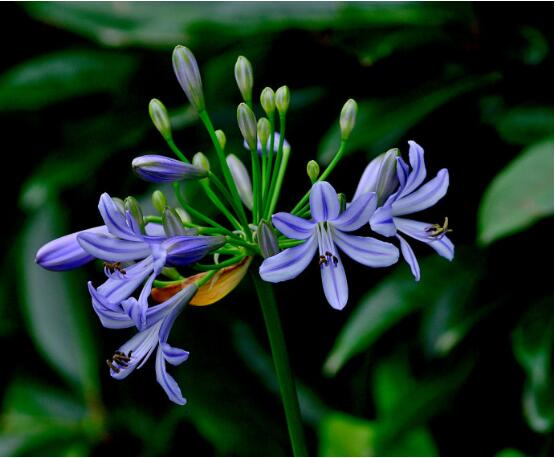
Cultivation methods for Agapanthus
Agapanthus is also called purple clivia by some people. It is a perennial herbaceous plant of the Amaryllidaceae family, with leaves in two rows, broadly lanceolate, deep green, and short thick fleshy roots underground. The flower scape is 60-90 cm tall, with a terminal umbel, bearing about 15-30 flowers, blue in color, with a flowering period of 6-8 months. It is very beautiful, and even when there are no flowers, its foliage is also pleasant to look at, so flower growers mostly like to grow it in pots for appreciation.Agapanthus is native to South Africa. It likes warmth and humidity, is not very cold-resistant, likes sunlight but fears scorching sun, is slightly shade-tolerant, likes fertilizer, and is suitable for growing in sandy loam rich in humus and with good drainage. The propagation of this flower is mainly by division, which can be done in spring and autumn, generally best in autumn, because when divided in spring, it often cannot bloom that year. Potted plants should be divided about once every 3 years. If not divided for a long time, growth and flowering will be affected. When dividing, each new plant should carry 2-3 buds. After division, first place it in a shaded place for a one-week transition, then move it into sunlight. If using the sowing method, it takes more than 5 years to bloom, so this method is used less often.
For Agapanthus cultivation, it is advisable to use 3 parts garden soil, 1 part rice husk ash and 1 part compost mixed together. For maintenance, it should be placed in a semi-shaded and moist place. From June to September, be careful not to let scorching sun shine directly on it, so as not to scorch the leaves. Watering should be done to the extent of keeping it moist, alternating dry and wet. In summer, especially ensure sufficient water is given, and frequently spray water on the plant and the surrounding environment to increase humidity and lower temperature. One day before fertilizing, pause watering once to let the potting soil dry out; after fertilizing, spray the leaves with clean water. It is best to alternate manure fertilizer, cake fertilizer and chemical compound fertilizer, once every 10-15 days.
For divided seedlings, sufficient fertilizer and water should be given so that they can bloom earlier. After flowering, remove the flowers and apply fertilizer promptly. Stop fertilizing after October, and when the temperature drops to 1-2°C, move it indoors to a moist place. Keeping it above 0°C is enough for overwintering. At this stage, pay attention to controlling watering, keeping the potting soil slightly moist is enough, and do not water too much.
Cultivation methods and precautions for Agapanthus
Agapanthus is also known as purple clivia. It has a terminal umbel, blue flowers, and a flowering period of 6-8 months. It is very beautiful, and even when there are no flowers, its foliage is also pleasant to look at. So how do you grow Agapanthus? What are the cultivation methods? Next, let us look at the cultivation methods and precautions for Agapanthus.
I. Cultivation methods for Agapanthus
1. Soil: For Agapanthus cultivation, it is advisable to use 3 parts garden soil, 1 part rice husk ash and 1 part compost mixed together.
2. Fertilization: One day before fertilizing Agapanthus, pause watering once to let the potting soil dry out; after fertilizing, spray the leaves with clean water. It is best to alternate manure fertilizer, cake fertilizer and chemical compound fertilizer, once every 10-15 days.
3. Watering: Water Agapanthus to the extent of keeping it moist, watering when dry and stopping when wet. In summer, especially ensure sufficient water is given, and frequently spray water on the plant and the surrounding environment to increase humidity and lower temperature. In winter, pay attention to controlling watering, keeping the potting soil slightly moist is enough, and do not water too much.
4. Temperature and light: Agapanthus should be placed in a semi-shaded and moist place. From June to September, be careful not to let scorching sun shine directly on it, so as not to scorch the leaves. Stop fertilizing after October, and when the temperature drops to 1-2°C, move it indoors to a moist place. Keeping it above 0°C is enough for safe overwintering.
II. Precautions for growing Agapanthus
Agapanthus likes warmth and humidity, is not very cold-resistant, likes sunlight but fears scorching sun, is slightly shade-tolerant, likes fertilizer, and is suitable for growing in sandy loam rich in humus and with good drainage.
After entering October, the weather gradually turns cooler, and the plant enters a semi-dormant state until April of the following year; during this period, watering should be controlled and fertilization stopped, so as to avoid sprouting and growth that affect flowering. In the south, the semi-dormant period is somewhat shorter, and attention should also be paid. In spring, before new leaves sprout, part of the old leaves should be cut off to keep the plant shape neat. For divided seedlings, sufficient fertilizer and water should be given so that they can bloom earlier. After flowering, remove the flowers and apply fertilizer promptly.
Cultivation methods and precautions for AgapanthusIt has already been shared. I believe everyone will know how to grow Agapanthus after reading it. I hope it is helpful to everyone.