How to plant Echinops sphaerocephalus seeds? A detailed guide to the planting method
Choosing a substrate
Because Echinops sphaerocephalus itself has extremely strong vitality and is also highly adaptable to its environment, it can adapt to different growing substrates. The soil must be a sandy soil with good aeration and strong water retention. Since Echinops sphaerocephalus is very afraid of waterlogging, and prolonged waterlogging can cause the roots to rot, the soil must never be allowed to accumulate water for long periods. When planting, there is also no need to apply large amounts of fertilizer; generally, the nutrients in the soil are enough to ensure its normal development.
Choosing an environment
Echinops sphaerocephalus likes a cool environment with good ventilation and cannot grow in hotter regions. If choosing container planting, it is best to regulate the temperature indoors, and absolutely avoid exposure to the sun in summer. The optimal temperature is 20 to 25 degrees, and it should be planted in a spot with relatively sufficient sunlight; do not choose an environment that is too shady.
Planting method
First prepare a container; the size of the container is determined by how many plants are being grown. Pour the soil into the substrate and use a shovel to level and loosen it to ensure aeration. Then slowly place the seeds on the surface of the soil, cover them with a layer of substrate, and then water lightly to keep the soil moist and give the seeds a suitable environment for sprouting.
If some flower lovers choose to plant in the ground, first dig a few small holes in the chosen planting spot, put 1 to 3 seeds in each hole, and note that the holes must not be dug too deep; 1 to 2 cm is enough. Gently pick up and place the seeds into the dug holes, cover the seeds with a layer of substrate, and use a watering can to moisten the soil. If choosing to plant a large area in the ground, it is recommended to first deep-plow the land, irrigate thoroughly, and finally scatter the seeds.
Now that you have learned these methods for planting Echinops sphaerocephalus seeds, do you know what other propagation methods Echinops sphaerocephalus has!
Propagation methods of Echinops sphaerocephalus
Seed propagation of Echinops sphaerocephalus
Seed propagation of Echinops sphaerocephalus is relatively simple. The suitable temperature for seed germination is 20°C to 25°C, and the seedling emergence rate is relatively high. This method can produce large numbers of Echinops sphaerocephalus plants, but this propagation method causes segregation of traits in the offspring, reducing the ornamental quality of Echinops sphaerocephalus to a certain extent.
Cuttage of Echinops sphaerocephalus
The roots of Echinops sphaerocephalus have a very strong regeneration capacity, and a large number of adventitious buds can be obtained through root segment cuttage. The offspring obtained through cuttage propagation have relatively stable traits.
For the soil needed for cuttage of Echinops sphaerocephalus, you can choose to mix substrate, river sand and peat at a ratio of 1:1:1, and then cut the root segments into lengths of 2 to 3 cm. Insert the root segments into a seedling tray and cover them with plastic film to create a microclimate and maintain humidity.
In a greenhouse, after about 10 days, callus tissue will form at the upper end of the inserted segment, appearing white, and then adventitious buds will differentiate. After about 20 days, adventitious roots will differentiate at the lower end. For propagation in open ground, it can be done in March in spring. After the cuttage seedlings have grown for about two months, they can be planted out. Choose a site with good drainage for planting out, then water thoroughly. Later, pay attention to cultivating and weeding, appropriately control the amount and frequency of watering, and drain promptly after rain to avoid water accumulation.
Tissue culture of Echinops sphaerocephalus
Tissue culture propagation of Echinops sphaerocephalus is mostly used in scientific research and large-scale production. It can achieve rapid propagation and screening of superior varieties of Echinops sphaerocephalus, can screen out virus-free plants, maintain the original superior traits and pass them on stably; in addition, tissue culture technology can also be used for mutation breeding of new varieties. However, it should be noted that tissue-cultured seedlings are relatively weak. If they need to be transplanted into field cultivation, hardening off is required in the earlier stage to enhance the adaptability of the seedlings.
Echinops sphaerocephalus L. Echinops sphaerocephalus illustrated guide: how to grow Echinops sphaerocephalus / how to propagate Echinops sphaerocephalus
Echinops sphaerocephalus profileEchinops sphaerocephalus L.
Alias: Blue Globe
Classification: Annual herbaceous flower
Family and genus: Plantae, Angiosperms, Dicotyledons, Asterales, Asteraceae, Echinops
Full bloom period: Autumn
Echinops sphaerocephalus L. is a plant of the genus Echinops in the Asteraceae family. It is distributed in Eastern Europe, Africa and Asia. There are about 10 or more species in China, mainly produced from the northwest to the northeast. It is a stout herb, somewhat thistle-like, with stems and leaf backs more or less covered with white woolly hairs; leaves alternate, often pinnately toothed or deeply lobed, with spines on the teeth and lobes; each capitulum has 1 floret; the involucre is composed of spiny outer bracts and linear or lanceolate inner bracts, and all the flowers aggregate into a dense, spherical compound capitulum, below which are drooping leafy bracts hidden at the base of the inflorescence; the achene is elongated, four-angled or cylindrical, often covered with long soft hairs, with a tip...
Cultivation methods and precautions for Echinops sphaerocephalus, and an introduction to Echinops sphaerocephalus
Echinops sphaerocephalus L. is a plant of the genus Echinops in the Asteraceae family. It is distributed in Eastern Europe, Africa and Asia. There are about 10 or more species in China, mainly produced from the northwest to the northeast. It is a stout herb, somewhat thistle-like, with stems and leaf backs more or less covered with white woolly hairs; leaves alternate, often pinnately toothed or deeply lobed, with spines on the teeth and lobes; each capitulum has 1 floret; the involucre is composed of spiny outer bracts and linear or lanceolate inner bracts, and all the flowers aggregate into a dense, spherical compound capitulum, below which are drooping leafy bracts hidden at the base of the inflorescence; the achene is elongated, four-angled or cylindrical, often covered with long soft hairs, and has several short scales at the tip. It is an excellent nectar plant and has great medicinal value.
Morphological characteristics of Echinops sphaerocephalus: Stem
Echinops sphaerocephalus is a perennial herb, 50-150 cm tall. The stem is solitary, with long or short branches in the upper part, stout, and all stems and branches are covered with dense multicellular long jointed hairs and sparse cobwebby thin hairs.
Leaves
The basal and lower stem leaves of Echinops sphaerocephalus are broadly lanceolate in overall shape, 15-25 cm long and 5-10 cm wide, pinnately parted, with 3-5 pairs of lateral lobes, triangular or lanceolate, with spiny teeth on the margins and needle-like acuminate tips; the upper leaves gradually become smaller, are the same shape as the basal and lower stem leaves and split in the same way. All leaves are thin in texture, papery, differently colored on the two sides, green above and covered with dense short rough hairs, grayish-white below and covered with thin cobwebby woolly hairs, but with multicellular long jointed hairs along the midvein.
Flowers
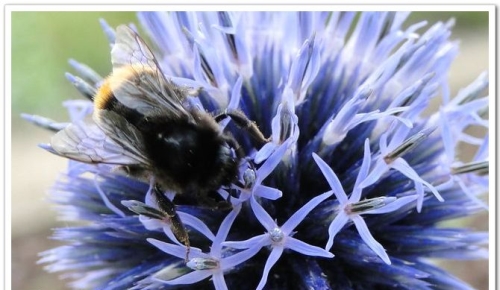
The compound capitulum of Echinops sphaerocephalus is solitary at the top of stems and branches, 4-5.5 cm in diameter. The capitulum is 2 cm long. The basal hairs are 1 cm long, half the length of the involucre, white, flat-hair-like, unequal in length. The outer bracts are slightly longer than the basal hairs, long oblanceolate, with the upper part enlarged into an ellipse, brown, covered outside with relatively dense short rough hairs and glandular dots, with slightly longer cilia on the margins, needle-awned long acuminate at the apex, and with long cilia up to 4 mm long on the lower part of the claw; the middle bracts are oblanceolate or long elliptic, about 1.1 cm long, with long cilia on the margins and dense short rough hairs outside; the inner bracts are lanceolate, 8 mm long, covered outside with dense short rough hairs, with awn-toothed or awn-lobed apex, and the middle awn lobe is longer. All bracts number 14-18. The florets are light blue or white, the corolla is deeply 5-parted, the lobes linear, and the corolla tube has no glandular dots or has sparse glandular dots.
Fruit
The achene of Echinops sphaerocephalus is obconical, about 7 mm long, covered with dense yellow upward appressed long straight hairs that do not cover the pappus. The pappus is cup-shaped, about 1.2 mm high; the pappus segments are linear, with rough-hairy margins, mostly united.
The flowering and fruiting period of Echinops sphaerocephalus is August-September.
Ecological habits of Echinops sphaerocephalus
Echinops sphaerocephalus has strong adaptability, is drought-tolerant, barren-tolerant and cold-tolerant, likes a cool climate and well-drained sandy soil, and avoids heat and waterlogging. It can be managed extensively. It is a good summer-flowering perennial flower.
Cultivation techniques for Echinops sphaerocephalus
Echinops sphaerocephalus can be propagated by methods such as seed propagation, root segment cuttage and tissue culture.
1.Seed propagation is relatively simple. The seeds of Echinops sphaerocephalus germinate easily at 20°C to 25°C, and the seedling emergence rate is high, but the seedling offspring obtained by this propagation method show relatively great trait segregation, reducing the ornamental quality of Echinops sphaerocephalus.
2.The roots of Echinops sphaerocephalus have a very strong ability to regenerate adventitious buds. A large number of adventitious buds can be obtained through root segment cuttage, and offspring with relatively stable traits can be obtained through cuttage propagation. Generally, root segment cuttage is used for propagation, which can maintain the excellent characteristics of the mother plant. The method is: substrate:river sand:peat = 1:1:1, and the root segments are cut into lengths of 2 to 3 cm. After root cuttage, plastic film can be placed over the seedling tray to maintain humidity. After 10 days, the upper end of the inserted segment first forms white protruding callus tissue, and then adventitious buds differentiate. After 20 days, adventitious roots differentiate at the lower end. This method can be carried out year-round in a greenhouse; if in open ground, it can be done in March in spring. After the cuttage seedlings have grown for two months, they can be planted out. Choose a site with good drainage and plant out at a spacing of 40 cm x 40 cm between plants and rows, then water thoroughly once. Pay attention to cultivating and weeding, appropriately control watering, and drain promptly after rain.
3.Tissue culture: Tissue culture technology can be used for factory production, achieving rapid propagation of superior varieties of Echinops sphaerocephalus, obtaining virus-free plants, and maintaining the original superior traits unchanged; tissue culture mutation can also be used to breed new varieties.
Cultivation: It should be planted in soil with sufficient sunlight and good drainage.
Distribution area of Echinops sphaerocephalus
Echinops sphaerocephalus is distributed in the **Tianshan region. It grows at the edges of mountain forests or beside canals. It is widely distributed in the Soviet Union (Central Asia, the Caucasus, Siberia) and central and southern Europe.
Dietary or medicinal value of Echinops sphaerocephalus
The medical information and health dietary information on Huahua Network are for reference only and cannot be used as a basis for diagnosis or medical treatment. Any health problems should be consulted with professional medical staff, and the treatment of any disease should follow medical advice.
Ultimate flower-protecting mission: To love yourself, start from reality and strictly follow medical advice. For illness, do not be careless, do not delay, do not give up hope, face it bravely, use love to warm the silent world, and use your heart to care for the flower field within.
In Europe, some species of Echinops sphaerocephalus have already been widely cultivated as ornamental plants, a few annual species have certain medicinal value, and some species can be used as nectar plants. Some species contain alkaloid substances and are toxic to livestock.
Pharmacological effects
1. Antibacterial test: The water infusion of Echinops sphaerocephalus has varying degrees of inhibitory effect in test tubes on skin fungi such as Trichophyton schoenleinii, Cladosporium carrionii, and Nocardia asteroides.
2. The ecdysone contained in Echinops sphaerocephalus has an adaptogenic-like effect.
3. Ecdysterone can reverse hyperglycemia caused by glucagon and can inhibit the synthesis of liver cholesterol.
4. It can increase the number and ratio of peripheral blood T lymphocytes in normal and immunosuppressed animals.
5. The water decoction of Echinops sphaerocephalus can improve hyperlipidemia, reduce atherosclerotic lesions, lower the content of lipofuscin in internal organ tissues, and prevent damage to the aging body from free radicals.
6. Different extracts of Echinops sphaerocephalus have varying degrees of scavenging effects on various reactive oxygen species.
7. The water extract of Echinops sphaerocephalus has a clear antagonistic effect on the photo-oxidation of photopurine, and its effect is related to the scavenging of singlet oxygen produced by photopurine. The water decoction of the roots and aboveground parts of Qizhou Loulu can inhibit the formation of lipid peroxides in rat heart, brain, liver and kidney tissues, and has an anti-lipid peroxidation effect.
Introduction to efficacy
[Chinese medicine name]: Yuzhou Loulu
[Pinyin name]: YuzhouLoulu
[English name]: RADIX ECHINOPSIS
[Source]: This product is the dried root of the Asteraceae plant Echinops latifolius Tausch or Echinops grijisii Hance. It is excavated in spring and autumn, the fibrous roots and soil are removed, and it is sun-dried.
[Traits]: This product is subcylindrical, slightly twisted, 10-25 cm long and 0.5-1.5 cm in diameter. The surface is grayish-yellow or grayish-brown, with longitudinal wrinkles, and the top has fibrous brown hard hairs. It is hard in texture and not easy to break; the fracture shows a brown bark and a wood part with alternating yellow and black radial striations. The odor is slight and the taste slightly astringent.
[Processing]: Remove impurities, wash clean, moisten thoroughly, cut into thick slices, and sun-dry.
[Nature, flavor and meridian entry]: Bitter, cold. Enters the stomach meridian.
[Functions and indications]: Clear heat and detoxify, discharge pus and stop bleeding, disperse carbuncles and promote lactation. Used for various sores, carbuncles and wind, swollen and painful breast carbuncles, blocked milk secretion, scrofula and sore toxins. It is also used as an anthelmintic.
[Usage and dosage]: 4.5-9 g
[Storage]: Keep in a ventilated and dry place.
Instructions for use
For sores and carbuncles in the early stage with redness, swelling, heat and pain, it is often used in combination with Forsythia suspensa, Rheum officinale, etc.;
For those with red, swollen and painful breasts about to form carbuncles, it is often used in combination with Trichosanthes kirilowii, Taraxacum mongolicum, Fritillaria, etc.
This product can also promote milk secretion. Combined with Tetrapanax papyrifer and Vaccaria segetalis, it can also be used for failure of milk secretion. It can also be used for various tumors.
If used for liver tumors, it is often used in combination with Scutellaria barbata, Lobelia chinensis, Salvia chinensis, etc.
Landscape uses of Echinops sphaerocephalus
As an ornamental plant, Echinops sphaerocephalus is also called Blue Globe. Its color is blue-gray, and its forms include "single-head type" and "multi-head type." It can also be made into natural dried flowers (first remove part of the leaves, hang them upside down in a ventilated place, and drying can be completed in one week). At present, this plant is rarely used in China. However, due to its unique flower shape and flower color, it is believed that in the near future it will certainly be deeply loved by Chinese people.
Uses of Echinops sphaerocephalus 1.Floral decoration: Echinops sphaerocephalus can be used as fresh cut flowers and dried flowers. Because of its peculiar flower shape, rich and vivid flower colors, and long ornamental period, it can be used for floral decoration in homes, hotels and restaurants. After its cut flowers came on the market, they were loved and recognized by consumers, especially friends from abroad, and are expected to enter the international market.
2.Landscape application: Echinops sphaerocephalus is a wild flower unique to high-altitude grasslands and mountains. After introduction, it shows the characteristics of extensive management, strong adaptability and low maintenance cost; moreover, it has high ornamental value such as rich and vivid flower colors and unique inflorescences, so it has very broad application prospects in landscaping.
Single-plant planting for ornament
Echinops sphaerocephalus has a graceful plant form. Its peduncles emerge from the leaf cluster, and there are relatively many branches, ranging from 3 to 12; the number of flower balls is as few as several and as many as 40; the diameter of the flower balls is 4-8 cm; the flower colors include blue, blue-purple, white, etc.; planted as a single plant on lawn green spaces, road corners and other places, it is very eye-catching and attracts visitors' attention. Because the aboveground part of Echinops sphaerocephalus gradually withers after the flowering period, attention should be paid to reasonable combined planting with other plants to create a continuous landscape.
Clump planting
Echinops sphaerocephalus has good clumping traits, and its roots have a very strong ability to regenerate adventitious buds, so after a few years it will present a clump-planted landscape. Clumps of Echinops sphaerocephalus growing on lawn green spaces or under open forests fill the rigid greening space with wild charm and give people the psychological satisfaction of being close to nature.
Mass planting
Echinops sphaerocephalus can be mass-planted as a flower border; planted along both sides of roads. It can soften stiff road curves and avoid regular hedge lines. If planted in combination with evergreen small shrubs, it can create a changing landscape, far superior to the planting form of a single shrub green belt. In addition, planting it as a flower bed can also meet the need for diverse colors.
Ground cover greening
With the rapid development of urban landscape construction, ground cover plants, as a carrier of landscape and ecological functions, are increasingly valued by designers. As a ground cover greening plant, Echinops sphaerocephalus has many excellent characteristics. It has a wide ecological distribution and strong adaptability and resistance. It can grow well in arid, barren land and under open forests on hillsides, and one planting can provide many years of ornament, greatly saving management costs. Planting it in combination with other annual and biennial herbaceous flowers in flower beds, flower borders, and mountain slope protection, especially planting it under open forest spaces, can not only reasonably use space but also create a continuous landscape. Therefore, as a ground cover greening material, it has great development potential.
Echinops sphaerocephalus pictures