This plant can be used as a rootstock for grafting other plants
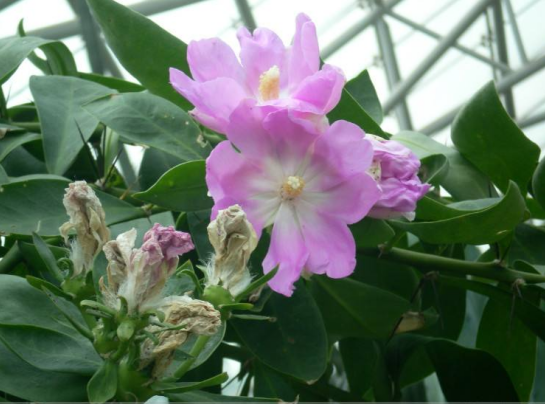
Pereskia, a primitive type of cactus, can be used to graft Christmas cactus, epiphyllum and ball cacti. Because of its strong cold resistance, well-developed root system and vigorous growth, it is often used as a rootstock for Gymnocalycium mihanovichii and other colorful cacti. However, since its stem is too thin, it is only suitable for grafting ball cacti of no great diameter. Grafting can improve the ornamental value of plants and elevate the value of Pereskia.
This is also an outstanding advantage of Pereskia.
What should be done if the rootstock used for grafting Christmas cactus wilts?
What should be done if the rootstock used for grafting Christmas cactus wilts?
What should be done if the rootstock used for grafting Christmas cactus wilts? The cactus used as a rootstock for grafting Christmas cactus often wilts in the hot summer, which is caused by the special weather conditions of summer. Although cacti can withstand extreme high temperatures of 40°C, and although in their native habitats in Africa the daytime is very hot and dry, the nights are relatively cool, so the effect on the plants is not great;
But in most parts of China, most cacti find it hard to endure sustained sultry high temperatures, especially when ventilation is poor. When the temperature reaches 30-35°C, the growth rate of most varieties slows down; if it exceeds 38°C, and the nighttime temperature also remains high, potted cacti are forced into a dormant state, the so-called summer dormancy, and only recover normal growth after the weather turns cool in autumn.
Therefore, Christmas cactus plants grafted and cultivated on cactus rootstocks generally grow fairly well in spring and autumn in most parts of China, but often become "half-dead" in the sultry, hot summer, and this is the reason. If at this stage they are watered too much or receive too much rainwater, or are given some fertilizer, the cactus rootstock will inevitably suffer root rot, causing it to wilt more with each passing day.
For a wilting plant, it can be placed in a cool, ventilated spot, or moved to an air-conditioned room with better ventilation; watering should be replaced by appropriate misting to create a relatively cool micro-environment for it, and by September it can be expected to revive. After summer arrives the following year, Christmas cactus plants grafted and propagated on cactus rootstocks should be moved early to a ventilated, cool, semi-shaded place to spend the summer, with watering restricted and fertilizing stopped, so that they can pass smoothly through the hot summer; then, when the weather turns cool in autumn, normal water and fertilizer management can be resumed. Only in this way can Christmas cactus plants grafted on cactus rootstocks produce flowers that are large, numerous and brightly colored.
Grafting of Cactaceae plants
There are many kinds of cactus plants; some have habits like woody plants, while others have habits like herbaceous plants, but all cactus plants are perennial and belong to the subclass Dicotyledoneae, so the vascular bundles in their stems can produce cambium and are arranged in a ring. Only in this way can the stems of cactus plants continue to thicken due to the dividing capacity of the cambium. The cambium is the meristematic tissue in the vascular bundles. It is precisely because the vascular bundles in the stem have cambium tissue that cactus plants can easily be propagated by grafting, just like fruit trees and other ornamental trees.A. Distribution patterns of vascular bundles in the stems of cactus plants
The stem forms of cactus plants vary greatly: there are tall tree types, dense shrub types, slender vine-like stems, creeping and hanging branches, and also flat, ribbon-like long leaf-shaped stems and small solitary globular bodies... In stems of different forms, the positions of the vascular bundles are not entirely the same. A person performing grafting must have a relatively clear understanding of the distribution of the vascular bundles; otherwise it is difficult to meet the requirement of closely joining the vascular bundles of both the scion and the rootstock. When a cactus stem is dissected for observation, compared with the parenchyma cells of the outer cortical tissue, the vascular bundles are denser in tissue and darker in color, appearing bright green, while the cortex and the pith inside the ring of central vascular bundles are light in color or even whitish.
To sum up, according to the general form of their stems, cactus plants mainly have the following forms of internal vascular bundle distribution.
1. Pereskia plants
This category of cactus plants is the most primitive type; its form and the form of the vascular bundles in its stem are the same as those of ordinary shrubs or small trees. What distinguishes it in form from other cactus plants is that its stem has not yet become very succulent and it still retains leaves, but while ordinary woody plants have ordinary axillary buds in the leaf axils (although in some cases these become latent buds), Pereskia has areoles in the leaf axils. Most cactus plants retain only areoles after the stem becomes succulent and the leaves degenerate. The areole can be said to be the "bud" of a cactus plant, but its structure differs from the buds of ordinary plants; it is a feature unique to cactus plants.
2. Pad-like stem type
The most typical example of this type is the common prickly pear cactus in cultivation; it can be said to be a shortened and flattened modified stem. When the prickly pear is young, its flat succulent stem segments bear short, degenerated succulent leaves, but these soon fall off; in the leaf axil portion, areoles remain, and the areoles bear bristles and spines. Branching and flowering both arise from the areoles. From a cross-section of the prickly pear, one can see the central vascular bundles and the vascular bundle branches leading to the areoles, roughly showing the evolutionary situation from Pereskia.
3. Columnar stem type
Although the columnar stems of this type may be several dozen cm in diameter in some cases and less than 1 cm in others, the distribution pattern of the central vascular bundles in the stem is much the same. The vascular bundle branches leading to the areoles often vary under the influence of the form and number of ribs or wings possessed by the columnar stem.
4. Globular stem (including cylindrical stem) type
A globular stem can be understood as a shortened and thickened columnar stem. Its central vascular bundles also change with the external form of the stem. Some globular stems still have ribs, and many globular stems have ribs further divided and evolved into tubercles, with their vascular bundle branches accordingly changing as they lead to the areoles.
5. Flat leaf-shaped stem type
Flat modified stems mostly have joints; the most common include Epiphyllum, Epiphyllum hybrid, Christmas cactus, and Rhipsalis. The central vascular bundles of this type are located in the central part of the flat stem; because the stem is flat and thin, their position can be seen from the outside, and when held against the light, the shadow of the position where the vascular bundle branches lead to the areoles can sometimes be seen.
In addition, many cactus plants show deformities on the basis of stems that are already modified. This is common in cultivation. For example, rock-like deformities are neither used as rootstocks nor often used as scions for propagation, and are often grown on their own roots. Crested deformed stems are mostly used as scions for grafting propagation. Because the external deformity is irregular, the form of the internal central vascular bundles is also hard to define, and generally changes with the external form of the stem; the vascular bundle branches leading to the areoles also run from the irregular central vascular bundles to areoles in uncertain positions. One more point to add is that in the succulent stems of cactus plants, besides the two levels of the central vascular bundles and the vascular bundle branches leading to the areoles, there is also a third level. However, these network-like vascular bundles mainly serve transport in fine parts and are generally not the main object utilized in grafting. Sometimes a grafter does not accurately identify or simply does not know how to use the vascular bundles to ensure survival; during grafting, the scion's vascular bundles do not contact the rootstock's central vascular bundles or the vascular bundle branches leading to the areoles, yet the graft somehow survives. Clearly, this is a case where a fine network-like vascular bundle happened to play a role. Although this can happen, it is not frequent, and network-like vascular bundles are unreliable in grafting. The schematic diagram only takes a longitudinal section of one prickly pear pad as an example; stems of all other types also have this network-like vascular bundle internally.
B.
Several aspects that should be noted
Through the above introduction, we can have a basic understanding of the vascular bundles in the stems of the vast majority of cactus plants. However, in order to remain calm during grafting operations and ensure quality, beginners are advised, based on the above content and schematic diagrams, to find some ordinary cactus plants and do several dissection experiments. When dissecting, do not rush to cut the stem open from the center with one slice; it is best to cut gradually, layer by layer. Through careful dissection, not only should the exact position of the vascular bundles be found, but this should further be linked to the direction of the main vascular bundle branches. This point is crucial when performing side grafting. Only when the grafter knows the positions of the vascular bundles in the stems of the rootstock and scion used as clearly as the palm of their hand, and has a well-thought-out plan for how to make the cuts, can the cuts be made steadily and accurately and the cut surfaces be smooth, thereby ensuring grafting quality.
In grafting propagation or grafted cultivation, the most fundamental thing is to combine the scion and the rootstock into a new individual through grafting technique. In actual operation, differences between the two in stem form, size, and seedling age are unavoidable. If such situations are encountered, please note the following points on how to adapt during grafting:
1. In grafting cuts, the main vascular bundles should be utilized as much as possible. Generally, the central vascular bundles in the stem are used as the main object of cutting. In the vast majority of cases, the scion is always grafted using the central vascular bundles, while the rootstock sometimes uses the vascular bundle branches leading to the areoles.
2. The cutting site should be the best and most appropriate site. When making grafting cuts, one must of course purposefully locate the main vascular bundles, but even if the vascular bundles can indeed be found, there is still the requirement of where it is best to cut; setting aside the question of the plant's posture after the graft survives, considering only the tissue characteristics of the rootstock and scion themselves, there is also the question of whether the selected site is appropriate. Take a globular stem as rootstock as an example: the tissue near the upper part is tenderer, the diameter of the vascular bundle ring is smaller, and cutting is also convenient. When cutting, the top of the globular stem must be removed, otherwise grafting cannot be carried out. On the other hand, the part closest to the top of the globular stem, that is, the slightly sunken and brightly colored area in appearance, is the site of the stem's growing point. Although the growing point has the strongest dividing capacity, its function is to make the stem elongate longitudinally; here the ring-shaped vascular bundle tissue has not yet formed. If the scion is attached here, the action of the growing point often causes the stem to elongate upward, and it is difficult for the scion to heal with the rootstock, affecting graft survival. A better cutting position should be moved downward from the stem tip to below the growing point. We can see with the naked eye that the formed central vascular bundles are a bright green ring. The diameter of the central vascular bundle ring in a globular stem gradually increases downward as the stem thickens, until after passing the thickest middle part; moving further downward, the diameter of the central vascular bundle ring gradually becomes smaller again as the stem body narrows. At the same time, the farther down the stem, the harder the outer epidermis, and the farther down, the older the tissue inside the central vascular bundle ring and the stronger the lignified component. Therefore, the best cutting site is within the range above the maximum diameter and below the growing point. In columnar cactus plants, the diameter of the central vascular bundle ring in the stem changes little, but its tissue also ages the farther down it goes, so cutting is best done in the upper part of the stem, while also avoiding the growing point. The scions used in grafting propagation are generally relatively tender stem bodies, and the cutting site is mostly in the middle-lower part. Sometimes growers want seedlings to grow quickly, or because the seedlings lack chlorophyll, etc., they often use grafting to keep them growing; at this time the rootstock is mostly the tenderer triangular column, and the cutting site should be just below the growing point. When cutting a seedling scion, it should be lifted together with its roots and cut a little above the stem base; the cut should be small to prevent water loss and drying, which would affect survival.
3. Cutting should match the stem form and grafting method. The stem forms of the scion and rootstock, such as globular stems, flat stems, and Pereskia stems, differ greatly, and how to cut during grafting must of course be matched accordingly. On the other hand, such matters as whether the scion and root
stock are well matched in size and how to adjust and coordinate this in the cutting site are also worth noting. After deciding on the appropriate grafting method and determining the cutting site, consideration should also be given to the convenience of managing the whole plant after the graft survives and to its attractive posture.
4. The vascular bundles of the scion and rootstock must be aligned correctly. After correct cutting, the vascular bundles of the scion and rootstock must be aligned correctly; this is very important, and often, due to insufficient attention, all the grafting effort is wasted. Take flat grafting as an example: when the center lines of the scion and rootstock are aligned very straight, sometimes the graft does not survive instead. In the opposite case, the scion placed slightly off-center survives instead, as can be seen at a glance from the schematic diagram below. Sometimes the diameters of the vascular bundle rings of the scion and rootstock are equal, and placing them very straight makes the two vascular bundle rings completely coincide; in this case healing is fastest and growth after survival is also good. But what grafters often encounter is that the diameters of the vascular bundle rings of the scion and rootstock are not the same (generally the scion's vascular bundle ring diameter is smaller). In this case, there are several possible placement positions. Among them, when the scion and rootstock are placed very straight and the two vascular bundle rings happen to form concentric circles, the graft fails. Only when the two vascular bundle rings are made to contact at two points is it most reliable. For other types of stems and grafting methods, how to place the scion and rootstock correctly is much the same as the above situation, and grafting beginners can draw inferences from one instance.
In short, cactus grafting technique is difficult or not difficult depending on how you look at it. The main thing is to master the science, observe carefully, practice more, have a clear understanding, operate carefully, and manage conscientiously; in this way, a high survival rate and good grafted cultivation quality will be achieved (reprinted from Shouguang Lao Zhang)