What are the propagation methods for daisies? This article teaches you to master them easily
1. Seed propagation
In the south, sowing is generally done in August-September, while in the north it is mostly done in spring. Generally, the seeds are evenly broadcast, covered with fine soil, and then watered thoroughly, maintaining a temperature of around 28°C; new sprouts can emerge in about 10 days.
2. Division propagation
Generally, in mid-to-late March, the old clumps of garland chrysanthemum can be dug out to expose the root crown, and the lateral buds that already have roots are cut off together with the old roots and transplanted into new pots. Division propagation can also be carried out when new shoots sprout.
3. Cutting propagation
Cutting propagation is generally done from April to June. It is best to use new soil mixed with decomposed organic fertilizer to prepare the seedbed. Cut branches with 3-5 nodes and a length of 8-10 cm, remove the basal leaves, and insert them to a depth of half the length of the cuttings. After cutting, keep the soil moist and ventilated.
How to grow daisies
DaisyHow to grow daisies Daisies are often sown in autumn and cultivated as biennials, while in alpine regions they are sown in spring and cultivated as annuals. In mid-August or early September, sow and propagate in an open-field seedbed. After sowing, it is advisable to shade with reed curtains, and plastic film should not be used as cover. When the seedlings have all emerged, remove the curtains. When two or three leaves have grown, carry out the first pricking out, bare-rooted without native soil. When the seedlings have 3〜4 true leaves, transplant with a soil ball once or twice, which can promote the development of large lateral roots and prevent legginess. Daisies are tolerant of cold during overwintering, but fear severe frost and dry wind. The thickness of the cattail mat and how early or late it is covered or removed should be flexibly controlled according to the growth of the flower seedlings and the changes in temperature, so as to prevent legginess and effectively control the flowering period. For those that have been transplanted once or twice in autumn, they can be directly planted in flower beds in spring when flowers appear. For those that have been divided in autumn but not transplanted between beds, in spring it is advisable to maintain and shape them in beds with sufficient base fertilizer, then plant them in flower beds or ship them to market. When planting, apply leaf mold or barnyard manure as base fertilizer, with a plant spacing of 15 cm. After planting, it is advisable to water once every 7〜10 days. Apply diluted manure water once every 2〜3 weeks until flowering.
During the growth period, daisies like sufficient sunlight and are not tolerant of shade. After autumn sowing to promote vigorous growth, if there has been no pricking out or transplanting, the seedlings can be lifted out at the end of October, separated, with the root clumps retaining a little native soil, then grab a handful of previously prepared moist fertile soil that is rich in humus and slightly clayey. Place one or two seedlings in the center of the soil and squeeze tightly into a ball, then store them one by one in a sunny cold frame, mist to retain moisture, so as to promote vigorous development of fibrous roots and make the plants small and sturdy; in the coming spring, they can be directly planted in flower beds or sold on the market without easily wilting.
>Ornamental and Application
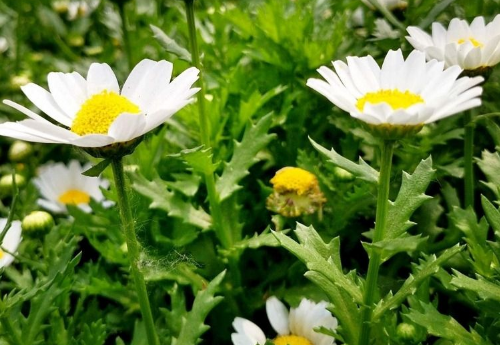
Daisies are raised in autumn and winter. The plants are delicate and small, green and lovely. They send up stems and bloom in spring, making them a rare spring chrysanthemum, and they feel especially fresh. They are usually planted in groups in flower beds or potted and placed on balconies, walkways and other places for viewing. The leaves of daisies are spoon-shaped, clustered and rosette-like, dense and low-growing, with a jade-green color. Flower stems are drawn out from between the leaves, one stem and one flower, arranged in a staggered manner, with a simple and rustic appearance; the flowers are dainty and exquisite, with harmonious colors.
If you look carefully, the spherical capitulum has yellow tubular flowers clustered in the center, surrounded by brightly colored ligulate flowers, commonly known as petals. The colors include white, pale red, deep red and others. Matched with a clump of tongue-shaped leaves, they form a small and exquisite pattern. Blooming in early spring, full of vitality, possessing the demeanor of a gentleman and a romantic and innocent charm, they are deeply loved by Italians, who designated them as the national flower. The flower language of the daisy: eternal happiness.
How do daisies propagate? The propagation methods of daisies
Daisies bloom in early spring, full of vitality, possessing the demeanor of a gentleman and a romantic and innocent charm, and are deeply loved by Italians, who therefore selected them as the national flower. So how do daisies propagate? Below, let me introduce the propagation methods of daisies.
How do daisies propagate? The propagation methods of daisies
Daisies can use multiple methods such as division, cutting, grafting and sowing. The grafting method and sowing method have high technical requirements and relatively cumbersome propagation processes. Without superb cutting and grafting skills, as well as selection of good varieties and artificial pollination techniques, it is very difficult to propagate successfully. These two propagation methods are also only carried out in nurseries when large numbers of seedlings are needed. For home chrysanthemum growing, division and cutting are generally used for propagation.
Seed propagation
In the south, sowing is mostly done in autumn from August to September, and spring sowing is also possible, but growth is often poor in summer. In the north, sowing is mostly done in spring, and autumn sowing is also possible, but in winter the flower seedlings need to be moved into a greenhouse for cultivation and management. Because daisy seeds are relatively small, broadcasting is usually adopted. However, sown seedlings often cannot maintain the characteristics of the mother plant. Before sowing, apply sufficient decomposed organic fertilizer as base fertilizer, and deeply plow and finely harrow to make flat beds. Mix the seeds evenly with fine sand and broadcast, then cover with fine soil about 0.5 cm thick. After sowing, cover with a shade net and water thoroughly.
After sowing, maintain the temperature at around 28°C. In early spring, when it is cold, overcast and rainy, cover with plastic film to maintain soil moisture and temperature. Watering should be done with a fine spray to prevent the soil surface from crusting. After about 10 days, the seedlings emerge; remove the shade net or plastic film, and when the seedlings have 2-3 leaves, they can be transplanted to the field. Garland chrysanthemum can be directly sown. In southern China, sowing can be done in February, while in cold northern regions sowing can only be done in early April. The seeding rate is about 0.2 kg per mu.
Division propagation
Because seedlings grown from seed vary greatly, division propagation can be used for some superior varieties, but the growth vigor is not as good as that of seedlings grown from seed, and seed setting is poor. In mid-to-late March, the old clumps of garland chrysanthemum can be dug out to expose the root crown, and the lateral buds that already have roots are cut off together with the old roots and transplanted into the field. Division propagation is more suitable when new shoots are sprouting.
Cutting propagation
Cutting propagation can be carried out throughout the growing season, with the highest survival rate for cuttings taken from April to June. The seedbed is best made with new soil mixed with composted decomposed organic fertilizer. Cut branches with 3-5 nodes and a length of 8-10 cm, remove the basal leaves, and insert them to a depth of 1/3-1/2 of the length of the cuttings. After cutting, keep the seedbed moist and avoid waterlogging. In high-temperature seasons, shading is needed, while when the temperature is lower, a plastic film arched shed can be built to preserve heat and moisture. Generally, after 15 days they can be transplanted to the field.