Detailed Guide to Daisy Cultivation Methods and Precautions
1. Light
Daisies love sunlight and also tolerate partial shade. Especially during the flowering period, ample sunlight will make the flowers bloom more vividly, but be careful to avoid strong sunlight in summer.
2. Water
Daisies have a high water demand during the germination stage, so water moderately and more frequently to keep the soil moist. Once the seedlings begin to grow, reduce watering, and generally wait until the soil is dry before watering.
3. Temperature
Daisies prefer warmth, and the suitable growing temperature is 20-25°C. In summer, avoid high temperatures and keep them in partial shade. In winter, keep the temperature above 5°C for healthy growth.
4. Fertilizer
The healthy growth of daisies requires not only nutrients in the soil but also regular topdressing. You can choose some compound fertilizer, and be sure to use diluted fertilizer to avoid burning the plant roots due to excessive concentration.
Daisy Cultivation Methods
DaisyCultivation methods: Daisies are often sown in autumn and grown as biennials, while in high-cold regions they are sown in spring and grown as annuals. Sow and propagate in open-ground seedbeds in mid-August or early September. After sowing, shade with reed curtains; do not cover with plastic film. Once the seedlings emerge completely, remove the curtains. When two or three leaves have grown, transplant for the first time with bare roots and without original soil. When the seedlings grow 3〜4 true leaves, transplant with a soil ball once or twice, which can promote the development of large lateral roots and prevent spindly growth. Daisies are tolerant of cold during overwintering, but fear severe frost and dry wind. The thickness of reed mats and the timing of covering and removing them should be flexibly controlled according to the growth of the flower seedlings and changes in temperature, so as to prevent spindly growth and effectively control the flowering period. For those transplanted once or twice in autumn, they can be directly planted in flower beds in spring when flowers appear. For those that were divided in autumn but not transplanted between beds, in spring it is best to maintain them in beds with sufficient base fertilizer until they take shape, then plant them in flower beds or ship them to market. When planting, apply leaf mold or barnyard manure as base fertilizer, with a plant spacing of 15 cm. After planting, water once every 7〜10 days. Apply thin manure water once every 2〜3 weeks until flowering.
Daisies like sufficient sunlight during the growing period and do not tolerate shade. After autumn sowing to promote vigorous growth, if there has been no seedling division or transplanting, the seedlings can be lifted at the end of October, separated, with a little original soil attached to the root clumps. Then take a handful of prepared moist, fertile soil rich in humus and slightly clayey, place one or two seedlings in the center of the soil and squeeze tightly into a ball, then store them one by one in a sunny bed, mist to keep moist, so as to promote vigorous fibrous root growth and make the plants small and sturdy. The following spring they can be directly planted in flower beds or sold on the market without easily wilting.
>Ornamental and Application
Daisies are raised in autumn and winter. The plants are delicate and small, green and lovely. They bolt and bloom in spring, making them a rare spring chrysanthemum and all the more refreshing. They are usually planted in groups in flower beds or potted and placed on balconies, walkways and other places for viewing. The leaves of daisies are spoon-shaped, clustered and rosette-like, densely dwarf-growing, and emerald green in color. Flower stalks emerge from between the leaves, one flower per stalk, arranged in a scattered pattern. The appearance is simple and unsophisticated, the flowers are small and exquisite, and the colors are harmonious.
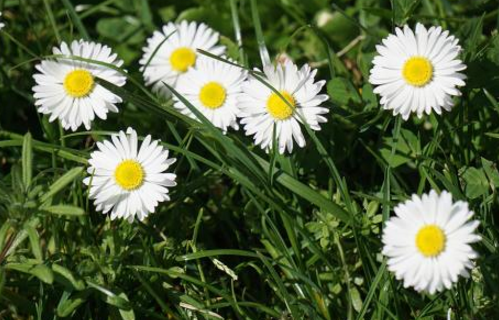
If you look carefully, the spherical flower head has yellow tubular flowers clustered in the center, surrounded by brightly colored ligulate flowers, commonly known as petals. The colors include white, pale red, deep red and so on. Matched with a clump of ligulate leaves, they form a small and delicate pattern. Blooming in early spring, full of vitality, with the demeanor of a gentleman and a romantic, innocent charm, it is deeply loved by Italians, who designated it as the national flower. The flower language of the daisy: eternal happiness.
Daisy Cultivation Methods and Daisy Benefits and Effects
Daisy plants are small and exquisite, diverse in type, and brightly colored in flower, so many people like to grow them at home. Below, we introduce the cultivation methods of daisies and their benefits and effects.
Daisy Cultivation Methods
1. Light regulation: Daisies also like sunlight, including during the growing period and flowering period. Sufficient light can promote plant growth, make the leaves tender green, and increase the number of flowers.
2. Temperature control: They like cool and moist conditions, tolerate cold but not intense heat. The most suitable temperature is 18-22°C. Daisies can bloom normally at 10-25°C. When the temperature is below 10°C, growth is relatively slow. If the temperature is above 25°C, the flower stems will elongate, and both growth vigor and flowering will decline.
3. Water and fertilizer management: Daisies like fertile soil. Topdress once every 7-10 days. You can use 20-10-20 and 14-0-14 flower fertilizers, or use compound fertilizer for spot application or dissolve it in water for irrigation, at a concentration of 200-250 ppm. Giving sufficient water and fertilizer during the growing season makes them grow luxuriantly and can extend the flowering period.
4. Cultivation management: Daisies are relatively tolerant of transplanting, and transplanting can make them produce more roots. They do not need shaping pruning or pinching to control the flowering period. For those transplanted once or twice in autumn, they can be directly planted in flower beds in spring when flowers appear. For those that were divided in autumn but not transplanted between beds, in spring it is best to maintain them in beds with sufficient base fertilizer until they take shape, then plant them in flower beds or ship them to market.
5. Pests and diseases: The main diseases of daisies include damping-off at the seedling stage, gray mold, brown spot, anthracnose, and downy mildew (can be controlled with chlorothalonil 800-**** times, and thiophanate-methyl 1000-1500 times); pests include aphids and others.
Daisy Benefits and Effects
1. Medicinal effects
Daisy is also called dried chrysanthemum and white chrysanthemum, and its medicinal value is very high. It also contains volatile oil, amino acids and various trace elements. Among them, the content of brass is 32% to 61% higher than that of other chrysanthemums, and the content of tin is eight to fifty times higher than that of other chrysanthemums.
The agronomist Zhang Luxiang once wrote in his work Supplement to the Book of Agriculture: "White chrysanthemum is sweet and warm in nature, and taking it for a long time is most beneficial. The ancients ate the seedlings in spring, the flowers in summer, and the roots in winter, and there was a reason for this. Plant one or two plants at each field ridge, harvest the flowers, and it can replace half of tea. The nature of tea is bitter and cold, and it can be brewed together with bitter chrysanthemum.
2. Ornamental effects
The leaves of daisies are spoon-shaped, clustered and rosette-like, densely dwarf-growing, and emerald green in color. Flower stalks emerge from between the leaves, one flower per stalk, arranged in a scattered pattern. The appearance is simple and unsophisticated, the flowers are small and exquisite, and the colors are harmonious. Flower stalks emerge from between the leaves, one flower per stalk, arranged in a scattered pattern. The appearance is simple and unsophisticated, the flowers are small and exquisite, and the colors are harmonious. Blooming in early spring, full of vitality, with the demeanor of a gentleman and a romantic, innocent charm.
3. Horticultural effects
Daisies have strong growth vigor and are easy to cultivate. The flower stalks of daisies are moderate in height, the flowers are neat, and the colors are bright and plain. They can be potted to beautify courtyards and balconies, and can also be used for garden viewing, potted plants, flower borders, cut flowers and so on.
The flowering period is long and cold resistance is strong, making it the first choice for early spring groundcover flowers. As groundcover flowers for street green spaces, daisies have strong appeal and can be planted together with pot marigold, pansy, azalea, Berberis thunbergii f. atropurpurea and so on.
4. Whitening effects
Daisy is a natural beauty product, and whitening is its most important effect. The flowers of this plant contain a large amount of essential oil and chrysanthemum pigment. After extraction, they can be made into many kinds of cosmetics, with the effect of removing melanin and softening epidermal cells. Regular consumption can make the skin increasingly fair and attractive.
5. Air purification
Daisies are an ideal choice for greening the environment. Their ornamental value is very high. Placing them indoors can make the indoor environment fresh and pleasant. Moreover, when daisies carry out photosynthesis, they can also absorb a large amount of harmful substances from the air and convert them into oxygen beneficial to the human body. Their effect on purifying the environment is obvious.
The above is an introduction to daisy cultivation methods and daisy benefits and effects. We hope it can help everyone. For more home knowledge, please stay tuned.