What are the care methods and precautions for the bird's nest fern?
1. Water
Spring and summer are the peak growing season for the bird's nest fern, so water it more at this time, and also mist the leaves frequently to keep them clean. Maintain humidity at 70%-80%, and do not let water accumulate, otherwise root rot will occur.
2. Division and pruning
When the bird's nest fern grows very dense, it produces small offsets. In late spring you can use a small knife to cut some of the roots away and plant them separately. Keep the potting soil moist when dividing the roots. For a newly planted bird's nest fern, you can cut off some of the old leaves, which is better for the plant's growth.
3. Pest and disease control
The bird's nest fern generally does not have pest problems, but when the air is too dry, red spider mites can cause damage, which can be treated by spraying with a targeted pesticide. Some plants can also be harmed by anthracnose; spray with a 600-fold dilution of 50% carbendazim in the early stages of the disease for control.
Alright, the above are the ways to deal with scorched leaves on the bird's nest fern. I hope the bird's nest ferns you grow will be healthier and more beautiful.
How to grow the bird's nest fern
1. Temperature
The suitable growing temperature for the bird's nest fern is 22-27°C. It is not tolerant of high temperatures or cold, and in winter it must not go below 5°C. If the temperature is too low, the leaf edges can easily turn brown, and the plant may even be frostbitten and die.
2. Light
The bird's nest fern is a shade-loving herbaceous plant and does not need much light. A moderate amount of diffused light is enough to maintain its normal growth. Keep it away from strong direct light, and potted plants can be kept long-term in a bright indoor spot.
3. Soil
To grow the bird's nest fern, you can choose a mix based mainly on leaf mold or peat soil and vermiculite, with a small amount of river sand added, or use a potting mix made by blending fern roots, crushed bark, moss, or crushed brick granules with a small amount of humus soil. Each spring you can add a small amount of crushed lime to the pot, which is better for the plant's growth.
4. Water
The bird's nest fern grows rapidly in summer, and at this time it needs more water to maintain air humidity. When watering, also be sure to water thoroughly, because its leaves become denser and denser; watering thoroughly can prevent the leaves from drying out and curling.
How to care for the bird's nest fern: growing methods and precautions for the bird's nest fern
The bird's nest fern's naturally spreading emerald-green leaves are like an enthusiastic, unrestrained young person waving to you. Besides being beautiful, it also has medicinal value. So what exactly are the growing methods and precautions for this treasure of a bird's nest fern? I believe everyone wants to know, so the following content is not to be missed.
Growing methods and precautions for the bird's nest fern
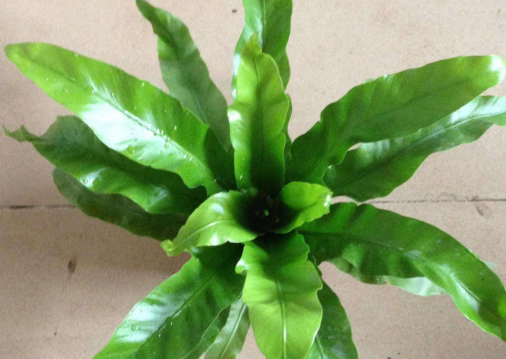
The bird's nest fern, also known as shan su hua, is a plant of the bird's nest fern (Asplenium nidus) in the spleenwort family (Aspleniaceae), native to eastern Australia, Southeast Asia, Indonesia, and other places. The plant is about 0.8-1 m tall, with an upright stem that is thick and short. The scales are broadly lanceolate, the midrib is raised on both sides, and the other leaves all spread out naturally. Like other ferns, it bears spores and has no flowering period. It likes to grow in hot, humid environments, but cannot withstand strong light.
The temperature suitable for its growth is between 16°C-27°C, and it needs to grow in moist potting soil; it also has relatively high requirements for relative air humidity. Because summer temperatures are generally high, it needs frequent watering to ensure the plant has enough moisture so that the leaves do not dry out and curl. When choosing a potting medium, you can use leaf mold, vermiculite, or peat soil as the main component, and mix in a small amount of river sand to use as the growing soil. In its early growth stage, it needs fertilizing once every 20 days; once it matures, there is no need to apply additional fertilizer.
Edible/medicinal value of the bird's nest fern
What many people do not know is that, besides its ornamental value, the bird's nest fern has many other uses.
It is a little expert at purifying the air. The bird's nest fern is also a must-have green plant for a new home, because it can purify the air and remove the strong odor of formaldehyde, making it one of the recommended gifts for a housewarming.
It is a good helper for healing injuries and recovering from illness. Because it is rich in potassium, iron, calcium, vitamin A, dietary fiber, and other substances, it can strengthen bones and muscles and promote blood circulation to remove stasis. In addition, it can also be used in the treatment of fractures, headaches, and other conditions.
It is a bitter yet pleasant-tasting good dish. The tender shoots of the bird's nest fern can be eaten; simply rinse them clean and blanch them briefly in boiling water, and they are ready to eat, or they can be used as a side dish and eaten together with other ingredients.
After reading this introduction to the bird's nest fern, a treasure from top to bottom, are you itching to grow one yourself? Although growing the bird's nest fern is not difficult, you should not be careless either. You should know that growing a plant well takes time and patience, and I hope every plant lover can take a little inspiration from this.