Key Techniques for High-Yield Cultivation of Early-Maturing Autumn Chinese Cabbage
11. Select superior varieties.For early-maturing autumn Chinese cabbage, choose varieties with good early maturity, strong heat tolerance, strong disease resistance, and outstanding yield potential, such as the Xiaoza series and Zaoxinbai.
22. Sow at the right time.The growth period of early-maturing autumn Chinese cabbage is generally50~60days, and the market period should preferably come before that of the mid-to-late-maturing autumn Chinese cabbage, which is planted on a larger area. Sowing too early tends to trigger pests and diseases, while sowing too late delays the market period and defeats the purpose of early-maturing cultivation.
The suitable sowing period for early-maturing autumn Chinese cabbage is7late month to8early month, preferably about10days before the Start of Autumn (Liqiu), and the market period should come before National Day.
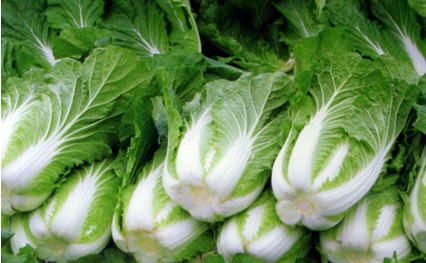
33. Balanced fertilization.Early-maturing autumn Chinese cabbage is a high-yield vegetable variety, generally yielding about4000kg per mu, and it has a relatively large demand for fertilizer. The principle of fertilization is to emphasize base fertilizer and apply appropriate topdressing. Before sowing, while plowing the land, apply5000kg of high-quality farmyard manure and40kg of a three-element compound fertilizer with high nitrogen, low phosphorus, and medium potassium. The previous crop is best a plot that has not grown cruciferous vegetables. If the plot has been planted with vegetables for many years, apply2~3kg of biological bacterial fertilizer per mu, which can improve soil conditions and enhance the cabbage's ability to resist pests and diseases.
44. Field management.The early and mid-growth stages of early-maturing autumn Chinese cabbage fall in the hot, humid, and rainy season. The cabbage root system is relatively shallow and is neither drought-tolerant nor waterlogging-tolerant. Severe drought and waterlogging weather will trigger major outbreaks of pests and diseases, seriously affecting yield. In production, traditional planting methods can be actively improved, such as adopting high-ridge cultivation techniques, so that moisture can be conserved in drought and drained in waterlogging. Early-maturing autumn Chinese cabbage should be planted by dibbling, with3~4seeds per hole, and thinned twice. After final thinning, strictly control water and subject the plants to drought hardening for about10days. After entering the rosette stage, focus on strengthening fertilizer and water management. At the early rosette stage, apply urea or nitrogen-potassium fertilizer as topdressing together with watering,20kg; at the full heading stage, apply urea as topdressing,20kg. During the heading stage, keep the soil alternately dry and moist to ensure a sufficient water supply and increase yield.
55. Disease and insect control.The growth period of early-maturing autumn Chinese cabbage occurs under high-temperature and high-humidity conditions, so pests and diseases occur to a relatively high degree. Common pests and diseases include aphids, tobacco budworms, cabbage caterpillars, and soft rot. For aphids, imidacloprid can be used as a1000-fold solution spray; for pests such as tobacco budworms and cabbage caterpillars, beta-cypermethrin can be used as a1500-fold solution spray. Chinese cabbage soft rot is extremely common under high-humidity conditions. In the early stage of the disease, agricultural streptomycin can be used for spray drenching. In severe cases, the plants should be pulled out with roots, taken out of the field, and deeply buried, and quicklime should be spread around the diseased holes to prevent the spread of pathogens.
66. Harvest at the right time.The growth period of early-maturing autumn Chinese cabbage is relatively short, generally about50~60days. When the leaf head grows compact and firm, the outer leaves turn yellow, and the weight per plant is about2kg, it can be cut and harvested. When harvesting, use a chopping knife or kitchen knife to cut it off from the base of the cabbage root, remove the outer old leaves, diseased leaves, and yellow leaves, and keep two or three leaves on the outside of the leaf head to prevent mechanical damage and protect the leaf head.