What to Do When Corn Is Hit by Disaster and Lodges? Detailed Explanation of Loss-Reduction and Remedial Measures
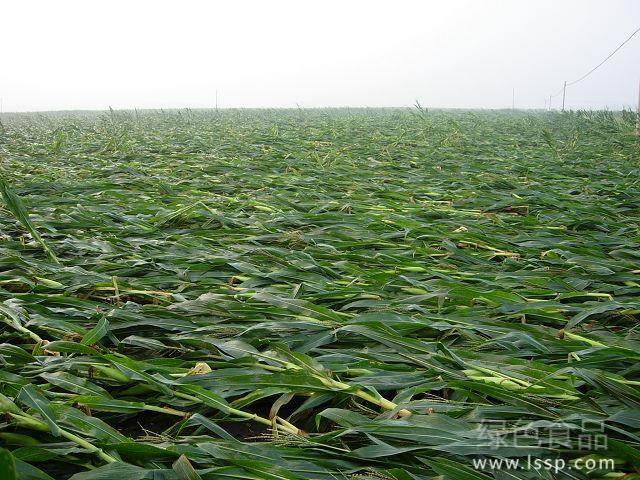
Corn Lodging
After storms cause crops such as corn to lodge, the leaves press against each other, changing the original rational spatial distribution, limiting photosynthesis, affecting dry matter accumulation, interfering with the normal growth and development of corn, and worsening pest and disease damage. To reduce the disaster to a minimum, the following disaster-reduction technical measures can be taken.
1. Drain field water as early as possible. For plots that still have standing water in the field, dredge drainage ditches and cross ditches early to drain the standing water. For plots that cannot be drained by drainage ditches and cross ditches, use mechanical pumping and other machinery to drain the water.
2. Manually lift the plants. When people can enter the field after the rain, use manual methods to lift the plants upright. Plants that have lodged more than 60° (with an angle of less than 30° to the ground) need to be manually lifted. When lifting, bank soil around the roots, and do not lift them too straight; make the stalks form an appropriate angle with the ground (an angle of about 60° to the ground is suitable), to avoid breaking more roots. Do not use too much force, to avoid breaking the stalks.
3. Control diseases in time. Spray 70% thiophanate-methyl 800-fold solution, or 50% carbendazim 500-fold solution, or 75% chlorothalonil 300-fold solution to control leaf diseases, once every 7-10 days, for 2-3 consecutive sprays.
4. Foliar fertilizer spraying. Along with disease control, spray a mixed solution of 2% urea and 0.25% potassium dihydrogen phosphate on the leaves to increase leaf photosynthetic intensity and increase dry matter accumulation.