Konjac has strong adaptability and high economic benefits: detailed explanation of sowing and cultivation techniques
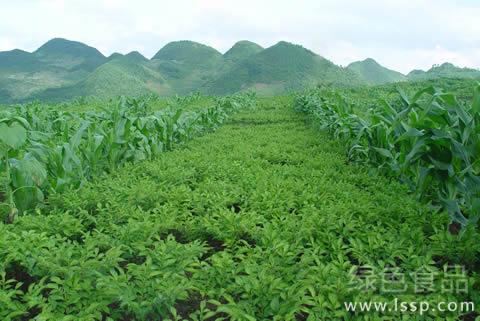
Konjac cultivation
Konjac, also known as ghost head and flower connecting stalk, with the scientific name konnyaku, is a perennial herbaceous plant of the Araceae family.
Konjac is extremely rich in nutrients. According to measurements, konjac contains a large amount of glucomannan, 17 kinds of amino acids needed by the human body, and a variety of unsaturated fatty acids. According to medical monographs such as Compendium of Materia Medica and Dictionary of Traditional Chinese Medicine, konjac has functions such as reducing swelling, dispersing toxins, resolving phlegm, promoting blood circulation, and strengthening the stomach, so it is favored by the world health food market and is popular in Southeast Asia. Moreover, the price is high; each ton of konjac refined powder reaches more than 2,000 US dollars on the Hong Kong, China and Macao, China markets.
Konjac has wide adaptability and does not demand much from conditions such as soil and temperature. It can be planted in plains, mountainous areas, field edges and corners, and in front of and behind houses. Konjac has high use value and can be processed into a series of foods such as konjac noodles, pastries, jam, and small champagne, as well as medicines. Therefore, the prospects for developing and utilizing konjac are very broad.
1. Choose a good plot and prepare the land finely. Choose a sandy loam gentle slope with loose and fertile soil, deep soil layer, shady and cool conditions, and no water accumulation, prepare the land finely, open furrows and make beds in preparation for sowing. For continuous cropping plots, 10 days before sowing, evenly spread 50—100 kg of quicklime per mu and plow it into the soil. Plots continuously cropped for 3 years must be rotated.
2. Form ridges and make beds, and practice intercropping. Konjac sowing adopts deep furrows and high beds (ridges), with ridge cultivation; keep ridge furrows more than 35 cm, bed width 40—120 cm, place the apical bud obliquely at a 45-degree angle, and cover with 10—15 cm of soil after sowing. When planting, pay attention to "shallow planting, deep hilling." When sowing, advocate covering the bed surface with grass, "using grass to control grass," with a thickness of 5—10 cm. For plots with more than 8 hours of sunlight, intercropping should be carried out, usually using the konjac—corn model. For corn, choose medium-maturity tall-stalk varieties with a growth period of about 130 days, raise seedlings in late March, transplant in mid-April, with a plant spacing of 30—40 cm; when transplanting, the corn leaves should be perpendicular to the konjac. After the corn is harvested at the end of July and the beginning of August, handle the corn straw promptly to provide sufficient light for konjac growth.
3. Carefully select seed corms and disinfect them. Choose those with glossy skin, regular shape, small bud eyes, flat mouth, thick and strong apical bud, smooth surface, and no scars, disease, or injuries as seed corms. Before sowing, air-dry the seed corms for 2—3 days and disinfect them in conjunction with air-drying. Methods: ① For each kilogram of seed corms, use 2 ml of 40% formaldehyde + 1 g of potassium permanganate for closed fumigation for 24 hours; ② use 500 times 72% agricultural streptomycin and 500 times 53.8% Kocide solution, alternating spray disinfection 2—3 times.
4. Sow at the appropriate time and plant reasonably densely. The suitable sowing period for konjac is March 20—April 10, slightly later in high-altitude areas and slightly earlier in low-altitude areas. When sowing, grade the seed corms by size and cultivate them by category. For sowing density, use 6 times the diameter of the seed corm as the row spacing and 4 times the diameter of the seed corm as the plant spacing.
5. Fertilize scientifically. The overall principle of konjac fertilization is to mainly use farmyard manure and supplement with chemical fertilizer; to mainly use base fertilizer and supplement with topdressing, and to persist in increasing phosphorus, controlling nitrogen, and supplementing potassium. Apply 2,500—5,000 kg of farmyard manure per mu as base fertilizer, 40 kg of potassium sulfate compound fertilizer, or apply 40 kg of potassium sulfate compound fertilizer per mu and 50 kg of ecological organic fertilizer. Use furrow application: first open furrows and band-apply organic fertilizer and chemical fertilizer, then cover the fertilizer with soil, then place the seed corms obliquely on both sides of the fertilization furrow, and finally form ridges and cover the seed with 15—20 cm of soil. During fertilization, strictly implement fertilizer-seed separation to avoid rotting the seed and burning the seedlings.