Key technical points for autumn and winter management of tea gardens to help achieve high tea yields
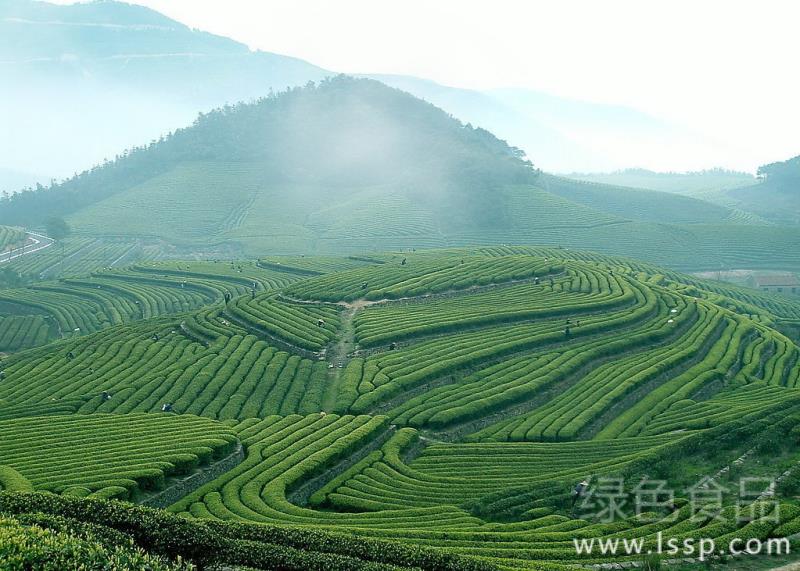
Tea garden
After a year of picking, the tea plant body suffers great damage. Doing a good job of winter cultivation in the tea garden in a timely manner is a key measure in the annual management of tea gardens, and it is crucial for speeding up the recovery of the plant body, building up a strong plant vigor, and securing high-quality and high-yield tea the following year.
Experts explain that autumn and winter management of tea gardens generally starts in October of the current year and ends in February of the following year. The main technical measures are as follows:
1. Tea plant pruning. This is generally carried out from October to November, and in high-mountain tea gardens it may be appropriately advanced by 10-15 days. Productive tea gardens are generally lightly pruned once a year, with the pruning position raised 5-8 cm above the previous year's cut. First prune the tea canopy, then carry out edge pruning. Tea canopy pruning is often done into a horizontal shape or a tile-backed shape. Edge pruning requires cutting off excess branches at the edges of the tea rows, leaving 30-40 cm of ventilation passages and operation rows. For low-yield tea gardens with many fine and weak branches and chicken-claw branches, deep pruning should be carried out, cutting off branches that exceed the canopy surface by 10-15 cm and cutting off all chicken-claw branches. After pruning, fertilizer and cultivation management of the tea garden should be strengthened.
2. Apply basal fertilizer heavily. The fertilization time is generally from mid-to-late October to early-to-mid November, and no later than the end of November. The overall principle is to give priority to organic fertilizers, apply a certain amount of quick-acting fertilizers in combination, and supplement corresponding trace element fertilizers according to the soil fertility status of the tea garden. Usually, tea-specific fertilizer, cake fertilizer, human and livestock manure, and organic compound fertilizer are the main types, and sulfur-containing nitrogen fertilizer is used as chemical fertilizer, while chlorine-containing nitrogen fertilizer is prohibited. Formula fertilization is carried out according to the soil fertility status of different tea gardens and the harvesting situation throughout the year. Generally, about 2,000 kg of organic fertilizer is applied per mu. For a yield of less than 250 kg of fresh tea leaves per mu, apply 12 kg of nitrogen fertilizer, 6 kg of phosphate fertilizer, and 8 kg of potassium fertilizer per mu; for a yield of 250-350 kg of fresh leaves per mu, apply 11 kg of nitrogen fertilizer, 5.5 kg of phosphate fertilizer, and 7.5 kg of potassium fertilizer per mu; for a yield of more than 350 kg of fresh leaves per mu, apply 10 kg of nitrogen fertilizer, 5 kg of phosphate fertilizer, and 7 kg of potassium fertilizer per mu. Adopt the method of digging trenches and burying fertilizer combined with deep plowing of the soil, that is, dig a fertilization trench 20 cm deep and 25 cm wide vertically below the outer edge of the tea canopy, evenly scatter the fertilizer into the trench, and then cover it with soil. For terraced tea gardens, fertilizer should be applied on the inner side of the terrace.
3. Deep plowing and weed removal. The time for deep plowing of tea gardens is generally from late September to mid-October each year, with a depth of 15-20 cm. During deep plowing, weeds are removed and buried in the soil. Generally, deep plowing can be carried out in combination with applying winter fertilizer.
4. Clear ditches and drain waterlogging. Carry out a comprehensive repair and clearing of the drainage ditches in the tea garden. For tea gardens where tea plants died due to low-lying water accumulation, reasonably open ditches to guide drainage, strive for smooth drainage, and at the same time make preparations for drainage in the coming rainy season, strictly preventing waterlogging from killing seedlings.
5. Clear the garden and spray pesticide. First, clear dead branches and fallen leaves from the tea garden and burn them outside the garden or bury them deeply, then spray with 0.5-0.8 degrees Baume lime-sulfur mixture. When spraying, ensure that the upper and lower parts, inside and outside of the tea bushes, and the front and back of the leaves are all sprayed, and the weeds on the ground and the branches inside the canopy are also sprayed to improve the control effect. Closing the garden should be completed before the end of November.
Experts remind that for tea gardens in high-mountain areas, preventing low-temperature freezing damage in winter is very important. The commonly used measures are as follows:
1. Soil banking around the rhizosphere: Soil banking at the roots is carried out in combination with deep plowing, usually after fertilization. Build up a new soil layer 8-10 cm thick at the base of the tea plant to prevent the root system from being exposed and suffering freezing damage. For terraced tea gardens with severe soil and water loss, soil banking work should be done even more well.
2. Straw mulching in tea gardens: Carry out from mid-October to early November. Use local materials, covering between rows with firewood grass, straw, barnyard manure, or rice straw. About 1,500-2,000 kg of straw is needed per mu. The part around the tea plant roots should be thicker to prevent the tea garden from freezing.
3. Canopy covering: Crop straw, weeds, or plastic film can be used to cover the canopy, and the covering should be removed in time after the beginning of spring.
4. Smoke to drive away frost: Always pay attention to weather changes. Before frost arrives, use smoke to drive away frost. The method is to set up piles and ignite them before the late frost comes, when the temperature drops to about 2°C, according to wind direction, terrain, and area. This both prevents late frost damage and accumulates fertilizer.
Experts explain that for the management of young tea gardens and nurseries, the focus is on strengthening prevention of low-temperature freezing damage. For young tea plants, before low-temperature cold waves arrive, shade nets and other materials can be used to cover the canopy, or plastic film, rice straw, or weeds can be placed over the shade nets; rice straw can also be used directly to cover the tea bushes to protect the tea plants and enhance their ability to resist frost. For cutting propagation nurseries, water management and shade and heat preservation work should be strengthened. Before cold waves arrive, promptly check the integrity of the plastic film arched sheds, use shade nets to cover the film, promptly replace or repair damaged film, and press down the film edges of the arched shed furrows and both ends to prevent cold wave invasion. If it snows, promptly clear the accumulated snow on the shade shed.