Loquat tree pruning methods and key points: adjust tree vigor for more fruit
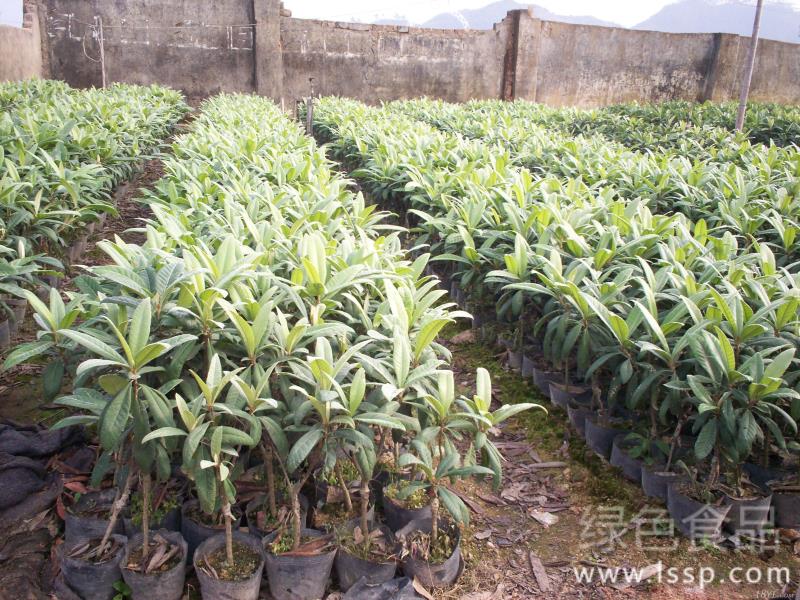
Loquat sapling
The pruning timing for loquat trees must be adjusted according to different conditions such as region, tree age and tree vigor. For young trees that have not yet fruited, pruning can be done after each shoot flush stops growing and before the next shoot flush emerges. For mature trees, if spring fruiting is excessive, only auxiliary pruning can be carried out.
Summer pruning after harvest is the most important pruning of the year for loquat trees; it should be done early rather than late, and a heavy fertilizer application should follow harvest. If it is a late-maturing variety, the fertilizer can be applied 1 week before harvest instead. If it is an old tree, a heavy fertilizer application should be given before fruit thinning in early spring.
The following are several pruning methods for loquat trees, for reference.
1. Bud removal: during the shaping stage of young trees before they bear fruit, in order to achieve a rational arrangement of main branches, secondary main branches and branch groups, buds with suitable direction and position are selected and kept when they sprout, and excess buds are removed, so as to concentrate nutrients on developing strong main branches, secondary main branches, etc. On mature trees, bud removal can reduce the number of branches, make fruiting branch groups full and robust, and benefit fruiting.
2. Thinning: loquat has the characteristic of producing whorled branches, and the tiers are fairly close together, resulting in a canopy with many shoots at the top and few at the bottom, many outside and few inside, and insufficient light. Therefore, dense branches, weak branches, overlapping branches, crossing branches, water sprouts and surplus branch groups or weak large branches with no room to develop inside the canopy should be thinned out. When thinning fruiting branches, remove the weak and keep the strong, remove inward-growing branches and keep outward-growing ones, so that on each mother branch 1 out of 3 fruiting branches is removed and 2 out of 5 are removed, so that the retained fruiting branches are distributed outward and on both sides of the mother branch. The degree of thinning should be heavier at the top of the canopy and lighter at the bottom, heavier outside and lighter inside.
3. Thinning out: in areas without freeze damage, in order to regulate alternate bearing and ensure a high and stable yield year after year, during the full fruiting period the fruiting branches of an "on" year should be thinned out. Usually the ratio of fruiting branches to vegetative branches on the whole tree is 3:2. If there are too few vegetative branches, some flower clusters on the fruiting branches should be cut off so that they become fruiting branches the following year. If both the mother branch and the fruiting branch bear fewer than 3 large leaves, they are weak branches and can be removed from the base; if there is a certain amount of space or the tree would be too open after cutting, 1-2 leaves can be retained and the branch headed back.
On loquat trees that have just begun fruiting or have just entered the full fruiting period, the ratio of vegetative branches to fruiting branches at the outer canopy is 2:1, while inside the canopy it is 1:2 or 1:3-4. In areas with freeze damage, before spring shoots emerge, when it can already be identified whether or not damage has occurred, the terminal flower clusters can first be cut off, or, based on surveys over the years, if freeze damage on shoots in a certain direction is more severe, the flower clusters can be cut off early so that spring shoots emerge.
Loquat tree
4. Heading back: this mainly refers to fruiting branches. Generally, depending on the position, space and vigor of the fruiting branch, 5-30 cm is retained for heading back; terminal summer-shoot fruiting branches are headed back leaving 5-10 cm, to prevent the shoots from moving outward and the base from becoming bare. For lateral summer-shoot fruiting branches, outward-growing ones should be headed back leaving a longer stub, while those growing to the sides should be left shorter, generally 10-20 cm is appropriate, so that after new shoots emerge the new growth will show a clear hierarchy and reasonable distribution. When heading back, the outer and upper parts of the canopy should be pruned lightly with longer stubs, and the lower and inner parts pruned heavily with shorter stubs; strong branches left long, weak branches left short. In terms of the number of cuts, more should be left at the outer canopy and upper part, and fewer inside and at the lower part.
5. Renewal pruning: fruiting branch groups whose bases have begun to become bare, whose shoots have drooped and whose vigor has declined should be cut back to varying degrees, to the extent that they can sprout vigorous summer shoots; be careful not to cut back too heavily, otherwise water sprouts are likely to emerge and disrupt the canopy.
6. Pruning of water sprouts: in young trees, or trees being reshaped or top-grafted for variety change, water sprouts are very likely to appear during reshaping or top-grafting. First, water sprouts should be fully utilized; second, they should be reshaped and finally cut off from the base. If there is a lack of scaffold branches and large fruiting branch groups nearby, their space can be fully used; if they are to serve as large fruiting branch groups, they should first be trained flat or at an angle to moderate their growth vigor, and after they have reached a certain length they should be pinched to encourage branching so they become good scaffold branches or large fruiting branch groups. If such branches are not trained flat or at an angle, or pinched, early on to make them branch, then although they may also branch at the next shoot flush and may bear fruit the year after next, they tend to remain upright, bare at the base and far from the scaffold branches, and in the end still have to be renewed and cut back; it is better to head them back early to make later renewal easier.
7. Renewal pruning of old trees: loquat trees generally do not age easily. However, if fertilizer is insufficient, if shaping and pruning are neglected, and especially if planting is too dense, premature aging can occur. To rehabilitate such trees, first strengthen fertilizer and water management and thin out overcrowded trees, and second carry out renewal pruning.
The renewal pruning method is to thin out surplus large branches in a planned way year by year, lower the canopy, and thin out excessively dense and thin 2-4 year old branches at the outer and top parts of the canopy. Vigorous 2-4 year old branches should be retained as much as possible, and part of them headed back, leaving a stub of 5-15 cm. Shoots sprouting from the trunk inside the canopy should be retained as much as possible; for weak 2-4 year old branches, apart from cutting out excessively thin and weak ones, most should be headed back to encourage new shoots.