Cultivation Techniques for Madeira Vine: How to Grow This Nutrient-Rich Leafy Stem Vegetable
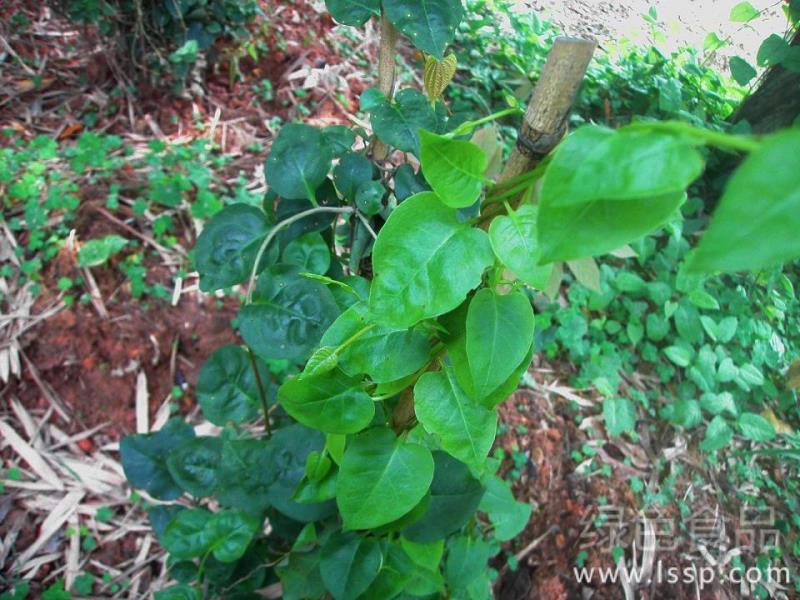
Madeira Vine
Madeira vine can be cultivated in spring, autumn and winter, and can be planted both in protected areas and in open fields, with the best growth achieved in spring and autumn. Madeira vine is a vining vegetable, grown for harvesting tender shoots and leaves. If the main purpose is harvesting leaves, it is best to use a trellis or hanging-vine cultivation method, though ground-crawling cultivation can also be used. Madeira vine easily roots at the stem nodes, and ground-crawling cultivation helps the plant absorb soil nutrients, allowing stems and leaves to grow rapidly and making harvesting more convenient. The drawback, however, is that in the early stage of ground-crawling cultivation, because the plant lies on the ground, sand and other dirt easily adhere to the leaves, affecting leaf quality; in the later stage, cultivation between rows is not possible, which hinders supplementary application of organic fertilizer, so field management must be strengthened through measures such as pruning and trimming. If the main purpose is harvesting tender shoots, the trellis cultivation method should be adopted: when the seedlings reach 30-40 cm in height, set up the trellis promptly to let them climb, and prune at the same time to promote rapid sprouting of lateral buds.
I. Propagation Methods
Madeira vine is generally propagated by bulbils. Plant the bulbils one by one on raised beds 1.4 m wide, in double rows, with a spacing of about 50 cm between plants; about 2000 plants per mu.
Greenhouse Three-Dimensional Cultivation Techniques for Madeira Vine
Three-dimensional cultivation makes use of the vertical space on the three side walls of the greenhouse, or is carried out through various design shapes. It not only effectively uses the surplus/vertical space of the greenhouse, but more importantly can increase the attractiveness of the park and generate more additional income.
In an ordinary park, within a half-meter-wide strip along the inner side of the greenhouse wall, apply about 5000 kg of farmyard manure per mu, deep plow so that the fertilizer and garden soil mix evenly, rake level, and use a hoe to form ridges 0.15 m from the wall. On the sides of the ridges, dig holes at a plant spacing of 0.3 m and plant seedlings, water to settle the seedlings, then set up guide strings, which may serve to secure the seedlings and also help the seedlings twine and grow upward. This method can effectively use the greenhouse space and improve economic returns.
Sightseeing greenhouses can carry out three-dimensional planting by designing different shapes, such as globes, fan shapes, elephants or arbors. On the one hand, this is artistic and increases the park's appeal to visitors; on the other hand, it can increase the growing space for Madeira vine, achieving the multiple goals of "production, living and ecology."
II. Field Management
1. Water management: Madeira vine has strong growth, thick leaves and a large amount of water evaporation during the growing period. Although Madeira vine is relatively drought-tolerant, in order to obtain high-yield, high-quality products it needs to absorb more water, especially in hot seasons, when it should be watered in time and the soil should be kept moist regularly. In rainy seasons, attention should be paid to drainage to prevent waterlogging in the soil, so as to avoid damage to the root system.
2. Fertilizer management: In addition to applying sufficient base fertilizer at planting, Madeira vine requires an adequate supply of nitrogen fertilizer and an appropriate amount of phosphorus and potassium fertilizer for growth. Generally, after every one or two harvests, apply a hole application of thoroughly decomposed, finely crushed farmyard manure at 300-500 kg per mu, or apply high-temperature-sterilized expanded chicken manure at about 200 kg per mu. Weeds should also be pulled out at any time and the soil loosened by cultivation to increase soil aeration.
3. Plant adjustment (pruning, pinching and removing flower clusters): Madeira vine has strong branching, overlapping stems and vines, and luxuriant growth. In production, measures such as pruning, trimming and pinching are needed to control plant growth and development. The specific measures to take should be determined according to plant vigor, cultivation method, planting density, climate conditions, etc. For ground-crawling cultivation, when the vines are 30-40 cm long, remove the growing points of the plants, which can promote thick new shoots, increase and thicken the leaves, and promote the sprouting of new shoots from the leaf axils. Later, as the stems and vines extend, remove their growing points again. After autumn begins, cut off the old stems and vines above ground, and mix organic fertilizer with soil to fertilize and earth up the soil, so as to help the plants rejuvenate. For trellis cultivation, flower clusters appear in autumn planting and these tender shoots should be removed promptly to control the occurrence of flower clusters. Pruning, pinching and removing flower clusters can promote thick, tender leaves and sturdy new shoots, achieving the goal of increasing yield and quality.
III. Timely Harvesting
Madeira vine is planted once and harvested for many years, usually with tender shoots or grown leaves as the product. Tender shoot products are usually picked when the stems and vines have extended to a certain degree (tender shoots 12-15 cm long); leaf products can generally be harvested at any time more than 30 days after planting Madeira vine. After 2 months it enters the peak production period, and on average each plant can have 300-400 leaves picked per month, with a harvest period of about 6 months. For large-scale cultivation, harvesting in the early morning is better, as it is more tolerant of storage and transport. After harvesting, fresh leaves should be wrapped in plastic wrap and stored at 5°C, where they can be kept for 10-15 days. If Madeira vine is cultivated and managed properly, it can be harvested in all four seasons, with an annual yield per mu of up to 3000-4000 kg.