Kiwifruit Winter Pruning Principles and Rational Thinning Techniques
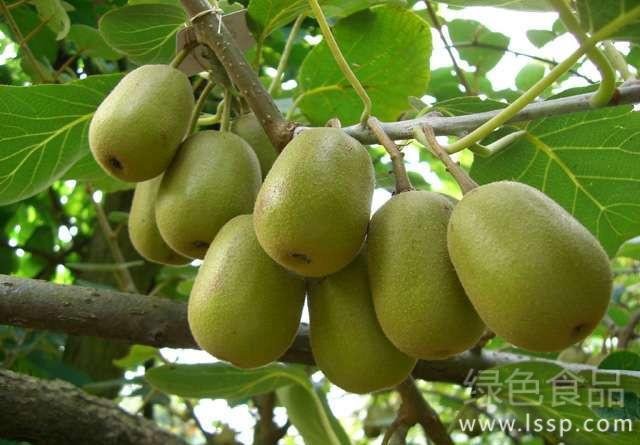
Kiwifruit tree
Winter pruning of kiwifruit mainly involves cutting away some poorly developed water shoots and overly dense branches; carrying out a renovation of some aging fruiting mother branches, fruiting branches can be headed back leaving 2-3 buds above the fruiting position, while short fruiting branches and short condensed fruiting branches should not be headed back but should be thinned. The author now introduces the pruning techniques as follows:
1. Determining the pruning length of fruiting mother branches
The pruning length of fruiting mother branches should be determined according to factors such as variety, training system, trellis size, and soil fertility. For young trees, in order to expand the canopy, fruiting mother branches can be left longer; for weak trees and old trees, some fruiting mother branches should be heavily cut back. The pruning length should be determined according to the thickness and vigor of the fruiting mother branches: strong, vigorous fruiting mother branches should be pruned to leave 20-40 cm; thin, weak fruiting mother branches should be pruned to leave 15-20 cm; fruiting mother branches less than 25 cm in length should generally be removed entirely. Vegetative branches are generally headed back leaving 8-15 buds; short condensed fruiting branches should be removed entirely. The spacing for arranging fruiting mother branches is preferably 30-40 cm.
2. Renewal of fruiting mother branches and fruiting branches
After 1-2 years of fruiting, fruiting mother branches often become weak or even die, and the fruiting position generally cannot sprout, very easily causing the fruiting position to move outward or upward, weakening tree vigor, leading to reduced yield and declining fruit quality. Therefore, when renewing fruiting mother branches, if there are robust fruiting branches or vegetative branches at the base, they can be cut back to a vigorous position, or removed and replaced with fruiting branches or vegetative branches, or cut short at the base where there are latent buds, and the following year select a well-developed new shoot as the fruiting mother branch for the next year. The renewal rate of fruiting mother branches should preferably be 1/4 to 1/3. Fruiting branches that have already borne fruit are generally renewed once every 1-2 years; for short fruiting branch type varieties with weak vigor, the fruiting mother branches or branches that have already fruited need to be renewed every year; for long fruiting branch type varieties with strong vigor, the fruiting mother branches or fruiting branches are renewed once every two years. The number of buds retained per plant is preferably 600-800. When handling fruiting branches, since bud positions 2-6 can generally bear fruit, generally 8-10 nodes should be retained, and for those with particularly good growth and development, at most 15 nodes should be retained, with the rest removed.
3. Pruning of other branches and vines
Vegetative branches should in principle be removed from the base, but those located in empty positions and with potential for training can be retained for renewal purposes, with only the upper thin and weak parts cut off. Dense branches should be thinned, removing the weak and keeping the strong, removing the dense and keeping the sparse; those retained as fruiting mother branches should have the unsubstantial top portion cut off. For crossing branches and overlapping branches, in principle one should be kept and one removed, and the retained branch should have its thin and weak top portion removed; however, if both crossing branches are well positioned and located in an empty gap, both can be retained entirely, with only the mutually crossing portions cut off. For tangled branches that disrupt the tree shape, the tangled portions should all be cut off. For thin and weak branches, dead branches, diseased and pest-damaged branches, and vegetative branches that are poorly developed and have no potential for training, they should be removed from the base.
4. Winter pruning of male plants
The purpose of winter pruning of male plants is to promote their production of large amounts of pollen for female plants during the flowering period. Winter pruning is generally lighter, mainly thinning out thin and weak dead branches, twisted and tangled branches, diseased and pest-damaged branches, crossing and overlapping branches, and adventitious water shoots; retaining all well-developed branches of each flush and lightly heading them back; heading back water shoots and vegetative branches retained for renewal purposes; and cutting back perennial aging branches.