High-yield cultivation techniques for radish sprouts, grow fresh and tender vegetables
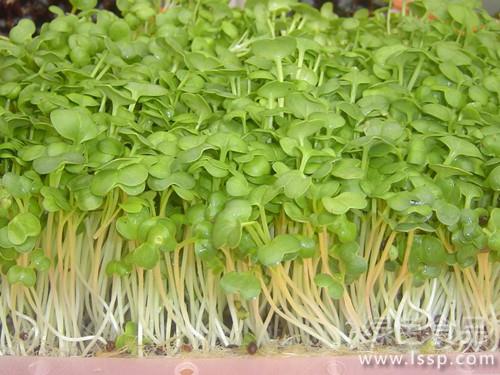
Radish sprouts
Radish sprouts are the plump, tender seedlings that grow after radish seeds are sown. This vegetable has a fresh and tender quality and a unique flavor, and is rich in vitamins as well as calcium, phosphorus, and others. It can be used as a soup ingredient or in cold dressed dishes, and is a seasonal vegetable that everyone loves. Its cultivation points are as follows.
Radish sprouts prefer warm and humid conditions, are not tolerant of drought or high temperatures, and are not strict about light. When the temperature is suitable, 7-10 days after sowing the hypocotyl grows to 5-6 cm and they can be harvested. They can be grown in open fields or in protected areas such as plastic greenhouses, and can also be cultivated using soil or nutrient solution.
(1) Seed selection Generally, seeds of any radish variety can be used, but seeds of varieties with green skin are preferable. For producing radish sprouts, plump seeds should be selected, such as Daqing radish, Chuanxin Hong, Manyuan Huazi, green manure radish, and others. There are also special varieties introduced from Japan, such as Fuye 40-day radish for cultivation in the high-temperature period, and Osaka 4010 radish and Ideal 40-day radish for cultivation at medium and low temperatures. The seeds are required to be free of sand, sclerotia, and other impurities. After screening out debris and unfilled seeds, rinse the radish seeds with water 2-3 times to remove dirt and foreign matter from the seed coat.
(2) Sowing Soak the seeds in water at 20°C for 2-3 hours to absorb water, washing with clean water 1-2 times during this period so that the seeds absorb enough water. Radish sprouts can grow at temperatures of 5-35°C, with the optimum temperature being 20-25°C. Before sowing, the culture trays should be washed clean. For trays with large mesh openings that would let seeds fall through, first spread a layer of clean wet white paper, then evenly scatter the seeds on it. The sowing density should be such that the seeds do not overlap.
⟧ (3) Management After sowing, shading treatment is needed to maintain a dark environment. Therefore, after sowing, the trays can be stacked, for example stacking every 5 trays into a pile, then placing an empty tray on top. Cover the empty tray with a wet burlap sheet to retain moisture. Three days before harvest, let them gradually receive light so the cotyledons turn green, ensuring the hypocotyls are upright and white and improving quality. In practice, after sowing, sprinkle water once every morning, and after 2-3 days the radicle can grow to about 2 cm. At this point, the trays should be spread out separately, and an empty tray placed over each tray to shade light and retain moisture. After 1-2 days, when the hypocotyl grows to 2-3 cm, remove the empty trays and increase light exposure. At the same time, sprinkle water once each morning and evening to bring the moisture to saturation.
(4) Harvest 5-8 days after sowing, when the cotyledons are fully expanded, true leaves have not yet appeared, the hypocotyl has grown to 4-6 cm, and the fresh weight of 100 plants reaches 8.5-10 kg, they can be harvested and sold. This is generally done in the early morning before the dew has dried or in the evening when the sun has set. Radish sprouts generally turn yellow and deteriorate after 10-13 days, so they should be sold as early as possible.