Overview of the Utilization and Handling Techniques for Grape Secondary Shoots
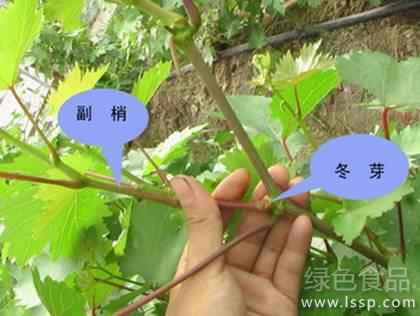
Grape Secondary Shoots
Grape buds have an early-maturing nature. Within a single year, as the new shoots extend, the summer buds in the leaf axils can successively sprout multiple secondary shoots, forming second-order shoots, third-order shoots, and so on. Therefore, secondary shoots are a component part of the grapevine. In production management, if secondary shoots are handled properly, they can accelerate the growth and training of the vine framework, compensate for the insufficient number of leaves on the primary shoots, improve photosynthetic utilization, and can even produce a second crop of fruit and be used for layering propagation; if handled improperly, they easily cause crowding within the trellis, poor ventilation and light penetration, severe pests and diseases, and reduced fruit quality. The utilization and handling techniques for grape secondary shoots are briefly summarized below:
I. Utilization of Secondary Shoots
1. Using secondary shoots for rapid framework training: ① When training double main canes, if a vine planted that year produces only 1 new shoot, when the new shoot grows to 4-6 leaves, promptly pinch the growing tip of the new shoot to encourage secondary shoots, and according to the training requirements, select secondary shoots to train as main canes. ② When the extension shoot of the main cane is damaged, the secondary shoot emerging at the tip can be used as an extension shoot, allowing it to continue extending and growing, to be trained and utilized as a main cane, accelerating framework formation. ③ When a certain part of a young vine or mature vine needs a permanent limb trained, the new shoot can be pinched early to encourage secondary shoots and increase the number of shoots.
2. Using secondary shoots to train fruiting canes: For vigorous-growing seedless varieties, such as Youwuhé (Huangti) and Thompson Seedless (Qingti), and for vines that grow vigorously in the young stage, such as Red Globe (Hongti) and Ribier (Heiti), both the primary shoots and secondary shoots grow very vigorously. Sometimes the winter buds on the primary shoots differentiate poorly, appearing flat, and it is extremely difficult for them to form flower buds, while the secondary shoots emerging beside the main bud often have moderate vigor, plump buds, and easily differentiate into flower buds, so they can be used as fruiting canes. The specific training method is: in mid-to-late June, for secondary shoots that have grown to 4-6 leaves, leave 3-4 leaves and pinch. After second-order secondary shoots form, leave 2-3 leaves and pinch, to promote bud differentiation and maturity on the secondary shoots. For third-order secondary shoots, leave 1 leaf and pinch continuously, ultimately ensuring that the secondary shoots have 10-15 mature leaves, which can satisfy flower bud formation and differentiation on the secondary shoots.
3. Using secondary shoots to propagate nursery stock: In regions with a growing period of 180 days or more, when secondary shoots reach a length of 15cm or more, the long new shoots at the base, or together with the mother cane, can be pressed into the ground in a shallow trench. As the secondary shoots grow, soil is gradually mounded up, promoting rooting at the nodes of the primary shoots and at the bases of the secondary shoots, thus training layered nursery stock.
4. Using secondary shoots to produce a second crop of fruit: For varieties that easily form a second crop, such as Red Globe, Thompson Seedless, Ribier, and other varieties, the new shoots can be severely pinched to encourage winter buds to sprout and form a second crop of fruit. In regions with a growing period of 200 days or more, the newly formed second crop can also ripen, and its quality is also relatively good.
II. Handling Techniques for Secondary Shoots
1. Handling secondary shoots on fruiting shoots: The role of secondary shoots on fruiting shoots is first to supplement the insufficient number of leaves (or leaf area) on the fruiting shoots, so as to produce photosynthates; second, they can shade the fruit clusters to prevent sunburn of the clusters; third, they can be used to produce a second crop of fruit (under normal circumstances they are not used to produce a second crop; only when the fruiting shoots or fruit clusters are damaged is a second crop used to compensate for yield). Apart from this, pinching must be carried out to prevent them from competing with the fruit clusters for water and nutrients.
2. The method for handling secondary shoots on fruiting shoots is: for the terminal secondary shoot on the fruiting shoot, leave 4-5 leaves on the first-order secondary shoot and pinch, leave 3-4 leaves on the second-order secondary shoot and pinch, and leave 2-1 leaves on the third-order secondary shoot and pinch; that is, the pinching pattern is the “(4-5)-(3-4)-(2-1)” pinching method.
3. Handling secondary shoots on vegetative shoots: Secondary shoots on vegetative shoots have no use other than being trained into fruiting canes, producing a second crop of fruit, and layering propagation. Therefore, when handling them, this can be managed flexibly. When the amount of branches and leaves on the trellis surface is not large, they can be handled according to the secondary shoots on fruiting shoots; if the amount of branches and leaves is large, then use the “2-1” pinching pattern, that is, leave 2 leaves on first-order secondary shoots and leave 1 leaf on second-order secondary shoots and pinch.
4. Handling secondary shoots on extension shoots: On vigorously growing young vines planted for 1-2 years, secondary shoots can be used to train fruiting canes. The specific measures are: when the secondary shoots on the main cane of a vigorous young vine grow to 5-6 leaves, leave 4-5 leaves and pinch; for second-order secondary shoots, leave 2-3 leaves and pinch; for third-order secondary shoots, leave 1 leaf and pinch; for secondary shoots that appear afterward, always leave 1 leaf and pinch continuously, thus forming the “(4-5)-(2-3)-1-1” pinching pattern, which can promote summer-bud secondary shoots to reach a thickness of 0.8cm or more, and flower buds can form on the summer-bud secondary shoots.
For vines that have entered the fruiting stage, summer-bud secondary shoots on the main cane extension shoot are generally not used to train fruiting canes, so as few secondary shoots as possible should be retained. Therefore, when pinching, for the terminal secondary shoot at the tip of the extension shoot (that is, the terminal secondary shoot), leave 5 leaves on the first-order secondary shoot, leave 3 leaves on the second-order secondary shoot, and leave 1 leaf on the third-order secondary shoot and pinch, thus forming the “5-3-1” pinching pattern. For the remaining secondary shoots, leave 2 leaves on first-order secondary shoots, leave 1 leaf on second-order secondary shoots, and afterward always leave 1 leaf, thus forming the “2-1-1” pinching pattern. For moderately vigorous varieties such as Red Globe and Autumn Black, the “thorough pinching method” of always leaving 1 leaf can be used, that is, first- and second-order secondary shoots leave 1 leaf to form the “1-1” pinching method.