What are the control methods for cabbage tipburn
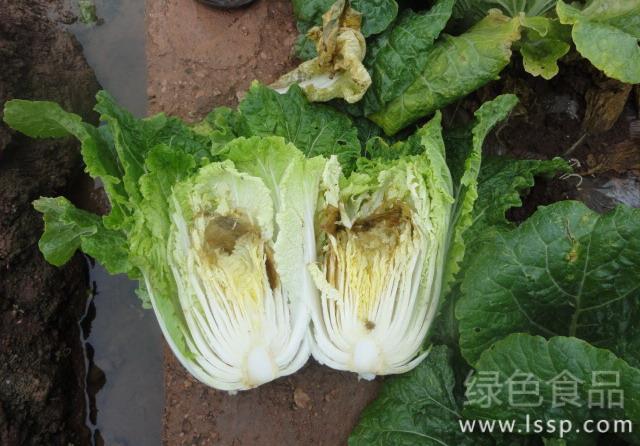
Cabbage tipburn
Cabbage tipburn, also known as internal rot, shows no abnormality in appearance, but the inner head leaves deteriorate and cannot be eaten, causing great losses to consumers. Due to root dysfunction or other reasons, calcium cannot be transported to the growing leaf tips, thereby causing a physiological disorder. In order to avoid the occurrence of tipburn in Chinese cabbage and improve the yield and quality of Chinese cabbage, in addition to selecting disease-resistant varieties, reasonable crop rotation, and sowing at the appropriate time, the following measures should also be taken:
1. Reasonable fertilization. Base fertilizer should be mainly organic fertilizer, supplemented by chemical fertilizer. Apply 4000-5000 kg of decomposed organic fertilizer, 50 kg of superphosphate, 15 kg of potassium sulfate, and a small amount of urea per mu to increase the soil organic matter content, improve soil structure, and promote robust plant growth. At the same time, choose a plot with level land, loose soil, and good drainage, and try not to choose low-lying saline-alkali land. Water evenly, and the water quality should be pollution-free. For acidic soil, increase the application of lime to adjust the soil pH.
2. Reasonable watering. Water supply during the growth period of Chinese cabbage should be uniform. In case of drought, water in time, and it is advisable to use small-amount irrigation so that the soil is neither dry nor waterlogged. After irrigation, cultivate and loosen the soil in time to prevent crusting, improve soil structure, and prevent the rise of salt and alkali. Avoid flood irrigation, so as not to waterlog the field and damage the root system, hindering absorption. Especially during the rosette stage, attention should be paid to changes in soil moisture. In years with a lot of rain, appropriate cultivation and drainage should be carried out.
3. Proper calcium supplementation. Spraying calcium fertilizer on the leaves can not only promote the growth of Chinese cabbage and improve quality, but also effectively prevent the occurrence of "tipburn" in Chinese cabbage. Usually starting from the rosette stage of Chinese cabbage, spray the heart leaves every 7-10 days with a mixture of 0.7% calcium chloride and 50 ppm naphthaleneacetic acid or 50 kg of 1% superphosphate solution. When applying, pay attention to spraying concentratedly on the heart leaves, for 3-5 consecutive sprays.
4. Supplement manganese fertilizer. During the rosette stage, spray 50 kg of 0.1% potassium permanganate solution or 0.1% manganese sulfate solution on the leaves, once every 7 days, for 2-3 consecutive sprays, and it can also be mixed with calcium for spraying.
5. Pay attention to the selection of the previous crop. When planting Chinese cabbage, avoid continuous cropping with crops that absorb large amounts of calcium, such as cabbage and tomato. If severe blossom-end rot is found during the fruiting period of tomatoes, it indicates that the soil is severely calcium-deficient, and it is best not to plant Chinese cabbage in the autumn crop, or to plant after supplementing calcium fertilizer.