Key Technical Points for Insect-Proof Net Covered Cultivation of Vegetables
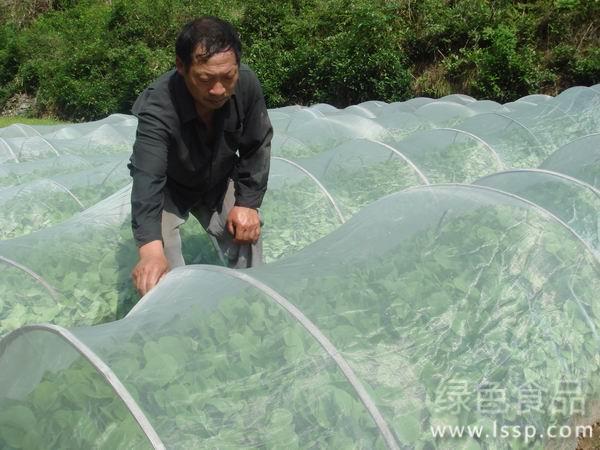
Insect-Proof Net Covered Cultivation
Insect-proof net covered cultivation is one of the important measures for pollution-free agricultural production. It is of great significance for avoiding or reducing the use of chemical pesticides, reducing pesticide pollution, and producing vegetables with no pesticide residues, no pollution, and no harm.
I. Covering Forms
For greenhouse covering, the insect-proof net can be directly placed over the greenhouse frame, with the surroundings firmly pressed down with soil or bricks, the pipes (frames) fastened with film-pressing wire, and the main greenhouse door left open for easy entry and operation.
For small arched shed covering, the insect-proof net can be placed over the top of the arch frame and sealed tightly all around. Watering is then done directly onto the net until harvest, using fully enclosed covering.
For horizontal trellis covering, about 1 hm2 of vegetable land is entirely covered with insect-proof net. This covering method saves insect-proof net and trellis materials and is convenient to operate.
II. Covering Effects
1) Regulating air temperature and soil temperature. According to experiments, under a 25-mesh white insect-proof net, the greenhouse temperature in the morning and evening is the same as in the open field, while under high-temperature conditions at noon on sunny days, the temperature inside the net is about 1°C higher than in the open field. The 10 cm soil temperature in the greenhouse is higher than in the open field in the morning and evening, but lower than in the open field at noon.
2) Shading and humidity regulation. The shading rate of a 25-mesh white insect-proof net is 15%-25%, lower than that of shade netting and agricultural film. Silver-gray insect-proof net is 37%, and gray insect-proof net can reach 45%. With insect-proof net covering, the air humidity in the morning is higher than in the open field, and lower than in the open field at noon and in the evening. The relative humidity inside the net is about 5% higher than in the open field, and nearly 10% higher after watering, making it especially suitable for summer and autumn cultivation.
3) Frost prevention and freeze prevention. From late March to early April in early spring, the temperature inside the insect-proof net covered shed is 1-2°C higher than in the open field, and the 5 cm soil temperature is 0.5-1 degree higher than in the open field, which can effectively prevent frost damage.
4) Rainstorm prevention and strong wind resistance. Strong winds and rainstorms in summer can cause mechanical damage to vegetables, harden the soil, and lead to seedling lodging and death. After covering with insect-proof net, because the mesh is small and the strength is high, rainstorms are broken up by impact with the insect-proof net and fall inside as fine drizzle, with weakened impact force, which is beneficial to vegetable growth. According to measurements, under a 25-mesh insect-proof net, the wind speed in the greenhouse is reduced by 15%-20% compared with the open field. Under a 30-mesh insect-proof net, wind speed is reduced by 20%-25%, so the insect-proof net has a good strong-wind resistance effect.
5) Insect prevention and virus disease prevention. After covering with insect-proof net, damage from many pests can basically be avoided, including imported cabbageworm, diamondback moth, cabbage armyworm, beet armyworm, tobacco cutworm, cotton bollworm, bean pod borer, cucumber moth, striped flea beetle, daikon leaf beetle, 28-spotted ladybird, aphids, American serpentine leafminer, and others, and the occurrence of virus diseases caused by pest transmission can be controlled.
6) Increasing yield and income, improving quality. According to experiments, greenhouse covering with a 25-mesh white insect-proof net gives the highest yield, increasing production by about 30%; the greengrocery inside the net has less pesticide pollution, no wormholes, is clean, and has little mud. The harvest period is 4-5 d earlier than in the open field, and the market quality is good.
7) Protecting natural enemies. The living space formed by the insect-proof net provides a relatively ideal habitat for natural enemies, while not allowing natural enemies to escape to the surrounding space, which creates favorable conditions for applying and promoting biological pest control technology.
III. Scope of Application
1) Leafy vegetables. Mainly used for the production of pak choi, summer Chinese cabbage, summer-autumn cabbage, spinach, lettuce, cauliflower, and radish. These vegetables have many pests and serious pesticide pollution when produced in the open field.
2) Solanaceous vegetables. These vegetables are prone to virus diseases in summer and autumn. The insect-proof net blocks the route of pest virus transmission and reduces the spread of virus diseases. At the same time, it isolates cotton bollworm, tobacco cutworm, 28-spotted ladybird, eggplant yellow stem borer, and others, reducing rotten fruit.
3) Cucurbit vegetables. Mainly used for melon, pumpkin, watermelon, and others, helping to reduce the occurrence of virus diseases and damage from cucumber beetles, cucumber moth, and others.
4) Legumes. The insect-proof net has a control effect of more than 95% on bean pod borer and American serpentine leafminer, and can also increase chlorophyll content, increase leaf area, and enhance root activity.
5) Seedling raising. June-August each year is the season for raising autumn vegetable seedlings, which coincides with high temperatures, rainstorms, and frequent pest outbreaks, making seedling raising difficult. After using insect-proof net, the vegetable emergence rate is high, the survival rate is high, and the quality of autumn seedlings is good, gaining the initiative in autumn and winter vegetable production.
6) Vegetable seed production and propagation. The insect-proof net can prevent crossbreeding among varieties caused by insect activity, which would otherwise lead to seed mixing and degeneration. It can be widely used in vegetable seed production and propagation.