Rising Temperatures and Increasing Pests: Spring Management Measures for Citrus
Citrus Management
In spring, the dormant period of citrus has ended, the root system begins to become active, spring buds sprout, and flower buds appear. As temperatures rise, pests and diseases will also occur one after another, so spring fertilizer and water management and pest and disease control for citrus are extremely important.
I. Spring Fertilizer and Water Management for Citrus
1. Fertilizer and water management for young citrus trees
For young trees that were planted and survived in the previous autumn, fertilization should follow the principle of "small meals, more often." For 1-2 year old young trees, foliar spraying is the main method, with ground fertilization as a supplement. The concentration of ground fertilizer should be dilute, and the fertilizer used should be mainly nitrogen fertilizer, appropriately combined with phosphorus and potassium fertilizers, to promote root growth and encourage young trees to produce more new shoots. For young trees, the citrus orchard soil should be shallowly turned in February to loosen the soil and enhance soil permeability. Before spring shoots sprout, apply a shoot-promoting fertilizer once (mainly quick-acting nitrogen fertilizer, supplemented by phosphorus fertilizer) to promote spring shoot sprouting and root growth, while also applying phosphorus and potassium fertilizers and other fertilizers to achieve balanced fertilization. Because young trees have a small root growth range and weak fertilizer absorption capacity, the amount of fertilizer applied should adopt the method of small amounts applied multiple times, applying frequently and lightly; the application method can use the ring-shaped trench method, and broadcasting should not be used.
2. Fertilizer and water management for mature trees
Before mature trees bloom, they need large amounts of nitrogen, phosphorus, potassium and various trace elements. For fruit-bearing trees, the pre-bud fertilizer should be mainly nitrogen, appropriately combined with phosphorus and potassium fertilizers. If the previous year's fruit yield was relatively small and the tree growth is moderate, it can be applied less or not at all; if the previous year's fruit yield was high and the post-harvest fertilizer was not applied or applied in relatively small amounts, the pre-bud fertilizer must be applied. Generally, from late January to mid-February, each mature citrus tree should be applied 0.2 kg of urea and 0.2-0.3 kg of compound fertilizer. During full bloom, spray boron fertilizer while adding 0.3% urea solution for foliar spraying. In order for citrus to absorb sufficient nutrients during full bloom and improve the fruit-setting rate, the pre-bloom fertilizer should be applied 20 days before the flowering period arrives. The application method uses strip trench application, and broadcasting should not be used. Irrigate promptly after fertilization.
3. Fertilizer and water management for old trees
Old trees are characterized by spring shoots as the main fruit-bearing branches, so the amount of pre-bud fertilizer should be increased to promote spring shoots and lay the foundation for fruiting the following year. The fertilizer should also be mainly nitrogen fertilizer, combined with phosphorus and potassium fertilizers.
4. Clear the drainage ditches inside and outside the orchard to remove standing water, so as to avoid water accumulation on rainy days, which affects root growth or even causes root rot, leading to flower and fruit drop. During continuous dry and hot weather of more than 10 days, irrigate promptly to keep the soil moist and loose, which helps the root mass absorb water and fertilizer.
II. Spring Pruning of Citrus
Pruning principles: Pruning should depend on the strength of the tree vigor, the amount of fruit set and the flower quantity, and the pruning amount and pruning time should be controlled accordingly. If the tree vigor is relatively strong, the fruit yield is normal, and the flower quantity is relatively large, the pruning amount should be appropriately increased, and the pruning time can be appropriately advanced; while for orange trees with a relatively high fruit yield the previous year, relatively weak tree vigor, and few flowers, the pruning amount should be light, and the pruning time can be appropriately delayed.
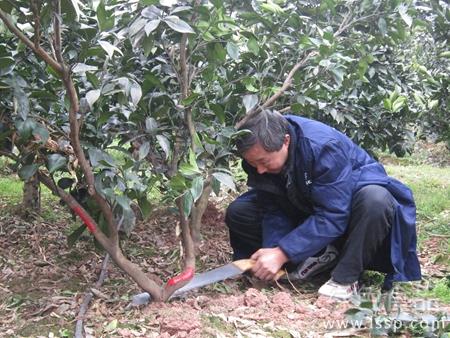
Pruning targets: On the basis of winter pruning, spring pruning of autumn shoots and late autumn shoots should be taken as a main task. That is, remove all late autumn shoots, appropriately thin out or cut back part of the autumn shoots, and promote and improve the quality of flower buds. Attention should be paid to thinning or cutting back senescent fruiting branch groups (clusters), crossing branches, and overlapping branches. In addition, for orange trees with overly tall crowns, the method of sawing large branches should be used to lower the crown, improve the light conditions inside the crown, promote the sprouting of new shoots inside the crown, and gradually form a pattern of three-dimensional fruiting.
III. Techniques for Preserving Flowers and Fruits in Citrus
Apply post-bloom fertilizer and fruit-strengthening fertilizer well to improve the fruit-setting rate. For citrus trees with a large flower quantity and relatively poor tree vigor, apply a high-quality, quick-acting fertilizer once when 70% of the flowers have fallen, depending on the crown size; generally apply 0.3-0.4 kg of 45% potassium sulfate compound fertilizer per tree. For trees with normal or relatively few flowers, do not apply nitrogen fertilizer; the post-bloom fertilizer should only apply organic fertilizer and phosphorus and potassium fertilizers to inhibit the sprouting of summer shoots and help preserve fruit. For fruit-stabilizing fertilizer, apply potassium fertilizer plus an appropriate amount of phosphorus fertilizer or mainly foliar fertilizer; for fruit-strengthening fertilizer, apply compound fertilizer plus potassium fertilizer. For foliar topdressing, spray 0.2% potassium dihydrogen phosphate twice from after spring buds sprout to before flowering; on cloudy and rainy days, spray nucleotides, with one application adding 0.1% borax; during the young fruit stage, spray foliar fertilizer 2-3 times in combination with pest and disease control or fruit preservation.
IV. Timely Pest and Disease Control
Do a good job in controlling the main pests that cause flower and fruit drop and reduce quality (citrus flower midge, mites, etc.). When citrus flower buds are the size of mung beans, choose a day after rain to spray the ground under the tree canopy to kill adult citrus flower midges emerging from the soil. When the flower buds begin to show white, spray the tree canopy with dichlorvos solution to kill adult citrus flower midges before they lay eggs. Chemical control of red spider mites should depend on the pest situation. Before spring buds sprout, if red spider mites occur severely, spray the entire orchard canopy once with lime sulfur mixture; after spring shoots sprout and young leaves turn green, if red spider mites occur severely, use acaricides such as "Tiannuo Hu'er No. 1" to spray once.