How to reduce empty and shriveled sunflower seeds affecting yield
Farmers want plump sunflower seeds, but empty and shriveled seeds often appear, yields are low, and profits are not high either. Only by clearly understanding the causes of empty and shriveled sunflower seeds can they be reduced. Empty and shriveled seeds on the outer ring of the sunflower are mainly caused by poor pollination; empty and shriveled seeds in the center of the sunflower are mainly caused by insufficient fertilizer and water and a lack of nutrients. Therefore, preventing empty and shriveled sunflower seeds first means ensuring sufficient fertilizer and water, and second, supplementing sunflower pollination by hand. The specific methods are as follows:
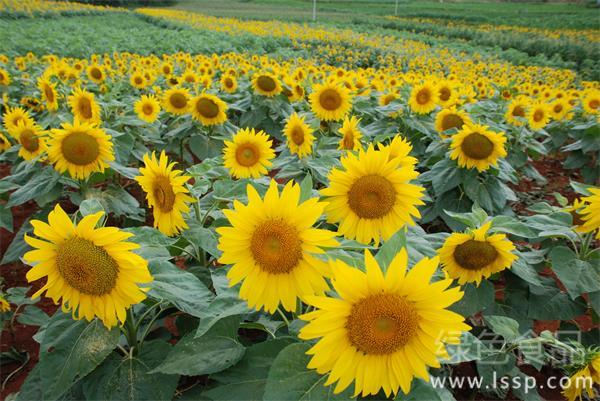
Sunflower
1. Remove branches promptly.“Once a branch sprouts, remove it immediately.” Generally remove branches 2~3 times to reduce the consumption of nutrients and water and ensure the sunflower seeds are plump and full.
2. Water promptly.Sunflowers must not lack water, especially from the bud stage to the flowering stage. Therefore, water promptly to ensure the sunflower plants have sufficient water, generally watering 3~4 times, and water thoroughly each time so that dry soil is not left in the middle, but if there is waterlogging or standing water, drain it promptly, avoiding both drought and waterlogging.
3. Fertilize rationally.Combining base fertilizer, seed fertilizer, and topdressing; combining farmyard manure, chemical fertilizer, and micronutrient fertilizer; combining nitrogen fertilizer, phosphorus fertilizer, and potassium fertilizer is the principle for fertilizing sunflowers; the base fertilizer application rate is more than 2000 kg per mu, mainly farmyard manure, the seed fertilizer amount is small, with 15 kg of diammonium phosphate and 40 kg of plant ash per mu; topdressing is mainly with quick-acting ammonium bicarbonate, urea, ammonium nitrate, and potassium fertilizer; nitrogen fertilizer and potassium fertilizer are generally applied at the 7~8 leaf stage, with better results; topdressing methods are divided into hole application and band application, with hole application being better. A fertilization depth of 10~15 cm is suitable, improving the utilization rate of chemical fertilizer.
4. Hand pollination.Hand-assisted pollination is an effective way to improve the seed-setting rate of sunflowers. Carry out hand pollination on sunflowers 2-3 days after entering the flowering stage. Use a soft-bristled brush to gently touch the sunflower head and pick up pollen grains from the stamens, then touch another sunflower head in the same way, which completes pollination. Pollination is generally done from 9~11 a.m. each day, that is, after the dew has dried, and no later than 12 o'clock, generally pollinating 2~3 times or 3~4 times.
5. Prevent disease and eliminate insects.Mainly prevent and control sclerotinia disease. When the temperature reaches 18-20°C, use 35-45 kg of quintozene plus 150-230 kg of wet sand per hectare and evenly scatter it on the ground where sunflowers are planted. After 10 days to half a month, scatter it again. In early August, during the occurrence period of sunflower moth larvae, spray 500-fold solution of 90% trichlorfon 2-3 times.