7 Key Points for Pollution-Free Loofah Cultivation When the Summer Loofah Market Is Booming
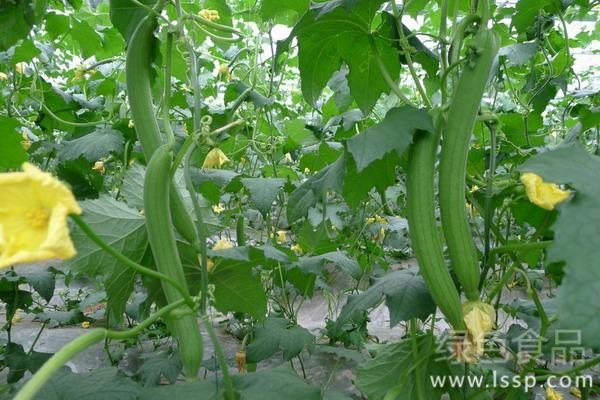
Loofah
Soil requirements.For planting loofah, choose a field with deep topsoil, flat terrain, convenient drainage and irrigation, and good physical and chemical properties, where cotton has not been grown in the past 3 years and the previous crop was not a cucurbit crop.
Variety selection.Choose non-GMO loofah varieties with good quality, high yield, resistance to pests and diseases, strong stress resistance, strong adaptability, and good market quality.
Seed treatment.Soak the seeds in warm water at about 50°C for 20 minutes, or soak the loofah seeds in a 100-fold dilution of glacial acetic acid for 30 minutes, wash them clean with water, sun-dry the seeds for 2-4 hours, soak them in 10% trisodium phosphate for 10 minutes, or dress the loofah seeds with 50% thiram wettable powder at 3% of the seed weight.
Seedling-raising nutrient soil.It can be prepared by mixing soil from a field where cucurbit crops have not been grown in the past 3 years with high-quality decomposed organic fertilizer. The high-quality decomposed organic fertilizer accounts for 30%, and it is used after sieving. For each square meter of seedbed, mix in 50% carbendazim or 5-10 grams of 50% thiophanate-methyl wettable powder to disinfect the seedling soil. Mix 50% carbendazim wettable powder and 50% thiram wettable powder at 1:1, or mix 25% metalaxyl wettable powder and 70% zineb wettable powder at 9:1, and mix 8-10 grams of the pesticide with 15-30 kg of fine soil per square meter to disinfect the seedling bed. When sowing, take 1/3 of the well-mixed medicated soil and spread it on the bed surface, then after sowing cover the seeds with the remaining 2/3. Use nutrient pots, paper bags, and other methods of seedling raising that protect the roots.
Planting.Per mu, apply 8000 jin of high-quality decomposed organic fertilizer, 40 jin of potassium sulfate, 240 jin of superphosphate, and 20 jin of urea to the loofah, plow 20 cm deep, level, form ridges, and cover with film. Use gauze netting to block the ventilation openings of the shed to prevent aphids, leafminers, and other pests from entering. Per mu, use 2-3 kg of sulfur and 0.25 kg of dichlorvos, mix with sawdust, burn in separate piles, close the shed for 24 hours, and after ventilating, plant when there is no odor. Per mu, lay 5 kg of silver-gray plastic film, or cut the silver-gray film into strips 10 cm × 15 cm wide, with 15 cm spacing, and stretch them lengthwise and crosswise into a mesh pattern.
Management after planting.In the early stage, the soil in the loofah field should not be too wet. After planting the loofah, carry out shallow intertillage and hilling, and in the middle stage carry out dark irrigation under the film or furrow irrigation. During the full fruiting period of loofah, maintain relatively high soil moisture. When the loofah seedlings grow to 30 cm, apply 400 kg of decomposed dilute manure water per mu. After the loofah seedlings are more than 1 m tall, apply 800 kg of 1:1 decomposed manure water in combination with watering. During the full fruiting period, apply 1200 kg of decomposed manure water as a top dressing.
Field management.When the loofah stems and vines are about 50 cm long, set up trellises. Do not keep side branches before fruiting; after fruiting, keep 2-3 strong side vines of loofah that bear female flowers early, and remove weak side vines, withered vines, diseased and old leaves, male flower buds, and deformed fruits. Set up yellow boards to trap and kill aphids and leafminers.