High abortive fruit rate in cucumbers affects yield; how should it be prevented and controlled?
Cucumber abortive fruit refers to the phenomenon where, after female flowers form, they cannot continue to grow into marketable cucumbers but instead gradually turn yellow, wilt, and drop off. It is also called physiological wilted fruit or aborted fruit. Abortive fruit is the most common problem in cucumber cultivation, especially for cucumbers grown in greenhouses. If management is poor, the abortive fruit rate can reach more than 50%, seriously affecting cucumber yield.
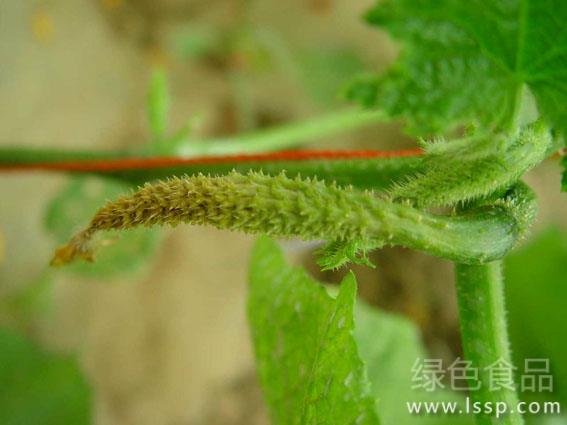
Cucumber abortive fruit
Prevention and control methods:
① Pollination. For abortive fruit caused by poor parthenocarpic ability in a few cucumber varieties, measures such as artificial pollination and keeping bees in the greenhouse can stimulate ovary expansion and reduce the abortive fruit rate, which can be reduced by about 70%.
② Enhance lighting. As long as the temperature outside the greenhouse is not lower than -20°C, even on cloudy days, the curtains should be briefly opened around noon so that the cucumber plants receive scattered light. When conditions permit, agricultural infrared lamps can be installed to supplement light and increase temperature.
③ Foliar fertilization and hormone treatment for cucumbers. Spraying the leaves with 1% potassium dihydrogen phosphate plus 0.4% glucose plus 0.4% urea, as well as 15.5 mg/L Baogualing and Qiangli Zenggua Bao, is also very effective. Zenggualing can also be used to dip cucumber female flowers or spray the flowers, and expanding agent can also be used to spray cucumber plants or dip flowers.
④ Temperature regulation. If a large number of abortive fruits appear in the later stage of winter-spring cucumbers, the temperature inside the greenhouse should be kept on the low side: 23-25°C during the day on sunny days, not exceeding 28°C, and 10-12°C or lower at night. When the temperature is too high, ventilation management should be strengthened to keep the greenhouse temperature within the range suitable for normal cucumber growth and development.
If abortive fruit occurs due to low temperature in deep winter, the temperature inside the greenhouse should be raised as much as possible, especially the soil temperature. The soil temperature should not be lower than 10°C at minimum, and generally should be above 14°C. Raising ground temperature does not necessarily depend on the greenhouse structure or on sunny weather. When transplanting cucumbers, vegetable growers can bury corn stalks between cucumber rows, or lay corn stalks, using the heat generated by the decomposition of corn stalks to raise ground temperature, with very good results.
⑤ Coordinate the relationship between cucumber vegetative growth and reproductive growth. For abortive fruit caused by growth imbalance due to "fruit weighing down the vine" from delayed harvesting, fertilizer and water management should be strengthened, and cucumbers should be harvested in time.
There is also another type of abortive fruit caused by excessive vegetative growth in cucumbers. Because harvesting is too frequent, there are no vigorously growing cucumbers on the plants, and most nutrients are supplied to the growth of stems and leaves. As a result, stems and leaves grow too vigorously, and the plant enters another metabolic pathway, so nutrients are no longer supplied to the growth of young cucumbers. The best preventive measure is to pay attention to harvesting standards: harvest in time, but also keep at least one vigorously growing cucumber on the plant. If abortive fruit is caused by lack of water and fertilizer, increase the amount of watering and fertilization.