Tomato plants turn brown and die: how to prevent and control Fusarium wilt of tomato?
Due to years of continuous cropping, Fusarium wilt of tomato has become more severe year by year, not only reducing tomato quality and yield, but also affecting growers' economic returns. In production, one should understand the field symptoms and occurrence patterns of Fusarium wilt of tomato, identify it correctly, and adopt integrated control methods such as crop rotation, soil disinfection, use of resistant varieties, seed disinfection, strengthened fertilizer and water management, and selection of appropriate chemical agents.
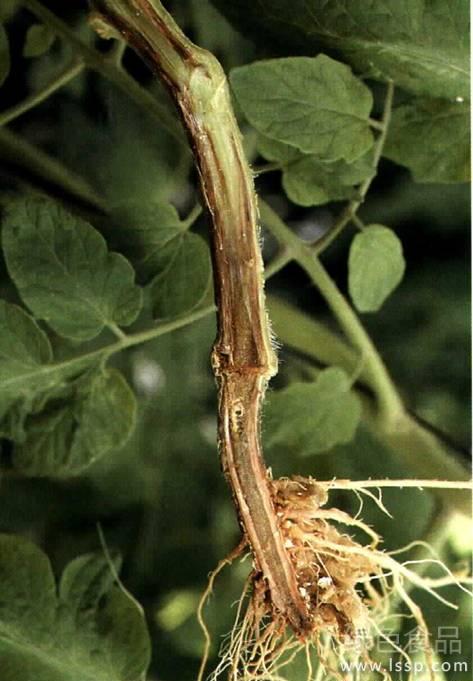
Fusarium wilt of tomato
I. Symptom characteristics:
Fusarium wilt of tomato begins at the flowering and fruiting stage. At first, only one side of the tomato stem develops a sunken area from bottom to top, causing the leaves on that side to turn yellow and then brown and die; in some tomato plants, half a leaf sequence or half of a leaf turns yellow; in others, it starts from the leaf sequence near the ground and gradually spreads upward, with all leaves withered and dead except for a few at the top of the tomato plant. When the diseased stem is cut open, the vascular bundles are brown. When humidity is high, pink mold develops on the diseased parts of the tomato, namely the pathogen's conidiophores and conidia. Fusarium wilt of tomato progresses relatively slowly, generally taking 15—30 days to cause death.
II. Occurrence patterns:
The pathogen overwinters as mycelium or chlamydospores with diseased residues in the soil or attached to seeds, and can live saprophytically. It generally invades the host from young roots or wounds, enters the vascular bundles, blocks the vessels, and produces the toxic substance fusarin, which spreads and causes the leaves of diseased tomato plants to turn yellow, wither and die. The pathogen spreads through water flow or irrigation water. When soil temperature is 28°C, the soil is moist, the land has been continuously cropped, and there are many wounds from transplanting or cultivating, diseased tomato plants with weak growth are affected more severely. In addition, acidic soil and wounds caused by nematode feeding favor the occurrence of this disease. Below 21°C or above 33°C, the disease develops slowly.
III. Control methods:
(1) Rotate crops for more than 3 years. The organic fertilizer applied must be fully decomposed. Adopt formula fertilization technology and appropriately increase potassium fertilizer to improve the disease resistance of tomato plants.
(2) Choose disease-tolerant tomato varieties such as Sukang No. 5, Xi'an Dahong, Shuzhao No. 3, Yukang No. 4, Qiangli Mishou, Floradel, Qiangfeng, Wanhong No. 1, and Mansi.
(3) Use new soil for seedling raising or disinfect the seedbed soil. For each square meter of seedbed surface, use 8—10 grams of 50% carbendazim wettable powder, mix well with 4—5 kg of weir soil, first spread 1/3 of the medicated soil on the seedbed surface, then sow, and then cover the remaining medicated soil over the tomato seeds.
(4) Disinfect seeds by soaking them in 0.1% copper sulfate for 5 minutes, wash them clean, then germinate and sow.
(5) In the early stage of the disease, spray 50% carbendazim wettable powder or 36% thiophanate-methyl suspension at 500 times dilution. In addition, 12.5% carbendazim soluble concentrate at 200 times dilution can be used to drench the roots, applying 100 mL of the prepared solution per tomato plant, once every 7-10 days, for 3-4 consecutive applications.