How to prevent and control northern corn leaf blight and southern corn leaf blight that damage leaves
Northern corn leaf blight and southern corn leaf blight mainly damage corn leaves, and in severe cases also damage the leaf sheaths and husks of corn. Northern corn leaf blight: long spindle-shaped, grayish brown or yellowish brown, 5-10cm long, about 1cm wide, sometimes several lesions join together into large irregular dead spots, and in severe cases the leaves become scorched. In rainy and humid weather, a grayish black mold layer grows on the lesions. Southern corn leaf blight: initially small water-soaked spots, slowly forming elliptical lesions with reddish brown edges and yellowish brown centers. The size and shape of the lesions vary because they are restricted by the corn leaf veins, but the longest lesion is about 2cm (smaller than northern corn leaf blight). The lesions are often elliptical or elongated; on disease-resistant corn varieties, some are only small round necrotic spots. After the lesions merge, they often cause the corn leaves to dry up and die prematurely, and a thin black mold layer forms on the underside of the lesions or on the underside of dead corn leaves.
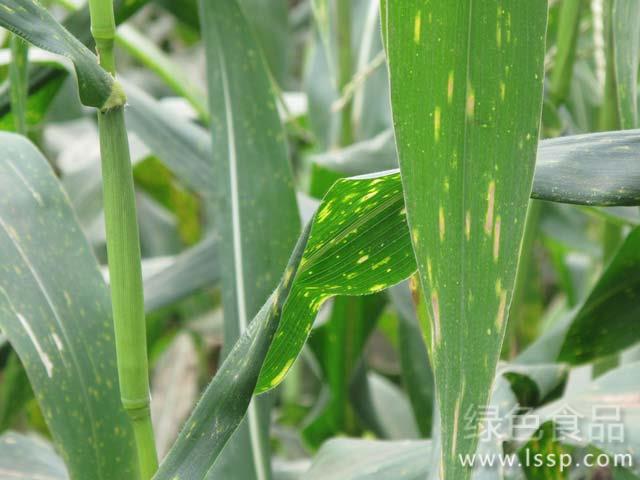
Northern corn leaf blight and southern corn leaf blight
Control methods:
1. Select corn hybrids that are resistant or tolerant to disease and resistant to both northern and southern leaf blight.
2. Implement a crop rotation and stubble rotation system. Avoid continuous corn cropping, deep plow the soil in autumn, deep plow diseased residue to eliminate sources of inoculum; corn stalks used as fuel should be disposed of early after the beginning of spring, which can also help control the Asian corn borer; diseased residue used for compost must be fully decomposed, and stalk fertilizer is best not applied in corn fields.
3. Spray control. Before and after corn tasseling, when the rate of diseased plants in the field reaches more than 70% and the rate of diseased leaves is 20%, begin spraying. Effective chemicals include: 50% carbendazim wettable powder, 50% anilazine wettable powder, 90% mancozeb, all diluted 500 times with water, or 40% hinosan emulsifiable concentrate diluted 800 times for spraying. Use 50-75 kg of spray solution per mu, spray once every 7-10 days, for a total of 2-3 treatments.
4. Remove diseased leaves. Both leaf spot diseases generally start on the lower corn leaves and then gradually develop on the upper leaves. When the disease incidence on the lower two leaves reaches about 20%, the diseased leaves should be removed immediately, and after 7-10 days another 3-5 leaves should be removed, which can effectively control the spread of the disease. However, removing diseased leaves must be carried out over a large area and completed within a short period for an obvious effect. After removing the diseased leaves, immediately apply fertilizer and water to promote growth and enhance disease resistance.