Strawberry root rot causes the whole plant to wither and die; how can it be effectively prevented and controlled?
Root rot damages the strawberry root system, starting with the lateral roots or newly formed roots. In the early stage of the disease, light red or brown irregular patches appear on the roots, gradually turning dark brown. As the disease progresses, the root system turns brown and necrotic; on the above-ground part, the outer leaves first turn yellow at the leaf margins, and some leaves turn brown, become necrotic and curl up. The diseased plants appear water-stressed and the symptoms gradually spread toward the heart leaves, until finally the whole strawberry plant turns yellow and dies.
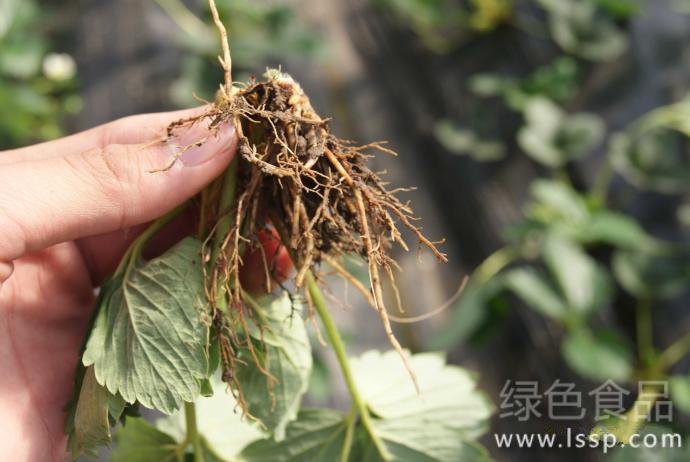
Strawberry root rot
Strawberry root rot is closely related to the soil. Plots that have been planted with strawberries for less than 5 years show mild or no disease; old greenhouses that have grown strawberries for 5 years, especially more than 10 years, show severe disease, and yields decline accordingly. The root system of strawberry plants infected with root rot is noticeably shorter and smaller than that of normal plants, with a dull gray color; the adventitious roots underground die in large numbers, and after the new roots are attacked, they grow sparsely. When the roots are damaged, their ability to absorb water and fertilizer declines, directly preventing water, inorganic substances and nutrients from being transported normally, which causes the above-ground part to be weak or the whole strawberry plant to turn yellow and wither.
Prevention and control methods:
1. Reasonable crop rotation, clean up the field: promptly remove the diseased residues of the previous crop from the strawberry field and burn them in a centralized manner. During the idle period of the greenhouse, disinfect the soil: use 120 kg of lime nitrogen per mu, cover with film and water, then seal tightly and keep the greenhouse closed for more than 25 days, which can effectively kill soil pathogens and insect eggs.
2. High-ridge cultivation with plastic film mulching, scientific watering and fertilization: root rot is directly related to excessive humidity in the strawberry greenhouse or too much water at one time. To reduce humidity in the greenhouse, use the high-ridge film-mulching cultivation method, water under the film, and water frequently in small amounts; where conditions permit, use drip irrigation. Choose fully decomposed organic fertilizer as the base fertilizer for strawberries, increase the amount of bio-organic fertilizer, and deep-plow the soil to improve soil aeration and buffering capacity.
3. Chemical control: for strawberry root rot, prevention is the main approach. During the strawberry planting and seedling recovery stage and before flowering, spray respectively with 75% chlorothalonil wettable powder 500 to 800 times solution + Priden fish protein 300 times solution. Alternatively, after planting, drench the roots with Priden fish protein 500 times solution + hymexazol 800 times solution to prevent early root rot. For greenhouse strawberries that have already developed root rot, promptly pull out the diseased plants and drench the roots with metalaxyl • hymexazol 1500 times solution + Priden fish protein 500 times solution.