How should konjac soft rot, which causes rot and a foul odor, be prevented and controlled?
Konjac soft rot is a bacterial disease. Its pathogen can overwinter in the soil or in stored seed corms with diseased plant residues and diseased tubers. In the field, the pathogen is mainly spread by rainwater, irrigation water or insects. The pathogen invades plants through various wounds such as insect wounds and mechanical wounds caused during cultivation. High temperature and high humidity environments favor the occurrence and epidemic of soft rot. In the seedling stage, konjac soft rot appears as bending of the shoot tip, leaves that cannot fully unfold, and rotting of the lower petioles and seed corms; when the disease occurs during the growing period, the plant turns yellow on one side or the whole plant turns yellow, and it can also appear as rotting at the base of the petiole and stem, with a foul odor at the rotting site.
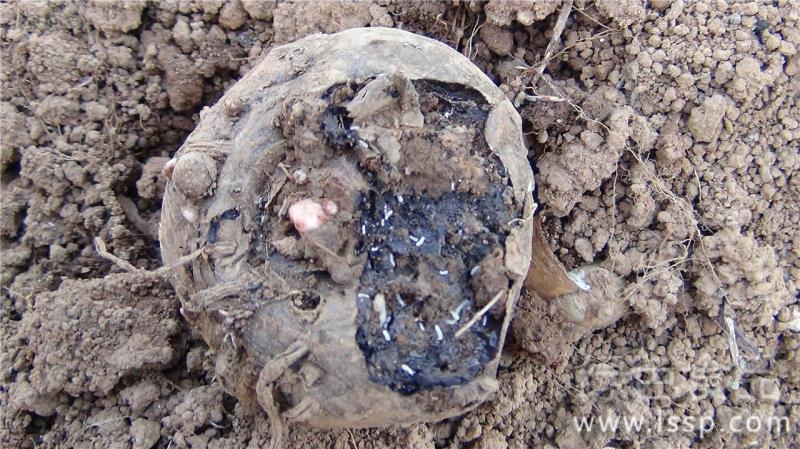
Konjac soft rot
Konjac soft rot should be controlled through early prevention and integrated control techniques.
1. Strict seed selection and disinfection: seed corms should be high-quality ones with smooth skin, tender yellow skin color, normal shape, short and thick apical buds, shallow and flat bud depressions, and no disease, insects or damage. Before sowing, soak the seeds for 1 hour with 10 million units of agricultural streptomycin + 100 g of 50% carbendazim mixed with 50 kg of water, or soak the seeds for 30 minutes in 40% formalin at a 1:200-250 dilution, or soak the seeds for 10 minutes in 0.05% potassium permanganate solution to disinfect the seed corms.
2. Field selection and crop rotation: choose soil with a deep soil layer, fertile, moist, well-drained, and slightly acidic to neutral. For fields with severe disease occurrence, crop rotation of more than 3 years should be implemented. The previous crop should be wheat, barley, onion, garlic and other crops, and continuous cropping with cruciferous, solanaceous, cucurbit and tobacco crops should be avoided.
3. Soil disinfection: in winter, deep plow the soil to a depth of 30-40 cm to accelerate the decomposition of diseased residues and inhibit the germination of sclerotia. In spring, land preparation should achieve deep furrows and high beds to facilitate drainage and prevent water accumulation. In heavily affected fields, during land preparation, a mixed powder made of 50 kg quicklime, 50 kg plant ash and 1 kg sulfur powder can be broadcast per mu, or 1-2 kg per mu of dikesone technical powder can be used for soil disinfection.
4. Seed corm disinfection: when sowing, remove seed corms with gum exudation, damage or deformity, and spread them in the sun for 1-2 days; soak the seeds in 200-500 ppm agricultural streptomycin for 2-4 hours, then soak them for 30 minutes in 20% limewater or 600 times dilution of 50% carbendazim wettable powder, and sow after the surface dries, or coat the seeds with a mixed powder (50 parts lime, 50 parts plant ash, 1 part sulfur).
5. Fertilizer and water management: konjac production should apply heavy basal fertilizer. At sowing, apply 3000-4000 kg of decomposed farmyard manure, 30 kg of superphosphate and 15 kg of potassium sulfate per mu as base fertilizer. The amount of base fertilizer applied should account for 70% of the total fertilizer use, with more phosphorus and potassium fertilizer and balanced fertilization. Avoid applying too much nitrogen fertilizer to prevent excessive vegetative growth, and increase the application of phosphorus and potassium fertilizer to enhance plant disease resistance. When topdressing, do not apply undecomposed fertilizer, and do not apply fertilizer close to the plants to avoid damaging the tubers and plants. In dry weather, water in time, and do not use flood irrigation or sequential irrigation to reduce the spread of the pathogen.
6. Shading and weeding: konjac “likes shade and fears sun”, and high temperature easily causes sunscald, so it can be intercropped or relay intercropped with corn or other economic forest trees to enhance the disease resistance of the plants. Konjac likes shady and moist conditions and fears high temperature and strong light, so it can be intercropped with tall crops such as corn and sorghum to provide shade, or it can be planted in fields in sparse woodland. When konjac seedlings emerge uniformly and unfold their leaves, weave straw and wheat straw into straw curtains for shading to favor konjac growth. Konjac has a shallow root system distributed within about 10 cm of the surface soil layer, so cultivation and weed control cannot use a hoe; weeds should be pulled by hand to prevent damage to the roots and seedlings. Or use herbicides to remove weeds.
7. Chemical control: before the disease occurs or in the early stage of the disease, use 200-500 ppm agricultural streptomycin, 50% amobam, or 600-800 times dilution of ammonium water solution, and 600 times dilution of 77% copper hydroxide wettable powder for control. For soft rot control, apply once every 7-10 days. When spraying, pay attention to spraying the base of the konjac plants and the soil surface. If diseased plants are found during the growing period, dig them out promptly, take them out of the field and burn them, spread slaked lime around the diseased plants, and spray the above-mentioned agents on neighboring plants to prevent the disease from spreading.