Severe purple blotch on Welsh onion can cause the plants to die off. How can it be prevented and controlled?
Purple blotch of Welsh onion, also known as black spot, damages the leaves and flower stalks. It usually starts on the leaf tips and the middle of the flower stalks and then spreads upward, producing small purplish-brown spots or spindle-shaped, slightly sunken lesions. In the early stage, the lesions appear as small water-soaked white spots, which then turn light brown and round or spindle-shaped, and continue to enlarge, becoming brown or dark purple. When humidity is high, the diseased parts of the Welsh onion become covered with a dark brown or blackish-gray mold-like growth, appearing pink, generally arranged in concentric rings. As the lesions continue to expand, several of them join into long, large patches; once the leaves and flower stalks are infected, they soften and break easily, and in severe cases large numbers of leaves die off. Control methods:
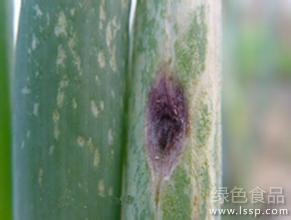
Purple blotch of Welsh onion
1. Practice crop rotation: rotate Welsh onion with other crops for more than 2 years.
2. Select disease-free seed: select and keep Welsh onion seed from fields that are disease-free or only lightly affected.
3. Seed disinfection: Welsh onion seed can be disinfected by soaking in a 300-fold dilution of 40% formaldehyde for 3 hours, then rinsed clean promptly after soaking. Welsh onion bulbs can be disinfected by soaking in warm water at 40-45°C for 90 minutes.
4. Field management: plant Welsh onion in loamy soil on flat terrain with good drainage; in addition to applying sufficient well-rotted, high-quality organic fertilizer as a base fertilizer, increase the application of phosphorus and potassium fertilizers and control irrigation to strengthen the resistance of the Welsh onion. Prevent and control onion thrips early to avoid creating wounds through which the disease can then enter.
5. Clean up the field: regularly inspect the development of purple blotch on Welsh onion, promptly pull out diseased plants, remove old leaves, diseased leaves and diseased flower stalks, and bury them deeply or burn them; after harvest, promptly clear away the diseased Welsh onion residues and plow deeply.
6. Chemical control: before transplanting into continuous-cropping land, spray with Nongkang 120, chlorothalonil or carbendazim, then transplant with the pesticide. At the beginning of disease onset in the field, you may use a 500-600-fold dilution of 75% chlorothalonil wettable powder, or a 500-fold dilution of 64% sandofan wettable powder, or a 500-fold dilution of 53% Jinlei water-dispersible granules, or a 1500-fold dilution of 50% iprodione wettable powder, or 2% polyoxin wettable powder at 30 mg/kg for control, spraying once every 7-10 days for 2-4 consecutive sprays. Because Welsh onion leaves have a waxy layer, ordinary spray solutions adhere poorly, so you can add 10 g-15 g of neutral laundry detergent to every 15 kg of spray solution to increase the adhesion of the spray solution.