Celery leaf rot with gray mold layer, how to prevent and control gray mold
Celery gray mold, at the seedling stage, mostly starts from the root-stem part of celery seedlings, showing water-soaked necrotic spots densely covered with a gray mold layer. At the mature plant stage, the aboveground parts can also be affected; generally it first occurs on the heart leaves of celery plants where dew forms, or on leaves, petioles, or yellowed and weakened outer celery leaves that have wounds on the lower part. It is initially water-soaked, and later the diseased tissue softens, rots, or wilts, and a gray mold layer grows. In severe cases, the entire celery plant rots.
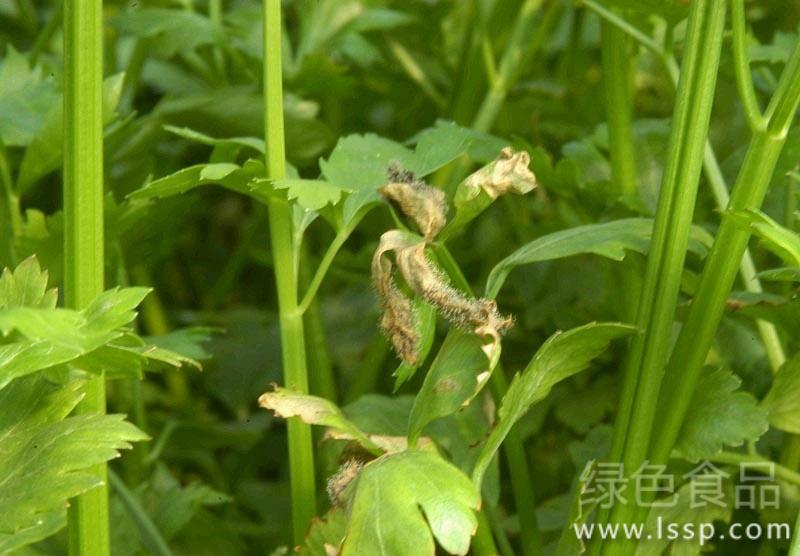
Celery gray mold
Pollution-free control techniques:
1. Crop rotation; when diseased plants are found, remove them promptly. Rotate for more than 2 years. Apply more base fertilizer to promote robust celery growth and enhance disease resistance. Watering should preferably be done in the morning. At the early stage of disease onset, watering should be appropriately reduced, with light watering. Strengthen management after watering to prevent dew formation.
2. Variable temperature in the greenhouse. On sunny days, ventilate late in the morning; when the greenhouse temperature rises to 33°C, begin ventilation; when the temperature in the greenhouse drops to above 25°C, continue ventilation at noon so that the temperature in the greenhouse in the afternoon remains at 20-25°C. When the temperature in the greenhouse drops to 20°C, close the ventilation to slow the temperature drop in the greenhouse. At night, keep the greenhouse temperature at 15-17°C; on cloudy days, open the ventilation openings for air exchange.
3. Chemical control. Use 200 g of 15% procymidone smoke agent per mu of celery, or 50 g of thiabendazole smoke agent per 100 cubic meters, or fumigate for 1 night with 250 g of 45% chlorothalonil smoke agent per mu, then fumigate again after 7—8 days. Or spray 50% procymidone wettable powder at 1000—1500 times dilution, or use 1 kg of 5% meimei dust per mu, or 50% Deyi wettable powder at 600 times dilution, or 60% Fangmeibao ultrafine powder at 600 times dilution, spraying once every 7—10 days, for a total of 3—4 sprays.