Control methods for cabbage downy mildew where lesions grow mold that merges and causes leaf death
Cabbage downy mildew is one of the main diseases of cabbage; besides harming cabbage, it also harms Chinese cabbage, radish, bok choy (rapeseed) and flowering Chinese cabbage, etc.
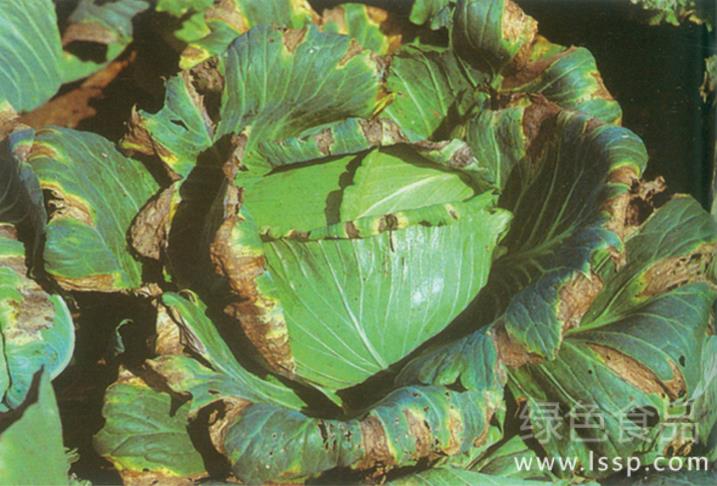
Downy mildew
(1) Symptoms of damage: Cabbage downy mildew mainly harms the leaves. The lesions are polygonal, initially light green, later turning yellowish brown, purplish brown or dark brown. When the weather is humid, a white mold layer grows on the underside of the leaves, and sometimes on the upper side as well, namely the pathogen's sporangia and sporangiophores. When the disease occurs severely, the lesions merge into patches, and the cabbage leaves dry up.
(2) Disease development pattern: Cabbage downy mildew is a fungal disease. The pathogen overwinters as oospores in cabbage diseased residues and soil, also as mycelium in seed cabbage plants, and can also overwinter as oospores attached to the seed surface or mixed in the seeds with diseased residues. The following year the oospores germinate and infect spring cabbage, producing sporangia that can cause repeated infection via airflow.
(3) Control methods: ① Select and keep disease-free cabbage seeds and disinfect the seeds. Select and keep seeds from disease-free fields or healthy plants. For seed disinfection, use 50% thiram wettable powder at 0.4% of the seed weight for seed dressing, or soak the seeds in 50% amobam aqueous solution at 200 times dilution for 15 minutes, then wash off the solution with clean water and dry them for later use. ② Practice crop rotation; avoid continuous cropping of cabbage with cruciferous vegetables. Strengthen cultivation management, apply clean fertilizer or composted farmyard manure. When diseased plants are found, pull them out promptly; after harvest, promptly remove diseased cabbage residues to reduce the source of disease. ③ In the early stage of the disease, spray 40% fosetyl-aluminum wettable powder at 200-300 times dilution, or 80% dimethomorph wettable powder at 500 times dilution, or 75% chlorothalonil wettable powder at 600 times dilution, or 40% mancozeb suspension concentrate at 400 times dilution. Use 60-80 kg of spray solution per mu of cabbage. Spray once every 7 days, for 3-5 consecutive sprays.