Autumn garland chrysanthemum downy mildew causes lesions to merge and leaves to turn yellow and die off: how to prevent and control it
Garland chrysanthemum downy mildew mainly damages the leaves. At the early stage of the disease, pale yellow nearly round or polygonal lesions appear on the lower old leaves of garland chrysanthemum and gradually spread to the middle and upper parts of the plant. Later, the lesions turn yellowish brown. When the disease is severe, the lesions merge into one mass, and the leaves turn yellow and die off. When humidity is high, white mold grows on the underside of the lesions.
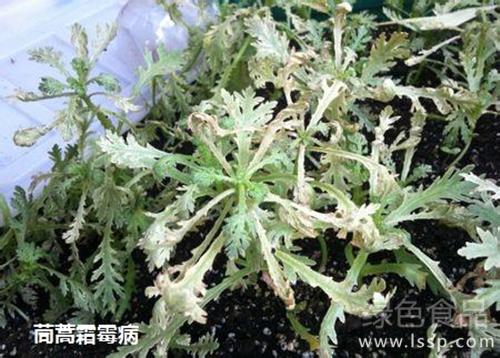
Garland chrysanthemum downy mildew
The optimal temperature for infection by the garland chrysanthemum downy mildew pathogen is 15~17°C, and the optimal humidity is above 85%. In autumn, weather with large day-night temperature differences, long frost duration, frequent fog, and cloudy and rainy days is a period when the disease is prone to occur. In addition, overly dense planting, an excessively large plant population, excessive application of nitrogen fertilizer, poor ventilation and light penetration, excessive watering, and poor drainage can also worsen the disease.
Agricultural control: rotate for 2~3 years with non-Asteraceae vegetables; maintain a reasonable planting density, avoid excessive density and crowding within the plants, which is unfavorable for ventilation and moisture dissipation; apply heavy base fertilizer, increase the application of organic fertilizer, and when topdressing, control the amount of nitrogen fertilizer to prevent excessive vegetative growth; avoid flood irrigation, and drain promptly after heavy rain.
Chemical control: For seed dressing, 35% metalaxyl can be used at 0.2~0.3% of the garland chrysanthemum seed amount. For long-term use on garland chrysanthemum, 58% metalaxyl mancozeb wettable powder at 500 times dilution, or 72% dimethomorph wettable powder at 700 times dilution, or 72.2% propamocarb aqueous solution at 1000 times dilution, or 64% oxadixyl mancozeb at 500 times dilution, etc., can be sprayed once every 7~10 days for 2~3 consecutive times. For garland chrysanthemum grown in greenhouses, chlorothalonil smoke agent can be used for fumigation at 350 grams per mu.