How to distinguish apple rust fruit from fruit rust and prevent and control rust fruit disease
Apple rust fruit disease, also known as flower-face disease, is a viral disease and one of the main diseases harming Jiaodong apples in recent years. According to surveys, 50% of orchards have diseased trees, and in individual apple orchards the rate of diseased trees reaches as high as 40%, with a severe case rate of 20%. Many fruit growers treat apple rust fruit disease as fruit rust disease, which both worsens the condition and causes losses.
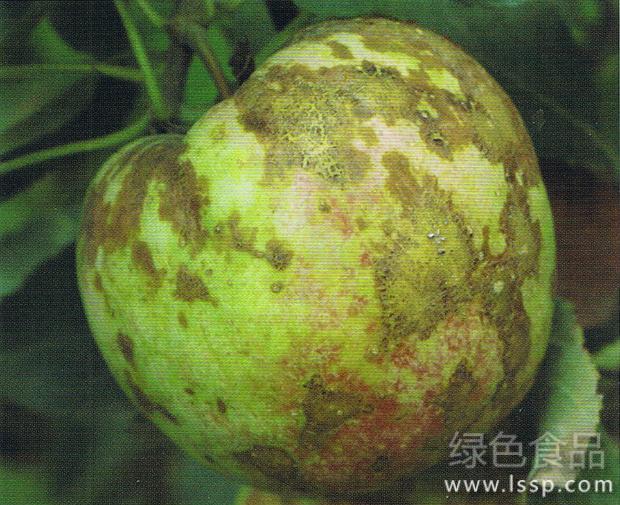
Apple rust fruit disease
I. Damage symptoms
The symptoms of rust fruit disease mainly appear on apple fruits and on the leaves of apple seedlings. There are three types on apple fruits:
1. Rust fruit type: The fruit of a diseased tree first develops a slightly darker water-soaked discolored area at the top of the fruit, which gradually expands into 5 regular longitudinal streaks. The water-soaked discolored area then gradually becomes suberized and forms rust spots, which spread along the fruit surface as the apple grows, and in severe cases can reach all the way to the shoulder of the fruit, often with longitudinal and transverse cracking. Fruit development is hindered, the fruit is small with little juice, but the taste is relatively sweet. This symptom appears most often on apple varieties such as Ralls Janet, White Winter Pearmain, Indo, Yanqing and Jonagold.
2. Flower-face type: The apple shows no obvious change before coloring; after coloring, yellow-green patches appear on the fruit surface, turning the fruit surface into a red-and-green flower-face pattern. This symptom appears more often on apple varieties such as Zhuguang, Danding, Beidou and Red Fuji. When bagged apples are removed from their bags, some white nearly round patches appear on the fruit surface, and later these patches do not color, so the fruit surface shows a red-and-yellow flower-face pattern.
3. Rust fruit-flower face mixed type: That is, the same diseased fruit has both rust spots and flower-face symptoms, appearing more often on mid-season apple varieties such as Red Banana, Starkrimson and Chiyang.
4. Rust fruit disease also shows symptoms at the seedling stage of some apple varieties: When Ralls Janet seedlings grow to 30-50cm tall, the leaves in the middle and upper part of the apple seedling curl backward from the base toward the underside, and near the midrib they shrink into a crimped shape, appearing arc-shaped from the side, even circle-shaped. Red Fuji apple seedlings, young trees and fruiting trees show no obvious leaf symptoms, making it relatively difficult to detect in the early stage.
II. Disease occurrence pattern
Rust fruit disease is a viral disease. The entire diseased tree carries the virus, and the virus continuously grows and multiplies as the apple tree grows. Therefore, once an apple tree develops the disease, the condition worsens year by year. It can be spread by grafting; healthy trees and diseased trees can also infect each other when they come into contact; during pruning, it spreads through pruning shears and saws; the mouthparts of insects can also spread it.
III. Control methods
1. When raising seedlings, sow seeds for propagation and avoid using root-sucker seedlings; strictly prohibit taking scions from diseased apple trees, avoid raising seedlings near old apple orchards, establish disease-free nurseries, and take scions from virus-free apple trees, which can prevent rust fruit disease.
2. Strengthen pest and disease control to reduce transmission routes.
3. Orchards with good fertilizer and water management show milder symptoms. Some people believe that applying more fertilizer and watering more can cure this disease, and that high temperatures can also inactivate the virus, making symptoms milder. As a result, many fruit growers are unwilling to dig out diseased trees, worsening the occurrence of the disease. When diseased trees are found, dig them out and burn them promptly.
4. Avoid mixed planting of apple trees and pear trees.