How to control sunflower brown spot disease that causes leaves to wither and die
Sunflower brown spot disease, also known as leaf spot and blight, has a wide occurrence range. In the early stage, it can cause the death of sunflower seedlings, and in the later stage, it causes sunflower leaves to wither and die prematurely, greatly affecting yield.
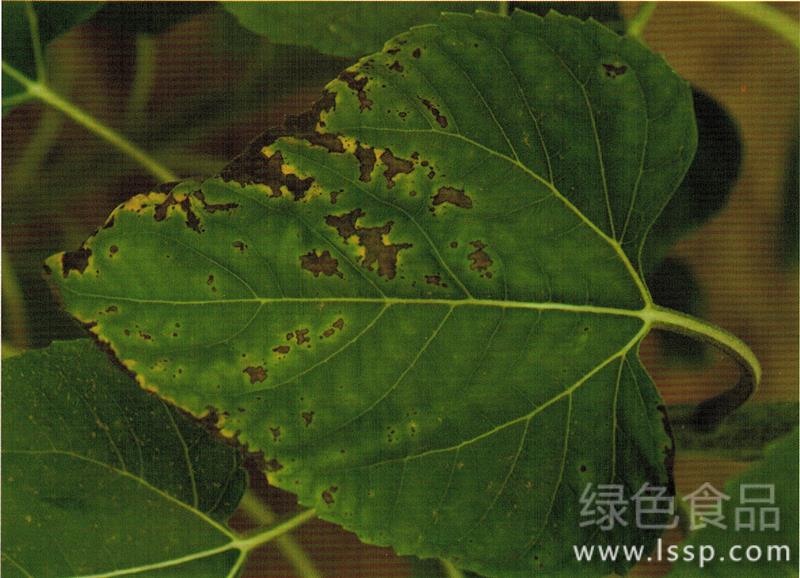
Sunflower brown spot disease
In the early stage of disease onset in seedlings, nearly round lesions form on sunflower cotyledons or young leaves, with a diameter of 2-6 mm. The front of the lesion is brown with a yellow halo around it, and the back is grayish white. When disease occurs at the adult plant stage, irregular or angular brown spots form on sunflower leaves, surrounded by a yellow halo, with the center of the lesion gray and scattered with small black dots, which are the pathogen's pycnidia. In severe cases, the lesions merge into patches, causing the leaves to wither and die. Both petioles and stems can be affected, showing narrow brown streaks. Black spot disease also commonly occurs on sunflowers. When diagnosing, attention should be paid to distinguishing them. Black spot disease lesions are larger and have concentric rings, and in humid weather, brown mold-like growth appears on the lesions.
Sunflower brown spot disease overwinters as pycnidia (small black dots or mycelium) on diseased plant residues. In spring and summer, when suitable temperature and humidity occur, especially with continuous rainfall, large numbers of conidia are released and spread by wind and rain. Generally, disease is more severe in continuous cropping fields, low-lying fields, and sunflower plots that had more severe disease the previous year, under conditions of abundant rain in the current year and high field humidity.
Key control points: rotate crops, with sunflowers rotated with grass family crops for more than 3 years; before cultivation, diseased residual leaves must be thoroughly removed and the soil deeply plowed to reduce inoculum sources; select disease-resistant varieties according to local conditions; strengthen field management, including rational close planting, fully decomposed organic fertilizer, balanced fertilization, timely sowing, and rational irrigation, and drain accumulated water promptly after rain to reduce field humidity; in the early stage of disease, diseased leaves and bottom leaves can be removed manually; chemical control: the pathogen of sunflower brown spot disease is relatively common, and many fungicides are effective, such as 50% carbendazim wettable powder 500 times solution or 70% thiophanate-methyl wettable powder 1000 times solution, or 30% basic copper sulfate (Lüdebao) suspension concentrate 400-500 times solution, 50% benomyl wettable powder 1500 times solution. Control is needed 1-2 times, with an interval of 10 days.