Sweet potato cracking affects sales and storage; how can it be prevented and controlled in a targeted way?
In recent years, farmers have continuously reported the occurrence of cracking in sweet potato storage roots. Cracking of the storage roots not only affects the storability of sweet potatoes, but also significantly reduces their commercial value, causing huge economic losses for sweet potato growers.
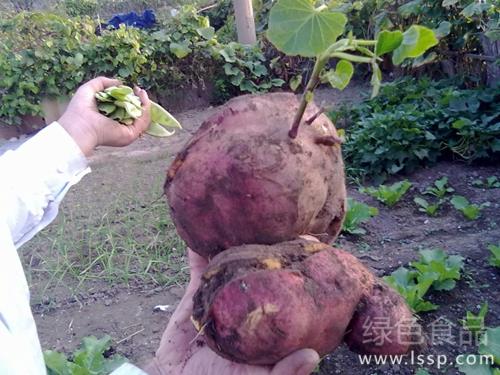
Sweet potato cracking
I. Causes of cracking in sweet potato storage roots
1. Imbalance of soil nutrient elements: In terms of fertilization, in recent years many farmers have reduced or even stopped applying organic fertilizer, applying only NPK compound fertilizer. Severe soil deficiency in organic matter means certain elements such as boron cannot be replenished. Boron deficiency causes sweet potato storage roots to become slender or deformed and misshapen, with rough skin. The decline in superphosphate application has led to a serious shortage of calcium in the soil. Calcium is an important component of cell walls; soil calcium deficiency directly affects sweet potato root development, reduces the accumulation of substances in the storage roots, makes the skin of the storage roots thinner, reduces elasticity, and makes the storage roots prone to cracking.
2. Imbalance of water supply: Due to adverse weather, soil moisture is imbalanced between dry and wet. After a long period of drought, suddenly giving a large amount of water causes the flesh of the storage root to grow rapidly, while the skin grows more slowly than the flesh, so the storage root develops cracking and fissures.
3. Damage from diseases and pests: When sweet potatoes are infected with stem nematode disease, the storage roots are damaged, causing cracking. Sweet potato stem nematodes spread mainly through seed potatoes and soil, and both storage roots and vines can be affected. If spread through soil, the nematodes invade from the surface of the storage root; the skin at the damaged site first fades in color, then turns bluish, becomes slightly sunken or has small cracks, and the tissue beneath the skin turns brown and shrivels, after which small fissures gradually form.
4. Soil that is too sandy or too clayey, thin soil layers, and storage roots covered with little soil; soil compaction, lack of looseness, and poor aeration; large changes in temperature and humidity, especially drought and high temperature suddenly followed by low temperature and heavy rain, all make the cracking of sweet potato storage roots prone to occur.
II. Preventive measures for cracking of sweet potato storage roots
1. Choose suitable sandy loam soil for planting sweet potatoes; soil that is too sandy or too clayey is not suitable for growing sweet potatoes. Deep plowing increases soil depth; plow to a depth of 25-30 cm to improve soil aeration and enhance the decomposition of soil nutrients and the soil's water-holding capacity. Deep plowing is most suitable before the ground freezes in autumn and winter, so that the soil has a longer ripening process. If conditions do not allow, spring plowing must be done early. Winter plowing should be deep; spring plowing should be early and shallow.
2. Apply organic fertilizer as a base fertilizer and calcium fertilizer as a top dressing: Apply organic fertilizer as a base fertilizer to replenish the soil's organic matter content. Generally, apply 3-5 cubic meters of organic fertilizer per mu as a base fertilizer. During the vigorous growth period of sweet potatoes, plots deficient in calcium should, in combination with irrigation or before rainfall, broadcast 20-30 kg of calcium sulfate per mu, which can prevent cracking of the storage roots.
3. After the sweet potato plants form round hills, because temperatures are high and evaporation is great, soil moisture is easily insufficient, so irrigation should be carried out to meet the water needs of sweet potatoes.
4. Prevent diseases, pests, and disease: Choose disease-resistant varieties, establish disease-free seed-production fields, and cultivate disease-free strong seedlings. For seed sweet potatoes, soak in warm water at 50°C-54°C for 10 minutes to disinfect. Before transplanting sweet potato seedlings, soak them in 300-fold diluted 50% phoxim solution for 30 minutes. Practice crop rotation. Rotating with peanuts in diseased areas has a better effect and can be done for one year. Rotation with corn, sesame, and others should be longer, preferably 2-3 years.