Rescue Measures for Corn Blown Down by Typhoon Dujuan
These past two days, Typhoon "Dujuan" has been visiting coastal areas such as Fujian with strong winds and heavy rain. Some crops, especially slender ones like sugarcane and corn, truly suffer under the onslaught of strong winds and heavy rain and are easily blown flat to the ground. Once corn is flat against the ground and sits in water for a long time, it is prone to mold and rot. So how should lodged corn be rescued?
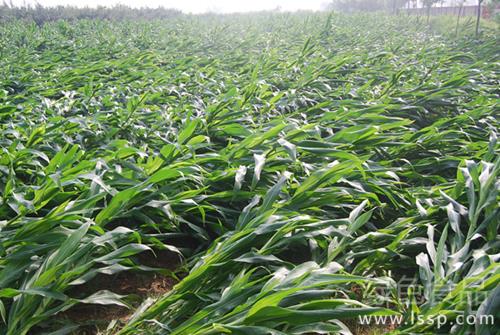
Corn Lodging
1. Manual Straightening:Corn that has lodged only slightly does not need to be straightened. Corn plants have a strong self-regulating ability and will naturally stand upright again as they grow. For severely lodged corn, wait until the soil dries slightly after the rain, then use the manual straightening method. For lodging that occurs before the large trumpet stage, the corn should be manually straightened immediately after lodging. The first and second nodes at the base of the corn stalk are relatively fragile, and some roots are damaged as well, so when straightening, take care to prevent stalk breakage and further root damage. It is best for two people to work together: one person grasps the upper part of the corn and pulls it up, while the other person mounds soil around the base of the corn. For fields where corn stalks have broken, remove the broken corn plants from the field as soon as possible to prevent rotting and to avoid affecting the growth of normal corn.
2. Mounding Soil to Firm It Up:If the lodged corn is at the stage around tasseling and pollination, after the rain, manually straighten it as soon as possible and mound soil to firm the corn in place. At this time the plants are tall, and after lodging they press against each other, making it difficult to restore them to an upright position. This not only affects pollination but also affects photosynthesis, so they must be manually lifted upright. When lifting them, be early, slow, and gentle to avoid damaging the roots. You can also tie several corn plants together into a triangle or quadrangle to allow normal pollination and grain filling. Manual lifting can be combined with mounding soil.
3. Water and Fertilizer Management:After corn lodging, poor photosynthesis disrupts physiological functions and affects grain filling and seed setting. For cornfields that were topdressed only once, an additional topdressing can be applied. If no phosphorus and potassium fertilizer was used in the first topdressing, spray the corn with a 5000-fold dilution of 1. 4% yield-promoting agent, which helps protein and chlorophyll synthesis and increases the plumpness of corn kernels.
4. Pest and Disease Control:After corn lodging, diseases often occur. Leaf diseases of corn include northern corn leaf blight, southern corn leaf blight, rust, and so on. Because the plants overlap and field humidity is high, ear rot occurs at a high rate. Depending on weather conditions and the spread of disease, once the ears can be harvested, harvest them as soon as possible, peel them, and dry them in the sun to avoid worsening ear rot and damage from insects and rodents, which would cause greater losses. Control the Asian corn borer at the appropriate time.