How to prevent and control soft rot in Chinese cabbage and cabbage? Roots and stems rot and topple over with a push
Soft rot of Chinese cabbage, also known as rotten lump, rot disease, leaf drop, etc., occurs mostly during the heading stage of Chinese cabbage. First, water-soaked pale yellow spots appear on the leaf stalks, which later expand into irregular yellow-brown lesions. Initially, the outer leaves of the Chinese cabbage wilt under strong sunlight but can still recover in the morning and evening. As the disease progresses, the whole plant wilts, the outer leaves lie flat on the ground, exposing the head.
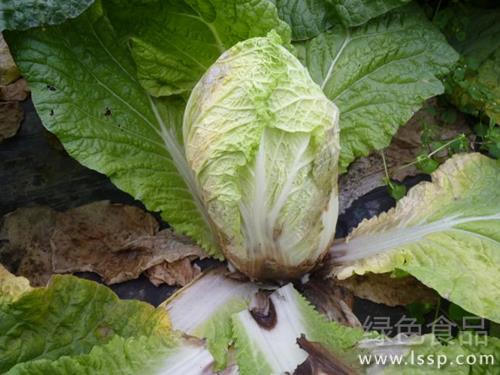
Soft rot of Chinese cabbage
In infected Chinese cabbage, the pith tissue at the leaf stalk base and root crown completely rots, filled with yellow viscous material and giving off a foul odor. A light kick to the plant causes it to fall over, or the head can be lifted up by hand. Sometimes, wet rot starts only from the edges of the outer leaves, or rot begins at the tip of the heart leaves and spreads downward, eventually also causing a rotten lump. Key identification points: outer leaves of Chinese cabbage wilt or the whole plant wilts, stems and heart leaves rot, and there is a foul odor.
Control techniques: integrated control, namely agricultural control, biological control, and chemical pesticide control.
1. Select disease-resistant varieties and choose varieties suited to local conditions.
2. Practice crop rotation: avoid continuous cropping with cucurbits, solanaceous crops, celery, celtuce, lettuce, and cruciferous vegetables (such as cabbage, cauliflower, radish). A rotation of more than 2 years with liliaceous vegetables (chives, scallions, garlic, etc.) or leguminous crops can be practiced.
3. Sow at the appropriate time.
4. Cultivation control: choose fertile land with high terrain and a low groundwater table for planting. Use high ridges or semi-high ridges for cultivation. Apply sufficient base fertilizer and increase phosphorus and potassium fertilizer. Inspect promptly during the heading stage. Once diseased plants are found, they should be pulled out immediately, taken out of the field, and deeply buried or burned. Apply lime in the holes or drench the holes with 20% lime water for disinfection.
5. Biological control Soil disinfection In the sowing furrow, use 1000 grams of 1% zhongshengmycin (nongkang 751) aqueous solution, mix with 30 kg of fine soil, mix evenly, and apply evenly on each ridge furrow, then water.
6. Chemical pesticide control: In the early stage of the disease, apply pesticides promptly for control. You can use 70% dexon wettable powder at 800-1000 times dilution for root drenching. At the same time, spray with 50% amobam aqueous solution at 1000 times dilution. Combining spraying and drenching gives relatively good results. Drench again after 7-10 days, for 2-3 consecutive drenchings. In addition, promptly use pesticides to control insect pests of Chinese cabbage.