Control methods for zucchini brown rot that causes fruit to turn brown, moldy, soften and rot
Zucchini brown rot, commonly known as "flower rot" and "rotten egg", causes large numbers of young zucchini fruits to rot, resulting in severe yield loss. The pathogen infects young fruits, mostly invading from the flower base, and from there spreads to the whole fruit. The outside of the diseased fruit turns brown and softens and rots rapidly; when humidity is high, white mold grows on the diseased part of the fruit, and within it one can faintly see grayish-white to black head-like structures atop the cottony mold. Finally, the young fruit rots away completely. In a few cases, mature zucchini can also partially turn brown, soften and rot. When stems and leaf stalks are infected, they show water-soaked brown soft rot.
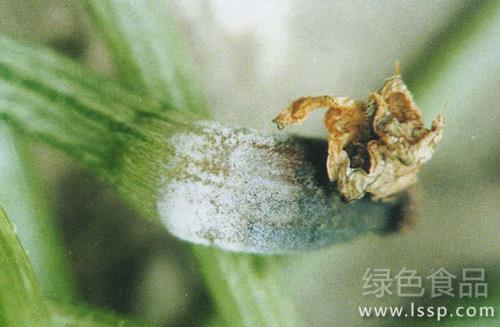
Zucchini brown rot
Control measures:
1. Seed selection and seed soaking. Choose disease-resistant, coated seeds; if not coated, zucchini seeds must be sterilized with a seed dressing agent or seed soaking agent. For soaking, use warm water at 55°C and soak for 15 minutes, and strengthen ventilation to dissipate moisture. For greenhouse cultivation, during the summer fallow period, irrigate inside the greenhouse and cover the ground with plastic film; after covering for a few days, use the high temperature to sterilize.
2. Reasonable close planting. Promptly remove diseased vines, diseased leaves and diseased plants, and carry them out of the field to burn; apply medicine (quicklime) to the diseased planting holes. Also note that zucchini should be rotated with non-cucurbit crops for more than two years.
3. Irrigation and moisture prevention. Use high-ridge cultivation with plastic film, irrigate reasonably, and ventilate promptly after irrigation. This prevents excessive soil moisture caused by flood irrigation.
4. Remove diseased flowers and fruits. After the young fruits set, promptly remove the remnant flowers and diseased fruits, and after removal, bury them deeply. When zucchini flowers, stems and leaf stalks are infected, promptly remove the remnant flowers and smear the affected parts with 50-fold Keshade paste; the effect is very good.
5. Chemical control. After sowing, cover with medicated soil; before transplanting, spray once with an insecticide and sterilizing agent such as 70% mancozeb wettable powder at 500-fold solution, 50% iprodione at 1000-fold solution, or 77% Keshade wettable powder at 400-fold solution for spray control. For zucchini grown in protected cultivation, 200-250 g of 45% chlorothalonil smoke agent can be used per mu for fumigation.