After mold appears on the leaves of Chinese chives, the whole leaf withers and scorches. How should gray mold be prevented and controlled?
The "rotten Chinese chives" mentioned here is what people commonly call the phenomenon of localized rotting and drying of Chinese chive leaves caused by infection with pathogenic fungi. Rotten Chinese chives may be caused by Chinese chive blight, or by Chinese chive gray mold, but at present it is mainly Chinese chive gray mold.
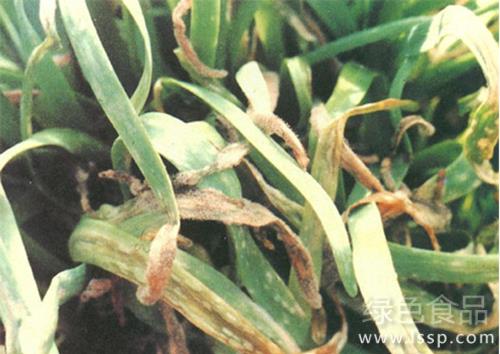
Chinese chive gray mold
I. Damage symptoms
Chinese chive gray mold is the most important disease in protected cultivation of Chinese chives. When Chinese chive leaves are damaged, small white to grayish-brown spots initially appear on the upper or lower surface of the leaf, generally more on the upper surface than the lower surface. When humid, a sparse brown mold layer forms on the surface of the lesions. In severe cases, the lesions join together into patches, causing the upper half of the leaf or the entire leaf to wither and scorch; in the later stage, a grayish-green to grayish-brown mold layer appears on the withered leaves. Sometimes rotting starts downward from the cut where the Chinese chives were harvested; initially it appears as water-soaked, pale green lesions in the shape of a semicircle or a "V", with yellow-brown diseased tissue and a grayish-brown to grayish-green downy mold layer on the surface.
II. Transmission routes and conditions for disease development
Chinese chive gray mold is caused by fungal infection. The pathogen overwinters dormant in the soil in the form of sclerotia. The sclerotia germinate to produce spores, and the spores spread through airflow. The growth temperature of the pathogen is 15~30°C, the optimum temperature for mycelial growth is 15~21°C, and the most sclerotia are produced at 27°C.
III. Prevention and control methods
1. Select disease-resistant varieties.
2. Clean the field, remove all residual branches and fallen leaves from the plot, and bury them deeply or burn them.
3. Strictly control temperature (and humidity). Controlling temperature (and humidity) is an effective measure to prevent Chinese chive gray mold. During the growth period of the first-cut Chinese chives, the daytime temperature generally should not exceed 23°C, and the nighttime temperature should not be lower than 10~12°C. For each subsequent cut of Chinese chives, the temperature can be increased by 2~3°C compared with the previous cut, but in the end it must not exceed 30°C. To control humidity, do not water when the film is about to be closed; after closing the film, pay attention to loosening the soil to reduce water evaporation from the ground; during the day, pay attention to ventilation to remove moisture; at night, pay attention to heat preservation to prevent excessive day-night temperature differences from causing dew formation on the leaf surface.
4. Smoke fumigation or dust control. Use 250 g of 3% thiabendazole smoke agent per 667 sq m, or 250~300 g of 10% procymidone, ignite them in separate spots, close the greenhouse, and fumigate overnight. Alternatively, use 1 kg each time of 5% meimeiling dust per 667 sq m, or sprinkle 1 kg of 6.5% carbendazim and procymidone dust, once every 7 days.
5. Spray control. Spray with 20% triadimefon wettable powder at 500 times dilution, once every 7~10 days for prevention. If Chinese chives are found to be infected with gray mold, immediately spray 40% dimethylpyrimidinamine suspension concentrate at 1200 times dilution, or 50% vinclozolin wettable powder at 100 times dilution, or 50% procymidone wettable powder at 1000 times dilution + 50% iprodione wettable powder at 1000~15000 times dilution; or 40% procymidone wettable powder at 600 times dilution, or 50% pyrimethanil wettable powder at 600 times dilution, or 78% metalaxyl-mancozeb at 500~600 times dilution, or 50% iprodione wettable powder at 1000~1500 times dilution, once every 7 days, spraying 2 times in succession.